Bob Avakian's article FASCIST CRUELTY AND ATTACK ON EMPATHY VS. THE NEW COMMUNIST VIEW OF EMPATHY is a much needed scientific explanation of empathy and its role—where society goes without empathy and what its limitations are for getting humanity beyond this system of monstrous atrocity. As with all of Bob Avakian's (BA's) works, the title and the subheadings provide an important guide to understanding the article as a whole and his scientific approach to identifying and breaking down the key contradictions. The following is my attempt to engage with this article more deeply and record some of my thinking after reading it.
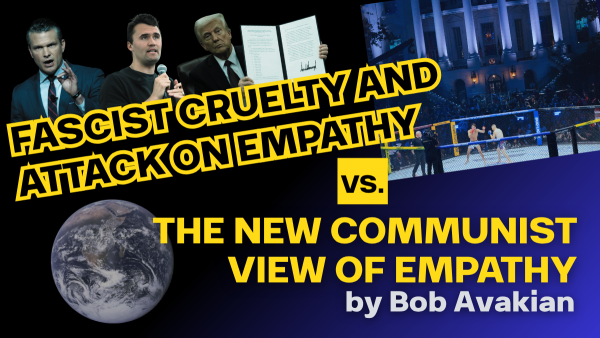
BA begins with the grotesque glorification of cruelty and violence by the Trump/MAGA movement, taken to weird and absurdist levels with the cage-fighting spectacle on the White House lawn. This is emblematic of all the terror the Trump regime has unleashed against immigrants and others here and around the world—in Venezuela and Iran (also in Cuba, where the power grid has totally collapsed because of U.S. sanctions and blockades.) Cuts to USAid has already caused over 500,000 preventable deaths, and the list of cruelties goes on and on.
As BA points out, this cruelty—“and ritualized exhibitions of cruelty”—is an essential component of the fascist program and society they are trying to bring into being. Millions of decent people who feel, show, and at times act on their empathy for those under attack is a big problem for these fascists—with (mainly untapped and unrealized) potential to reach crisis levels that threaten the fascist hold on power. BA walks through how these fascists think the very idea of empathizing with oppressed people will “lead to the destruction of everything that this country must be about and everything that makes it ‘god’s chosen nation,’ which must rightly dominate the world.” Thus, they are compelled to attack the very concept of empathy. This view lines up well with the capitalist mode of production. BA ends this section with a discussion of the writer Ayn Rand’s ideological attack on altruism. Incidentally, when I was in high school in the 1980s, all of my male classmates were passing around copies of Ayn Rand’s books Atlas Shrugged and The Fountainhead.

BA contrasts that with the new communist view of empathy, an ability of human beings to identify with others’ suffering and pain, a positive social and moral value—which nevertheless cannot be “separated, or posed in opposition to, fundamental social relations.” BA’s example of the slave owner and the slave is illustrative: you cannot identify and sympathize equally with the slave and the slave owner without obscuring the relation of exploitation and oppression and the antagonistic interests of each side. The interest of the slave owner is to profit from the exploitation and maintain the system of exploitation, and the interest of the slave is to be free of their bondage. That doesn’t mean we should not try to scientifically understand the outlook of the slave owner—as part of understanding reality and struggling effectively to end the system of slavery. This sentence is extremely important: “Only when the historic objective of the communist revolution has been achieved—the abolition and uprooting of all relations of exploitation and oppression, everywhere—can empathy be applied with regard to people generally.”
Empathy is one value that helps us to care, to viscerally hate what is happening to people, and as BA has often put it, “you have to hate this,” meaning, you have to hate the horrors being brought down on the masses of people by this system. But empathy alone is not enough, especially when there is an actual way to understand the problem—the system of capitalism-imperialism—and the solution—a revolution based on the science of the new communism.
The last section, “Emancipation, Not Revenge” reminds us of the fundamental goal and purpose of the new communist revolution. A refusal to equally identify with the exploiter and exploited does not mean that the “ends justify the means” or the tables are turned and “the last shall be first.” These ideas are motivated by revenge. Revenge will not lead to a society that is free of exploitation and oppression but would in fact lay the basis for the restoration of capitalism. Only a thorough and consistently scientific approach, which understands the need to seize state power and fights for that to be the basis on which a dictatorship of the proletariat would transition society and the world to communism, can get us to the kind of society where humanity can soar, to “—the emancipation of humanity as a whole from thousands of years of vicious exploitation and literally murderous oppression—emancipation from, and moving historically beyond, the long night in which human society has been divided into masters and slaves, and the masses of humanity have been lashed, beaten, raped, slaughtered, shackled and shrouded in ignorance and misery.”
Since I read this article, I’ve been thinking about the ideological attack on empathy as another aspect of the shared epistemology between the fascists and the woke identity hustlers. Although the woke view of empathy has different expressions, lacks state power, and does not celebrate and glorify cruelty against the oppressed, there are overlaps or perhaps a way they mirror each other. In woke culture, empathy gets attacked as “performative” or “appropriation.” There is a total disbelief that people from one group, usually the “privileged” group, can identify and sympathize with people from another group, especially a group they define as more oppressed. This calls into suspicion anyone who dares to put such empathy on display. In the woke worldview, such expressions of empathy cannot be real. They can only be a cover for self-interest, a desire to profit off the pain of others.
As BA has often critiqued, the rules of woke identity politics are arbitrary and constantly mutating—so who gets called out for a violation of their rules, i.e. “staying in their lane,” is often dictated by a woke mob and can seemingly come out of nowhere. An attack on the novel American Dirt, and the novelist Jeanine Cummins, is a good example of this phenomenon. American Dirt is about a middle-class Mexican woman who becomes the target of a drug cartel and is forced to flee with other migrants across the U.S.-Mexico border. It was released to fanfare and positive reviews. But one rant by Myriam Gurba went viral, and soon an internet mob, largely made of other writers of Latinx descent, accused Cummins of capitalizing on migrant trauma under the guise of social justice literature.
Along with the woke rules on empathy, a reactionary cancel/teardown culture revels in revenge and schadenfreude—a delight in the humiliation of others—led by an antiscientific epistemology where truth doesn’t matter: an epistemology that the woke and fascists have in common. Never aimed at the system, or even the fascist regime, woke culture identifies certain individuals as the embodiments of privilege who are neither permitted to express empathy nor receive any empathy if they are canceled. This reaches dangerously absurd levels with oppression Olympics stacking oppressions and pitting different oppressed groups against one another.
The battleground of woke attacks on empathy is often the arts—where their derision of empathy is having terrible effects. But this is a problem all over, including in every struggle for justice, dictating who should or shouldn’t be out in the streets and dampening a sense of responsibility to unite and act together for a better world. The woke attack on empathy goes hand in hand with excuses to avoid the reality of other people’s suffering. There are other ways, especially in the “wellness community,” that empathy is not exactly derided but is used as an excuse. “I feel things too deeply, therefore don’t ask me to look at the pain and suffering of others!”
Together, the fascist and woke attacks on empathy are a lethal combination. One works on hardening the MAGA base, preparing them to be vigilantes and shock troops for the fascist regime, while the other divides and pacifies the decent people, who should be filling the streets to stop this fascism and lifting their heads to revolution to put an end to this whole horrific system.
These are just some initial thoughts sparked by BA’s piece. I think engaging with this article is an important way to deepen our understanding of the dialectical relationship between the superstructure, especially in the realm of ideas, and the underlying mode of production—and how to wage the fierce ideological struggle necessary to bring forward a revolutionary people.