Download and print (PDF):
The Problem: Capitalism-Imperialism—Confining and Force-Marching Humanity to Disaster
In The Communist Manifesto, Marx and Engels refer to historical experience where the struggle between contending classes—between oppressor and oppressed groups in society—has led at times to the victory of one or the other, but also, at times, to the “common ruin of the contending classes.”
(There are many striking examples of this in the new book Goliath’s Curse, by Luke Kemp.)
Today, the prospect of “common ruin”—not just of contending classes and social forces, but of humanity as a whole—is a real and terrible prospect, as a result of the confinement of humanity within the awful relations and dynamics of the system dominating the world, the system of capitalism-imperialism. This gives concrete meaning to and underlines the urgency of my statement:
We, the people of the world, can no longer afford to allow these imperialists to continue to dominate the world and determine the destiny of humanity. They need to be overthrown as quickly as possible. And it is a scientific fact that we do not have to live this way.
Since the emergence of class and social divisions and antagonisms among human beings thousands of years ago, and the development of powerful oppressive states, history has been marked by the rise and then the fall of empires—only to be replaced by other empires. But today’s world is different.
There is the all too present, and now once again increasing, danger of nuclear war, particularly between the U.S. imperialists on the one hand and Russia and China, also capitalist-imperialist, on the other hand.
There is the ongoing, and rapidly increasing, destruction of the environment.
At revcom.us, in a number of works by Raymond Lotta, and others, as well as answers I provided to an interview requested by the publication Markaz Review (answers which they then declined to publish), there is scientific analysis of how the basic necessity and underlying dynamics of the capitalist system are accelerating the already far advanced danger of climate catastrophe. And with the rule now of the Trump fascist regime in this country, long a major polluter of the environment, things are rapidly going from very bad to even more terrible.
Trump ran on a platform of “drill baby drill!”—and since coming to power he has opened up new areas, including public lands, for exploration and exploitation of oil and other resources—fossil fuels in particular. He has denounced, including in a speech at the UN, the reality of climate crisis as a “con job”: “It’s a con job, only losers believe it...” And at the recent COP 30 conference in Brazil the whole thing was a farce. They couldn’t even agree, even in words, on what would have been a meaningless pledge to reduce fossil fuel—and, in fact, as I’ve said, the plundering of fossil fuels is increasing—not being curtailed, let alone eliminated.
There is the melting of the polar ice as part of the overall warming of the planet. And here is something very striking: What do these imperialists all around do in the face of this melting of the polar ice? Do they say, “Oh, this is terrible, it’s gonna contribute in a major way to accelerating the climate crisis.” NO. They see it as a question of strategic contention for control of key sea lanes that are now being opened up by the melting ice. This has a great deal to do with why Trump keeps proclaiming that he’s gonna “by one means or another”—I was gonna say “fair or foul” but they’re bound to be foul—he’s going to take control of Greenland, because it has everything to do with what I just mentioned in terms of strategic contention. This is the way the imperialist system and the leaders of the imperialist system respond to a major development in the climate crisis.
At the same time, Trump has proclaimed what many have called a new Monroe Doctrine: the insistence that the Americas are the “backyard” of the U.S. This goes along with his changing the Gulf of Mexico to the “Gulf of America”—in his own mind at least, and all too much in how some others have responded to that. He has engaged in naked military aggression against Venezuela, with the declared intent of taking over and “running” that country, with its vast oil reserves. He has also threatened Cuba, and the president of Colombia as well as the president of Mexico, interfered in the affairs of Brazil, Argentina and Honduras—all with the aim of insisting on and re-enforcing the whole notion of the Americas as the backyard, and as the sphere of influence and province to be dominated by U.S. imperialism.
Trump is aggressively reviving the role of classical Imperialist Bully, committing yet more acts of aggression and war crimes against less powerful countries, in line with the long, ugly tradition of Yankee military intervention in Central and South America in particular.
Yet this is not the world of the 19th or the early 20th century, and it remains to be seen what will result from Trump’s big power bullying and old-style colonialist military aggression.
In a larger dimension, Trump’s aggressive actions toward Latin America are part of strategic great-power imperialist contention with China in particular, which has become a major force in trade and relations with Latin American countries, including Venezuela: China has, for some time, been a major source for the export of Venezuelan oil. (Trump and his affiliated fascists regard China, not Russia, as the main challenger and threat to U.S. global dominance; even Trump’s approach to Russia and the war in Ukraine is aimed, at least in part, at severing, or at least weakening, Russia’s ties with China.)
Trump’s aggressive military posture and actions with regard to Latin America, and overall, are an expression of the monstrous system of capitalism-imperialism, which has given rise to fascism, as an extreme expression of the predatory, and moribund, nature of this system, in this country and as a broader phenomenon in the world.
In the statement from Refuse Fascism calling for massive nonviolent but determined mobilization aiming to drive out the Trump regime, there is this important description of the comprehensive nature of this fascist regime and its actions:
The Trump Fascist Regime is shredding the rule of law. Making a mockery of due process. Illegitimately deploying the military on U.S. soil. Disappearing immigrants and other brown-skinned people into brutal concentration camps. Aggressively resurrecting genocidal white supremacy. Reversing the gains not only of the 1960s, but even of the Civil War and Reconstruction. Enslaving women through the brutality and suffocation of forced motherhood. Erasing LGBT people. Trampling democratic rights. Violating international law. Assaulting and threatening politicians and judges. Paving the way for boundless terror against the people. Accelerating climate collapse. Cutting science and medicine, costing millions of lives. Depleting humanity’s store of knowledge. Destroying truth. Drowning out reason. Subjugating the arts to fascist cruelty and conformity. Targeting everything that is decent, moral and good. All at the whim of a debased lunatic tyrant.
In short, this is: A white supremacist, “masculine” woman-hating, American supremacist, anti-scientific Christian fundamentalist fascist regime whose power is exercised with deliberate terror and cruelty directed against real or imagined “enemies,” against anyone it sees as actually or potentially resisting, or obstructing, its barbaric rule.
An article at revcom.us sharply summarizes this:
Faced with a huge crisis of that very system [of capitalism-imperialism], the fascist section of this imperialist ruling class—Trump, Miller, Vance and all the rest—are on a mission to save that system through a fascist form of rule. In their view, a fascist form of rule—one rooted in blatant, open and violent white supremacy, in male domination of women and repression of LGBT people, and in open hatred and massive scapegoating of those they consider “foreigners”; one saturated in anti-scientific ignorance and theocratic fundamentalist Christianity; and one in which due process and civil liberties are essentially wiped out—[this in their view] is the only thing that can save the empire. (Stephen Miller [a major force within this fascist regime] says immigrants come from—and must return to—“broken homelands”… but the REAL question is: Who Broke Those “Homelands”? And What Does That Tell Us About the Fascists Who Now Rule This One?)
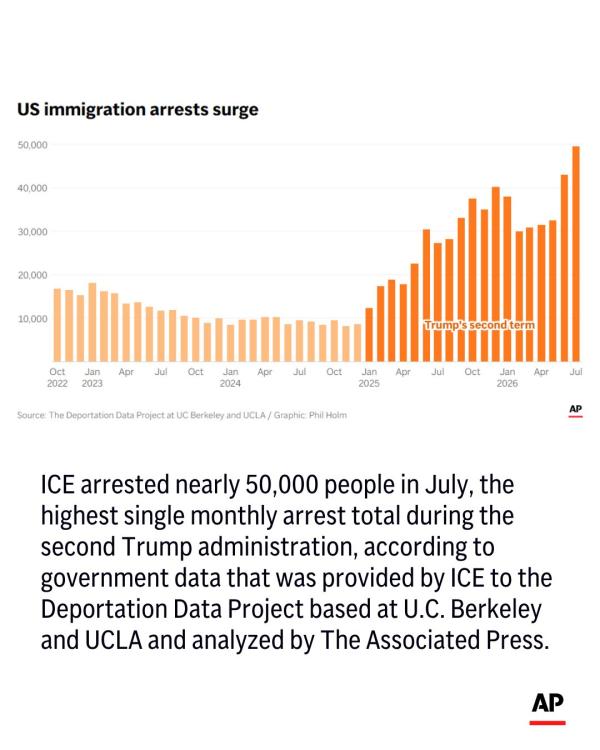
This fascist assault on immigrants—which has overwhelmingly targeted non-criminal immigrants, many of whom have been in the country for long periods and have made significant contributions to the economy—this is being carried out with a concentrated attack on people from the Third World, as part of the Trump fascist drive to Make America White Again, despite the fact that, as Raymond Lotta has pointed out, “immigrants from the Third World are essential to profitable functioning of key segments of the U.S. economy.” (This is from the essay by Lotta, Imperialist Parasitism and Class-Social Recomposition in the U.S. From the 1970s to Today: An Exploration of Trends and Changes.)
This fascism is a concentrated expression of the fact that this system of capitalism-imperialism is running up against its limits. It is proclaimed that in this country there is “liberty and justice for all,” but there is a whole history, and continuing reality, of savage inequality and brutal, literally murderous oppression of Black people and other people of color. There is the ongoing oppression based on sex and gender. Even short of all-out war between imperialist powers, this system is the fundamental cause of continuing wars as well as environmental devastation and plunder of countries throughout the Third World especially—all resulting in the uprooting of huge numbers of migrants into the U.S. (and other capitalist-imperialist countries). All this is built into and results from the basic relations, dynamics, and compulsions of this system, which cannot provide any positive answer to all this. At the same time, it remains true that where there is oppression there will be resistance—and the righteous resistance and rebellion against the oppressive relations and actions of this system has in turn strengthened the appeal of fascism among sections of the people, and of the ruling class, who are determined that not only the basic oppressive relations, but the most extreme expressions and excesses of this, must be brutally enforced. (In this country this is concentrated in the slogan “Make America Great Again,” while it finds different particular expressions in countries in Europe, and elsewhere, where powerful fascist forces have developed as an horrific expression of these basic contradictions. In my social media message #118, available @BobAvakianOfficial, I get into some of the key dimensions of this more fully.)
To repeat this crucial point from my January 2021 New Year’s Statement:
to the degree that things are maintained within the limits of this system, this will actually have the effect of furthering the horrors for humanity that are built into this system, while also reinforcing and giving further impetus to the underlying economic—and the social and political—forces that will strengthen the fascism that has already shown great strength in this country (and a number of others).
But, fascism:
as an open and aggressive dictatorship, trampling on and perverting the rule of law, relying on violence and terror, on behalf of the predatory capitalist system and as an extreme attempt to deal with profound social division and acute crises (both within the country and in the global arena)... might hold things together, in an extremely negative way, for a certain period, [but] in the final analysis this cannot succeed—cannot indefinitely preserve this system of capitalism-imperialism, and cannot lead to any future but one of horrors for humanity, if indeed we have a future at all. And the supposed “alternative,” as represented for example by the Democratic Party in the U.S., involving a “more democratic” means of exercising the rule of this system, will also continue to embody and enforce terrible and completely unnecessary suffering for the masses of humanity and pose an existential threat to humanity as a whole, even if not always through the same brute and unmitigated juggernaut of horrors as the fascist form of capitalist dictatorship.
Here it’s worth stepping back and reviewing the history of this country and the system in this country from the Declaration of Independence and the U.S. Constitution to today—to the thoroughly outmoded monstrosity of capitalism-imperialism. At the beginning of this country, at the initiation of the war of independence (which they like to call a revolutionary war), it was declared that “all men are created equal.” But the whole history of this country from that time forward has proven that it is definitely not the case within this country that there is equality for all. Even at the time when the Declaration of Independence and then the Constitution were written, there were huge numbers of slaves. There were Native Americans whose land was being stolen and who were being subjected to genocidal atrocity. There were women who basically had no rights, and certainly none equal to men. There was, in short, a system of exploitation which was given further impetus by breaking free of British colonialism.
So when you watch, for example, the Ken Burns series on the American Revolution—if you can work your way through and put aside the disgusting hosannas about how great this revolution was, how it was the greatest thing that’s ever happened in the world, and so on—there are some of these things that I’ve talked about, but it’s all in the framework of what liberals today like to talk about: “Yes, there were certain flaws—we even had the certain original sin of slavery, yes, we did this and that, terrible things to the Native Americans, people without property and women didn’t have the same rights as rich men—but we’ve always been moving toward a more perfect union.” When in reality, what they’ve actually been working toward—or, in any case, what has resulted from what was set in motion with the American Revolution, in the context of the larger world—is a completely horrific system of capitalism-imperialism which, again, has long since become outmoded, is long past its expiration date, and its continuation can only involve the continual infliction of terrible suffering for humanity.
The point is not that we should be nihilists—just thoughtlessly negating everything about the American Revolution and the founding documents of this country. As I’ve pointed to before, there are certain things in the U.S. Constitution, particularly in the Bill of Rights (the first 10 Amendments to the Constitution), which can be learned from—and I have incorporated some of this into a fundamentally different framework in the Constitution for the New Socialist Republic in North America. The point is that, despite some positive elements at the time of the founding of this country, it was even then a system of vicious exploitation and literally murderous oppression; and all this had within it the seeds and elements of where it has gone—to a terrible place, with the system of capitalism-imperialism now.
It is crucial to understand, and to enable growing numbers of people to understand, these basic truths—which are not “self-evident,” but are hidden and disguised through the very functioning of the system we live under, the system of capitalism-imperialism—basic truths that must be brought to light through the application of a scientific method and approach to reality.
The political system in this country is the rule—the dictatorship—of the section of society that dominates the economic system—the capitalist-imperialist class—a dictatorship that finds concentrated expression in the monopoly of political power, and more especially the monopoly of “legitimate” violence, exercised by the political representatives of this system and its ruling class. All the dominant processes and institutions of this system (including its elections) fundamentally serve and enforce this dictatorship. In its “normal” form, and as administered by the “mainstream” section of the ruling class, this is a dictatorship representing the interests of the capitalist class as a whole, and this dictatorship is more or less disguised as “democracy” and “rule by the people,” with basic adherence to a “rule of law” which ultimately embodies and reflects the basic relations in society and serves the fundamental interests of the ruling class while being applied, however unequally, to people in society generally.
As one significant example of the way in which this dictatorship, and its “rule of law,” “ultimately embodies and reflects the basic relations in society and serves the fundamental interests of the ruling class,” there is the fact that it is perfectly legal, under this system, for capitalists to “lay off” masses of people, if they can no longer be profitably exploited, even if this means that those who are “laid off” might become homeless, or even starve; but it is definitely illegal for people in this desperate situation to just take the basic necessities they lack, without paying for them, even if the reason they cannot pay for them is because they have been denied employment. All this corresponds to the basic “property relations” of the capitalist system. The “rule of law” in any system will essentially be an expression of those basic property relations—most fundamentally the production relations of the underlying mode of production. (More, later, on the crucial role of the mode of production as the foundation of any system, which ultimately determines the nature of that system, including its politics, ideology and culture, as well as its social relations.)
In the more overtly political dimension, as spoken to in my social media message number #17, beneath the outer shell of “democracy” in this country there is
living proof that this so-called “great American democracy” is in reality a dictatorship, where the power of the ruling institutions is used to viciously persecute, punish, and even eliminate people who pose a threat to the interests of the ruling class. Along with the murder by police and mass incarceration of thousands and millions of people in this country...there is the vicious repression being brought down against people protesting the genocide in Palestine carried out by Israel, with the full backing of the U.S. government and both ruling class political parties (Democrat and Republican)....
Why is this happening? Because fundamental interests of U.S. capitalism-imperialism are at stake.
There are many other examples that sharply illustrate this basic truth about the actual dictatorship under the “normal democratic” rule of this system—such as the outlawing of opposition to the U.S. role in World War 1, and the imprisoning of Japanese people in concentration camps during World War 2 (which was done during the administration of the great “hero” of “progressive” bourgeois democrats, Franklin Delano Roosevelt).
The rule of the Trump regime is the dictatorship of one section of the ruling class, which is determined to impose fascism as the form of capitalist-imperialist rule, utilizing the force and violence of the state (police and military forces and repressive institutions of government, such as the FBI, “Homeland Security,” etc.) not only against people in society as a whole but also against the “mainstream” section of the ruling class. With fascism, dictatorship is open, blatant, undisguised dictatorship, and the exploitation and oppression that is the actual basis and nature of this system of capitalist-imperialism, within this country and internationally, is blatant, undisguised exploitation and oppression, unrestrained by the “norms” and “rules” of “mainstream” capitalist-imperialist dictatorship. The following, from “Something Terrible, Or Something Truly Emancipating,” clearly points to what, in fact, is taking place now:
Given the nature, objectives and actions of the fascists, there is the real possibility of actual civil war. But given the nature, objectives and actions of the “mainstream” section of the ruling class (as represented by the Democratic Party and media such as MSNBC [now MS-NOW], the New York Times and CNN), and given the current situation with those, from different parts of society, who tend to support, and politically tail behind, this “mainstream” section of the ruling class, it is possible that the fascists could achieve and consolidate power without a civil war, but with all the terrible consequences that would follow this fascist consolidation of power. Or, as emphasized in the “Declaration and Call” [from the revcoms] in what would amount to a one-sided civil war, these fascists could carry out a slaughter of those they hate, including Black people and other people of color, “illegal immigrants,” “uppity women” and those who don’t conform to “traditional” sexual and gender relations and “norms."
In any case, it is a deadly serious reality that these fascists are determined to crush—as violently as necessary—anyone and anything, anywhere in society, that stands in the way of implementing their horrific objectives.
Both parts of this situation are vitally important to understand: There is a real and important difference between “mainstream” and “fascist” rule, and both “fascist” and “mainstream” rule are fundamentally forms of the dictatorship of the ruling capitalist class, representing, and enforcing, the interests of the capitalist-imperialist system, not just in this country but throughout the world.
In Hope For Humanity On A Scientific Basis, Breaking with Individualism, Parasitism and American Chauvinism, written during the first Trump regime, there is this important discussion of both very real and important differences, as well as the ultimate, underlying unity, between the different sections of the ruling class:
In an article in the New York Times, “Racism Comes Out of the Closet,” Paul Krugman makes the point that not just Donald Trump but the Republican Party as a whole has gone from “dog whistling” racism to overtly and crudely expressing it. Krugman concludes this article this way, referring to the Republican Party’s dropping of even any pretense of opposing racism:
It’s tempting to say that Republican claims to support racial equality were always hypocritical; it’s even tempting to welcome the move [on their part] from dog whistles to open racism. But if hypocrisy is the tribute vice pays to virtue, what we’re seeing now is a party that no longer feels the need to pay that tribute. And that’s deeply frightening.
Krugman does have a point—an important and relevant point—here, as far as it goes. The problem is that it doesn’t go far enough, and in particular does not break out of the constricting terms of contradictions and conflicts among ruling class parties (the Republicans and the Democrats). The stance of hypocritically pretending opposition to such outrages as racist oppression, while in fact acting as the representatives, functionaries and enforcers of a system that has this oppression built into it and could not exist without this oppression—this does not just apply to the Republican Party in the past...but also applies to the Democratic Party. What is concentrated in this situation is the need to recognize, and correctly handle, a very real and acute contradiction: the fact that, on the one hand, the Democratic Party, as much as the Republican Party, is a party of a system that continually commits, and cannot help committing, massive crimes against the masses of humanity and embodies an existential threat to the very future of humanity; and, on the other hand, the fact that (to paraphrase what is cited above from Krugman’s article) there is a very real difference and very direct danger embodied in the fact that one of these ruling class parties (the Republicans) openly abandons much of the pretense of being anything other than a rapacious, and yes racist, plunderer of human beings and of the environment. This requires the correct synthesis of, in fundamental terms, opposing the whole system, of which both of these parties are instruments, and actively working, in an ongoing way, toward the strategic goal of abolishing this system, while also, with the same fundamental strategic perspective, recognizing the acute immediate danger posed by [in that case] the fascist Trump/Pence regime, and working urgently to bring forward masses of people in non-violent but sustained mobilization around the demand that this regime must go!
This same basic, and crucial, understanding is expressed in the recent article at revcom.us, Venezuela and the Fascist Way of War, Mass Murder Is Legal Because We Say So:
The U.S. military has always been a machine of war crimes and crimes against humanity. Just look through the American Crime series on this website, revcom.us, for mountains of evidence. (See for instance, American Crime Case #96: Vietnam, March 16, 1968 and American Crime Case #93, U.S. Invasion of Korea—1950.) But Hegseth is moving to rip away any pretense of legality. This is a fascist military doctrine aiming to reforge the existing U.S. military into a fascist fighting force: a force ready and willing to carry out illegal orders and kill civilians because the fascist tyrant said so.
While they have very serious differences with the fascists, the “mainstream” imperialists and institutions like the Democratic Party will not, and cannot, fight these fascists the way they need to be fought. (As one important indication of this, there is the fact that, instead of acting with the necessary “deliberate speed” to indict Trump for his flagrant crimes, in particular his attempt to pull off a coup after he lost the 2020 election but refused to accept the results of that election and rallied forces in the attempt to unlawfully overturn it, the Biden administration dragged out the process of indicting Trump, squandering the political initiative and momentum Biden’s administration had because of the outrage over Trump’s attempted coup. The Biden administration, and its Attorney General, Merrick Garland, failed to act quickly and decisively to indict Trump because they did not want to appear to be “politicizing the process”! This is the same kind of logic that Biden applied when he refused to take action to expand the Supreme Court, when it was already obviously “politicized,” and the result of Biden’s inaction was that the Supreme Court has continued to be dominated by fascists, with all the consequences of that, especially now with Trump having returned to power with a vengeance.)
Now, the Trump regime is on a rampage to viciously suppress opposition and resistance to its fascist rule—including by declaring that any forces that are “anti-capitalist” or “anti-American” or “anti-Christian,” and generally anyone that the Trump regime designates as “enemies” (including by using the vague and “catch-all” term “Antifa”) can be labeled “domestic terrorists” and subjected to severe government repression.
Meanwhile, forces which are an extension of or aligned with the Democratic Party (and in general the “mainstream” section of the ruling class), have joined—and given their own particular “progressive” spin to—the attacks on Refuse Fascism and the revcoms who, along with others from many different political perspectives, are active in Refuse Fascism. This is an expression of the desperate determination to keep things within the confines and on the basis of the “norms of this system”—norms that the fascists are openly defying and running roughshod over (and “norms” that, in fact, are criminal to begin with).
As one significant dimension of this, it is another expression of the fact that, as soon as anything with which we revcoms are associated gains traction—as soon as the Call by Refuse Fascism to mobilize masses to DC around the one unifying demand that the Trump fascist regime must go, now—as soon as this has galvanized political sentiment and found active support among significant numbers of people, even if not the millions it has called for: out come the knives. This is a repeat of the experience in 2022 when, as it was made clear that there was a real possibility that the Supreme Court would rip away the right to abortion by reversing Roe v. Wade—and revcoms united with others to form RiseUp4AbortionRights!, determined to rally mass opposition to this outrage of reversing Roe—instead of joining in with RiseUp and the tens of thousands it was mobilizing, a motley group of opportunists launched slanderous attacks on RiseUp and the revcoms.
These attacks, on RiseUp, and now on Refuse Fascism, are on the level of that old crazy, cartoonish movie “Reefer Madness,” with the promotion of irrational anti-communist hysteria, involving crude distortions and ludicrous and long-disproven lies about the revcoms and Bob Avakian, including mindless accusations of “cult.”
The basic, and extremely harmful, position of those making these unprincipled attacks is, yes, unite all who can be united against this fascism—so long as it remains confined within the norms and limits of the capitalist-imperialist system.
The basic method is not to engage and express principled opposition to actual positions and work of Refuse Fascism or the revcoms, but to repeat and rely on low-level rumors, gossip, and plainly stupid snark—to blatantly lie and hope that no one looks into what is being lied about.
These kinds of attacks are giving opportunism a bad name. If these present-day opportunists felt the need to appear as if they were dealing with the substance of things (as was sometimes the case with opportunists in the past), then they would make a show of engaging—even if crudely distorting—the actual substance of what BA and the new communism are about (as expressed at revcom.us as well as the Collected Works of Bob Avakian, and concentrated in the Constitution for the New Socialist Republic in North America). These opportunist attacks do not even put up a real pretense of doing that. Instead they rely on—and get over to the degree that they do because of—the putrid culture that prevails overall in society now, and far too much among those who consider themselves “progressive” or “left”: a culture that revels way too much in “snark”; a culture that has too much in common with the approach of the Trumpites, relying on things like “a lot of people really think, a lot of people are saying,” instead of the approach of seriously looking into serious things, examining what people and groups actually say and do, and determining how it relates to the reality that has to be confronted and where different outlooks and programs will lead if they are taken up and acted on.
It is not hard to recognize the likelihood of involvement in all this by operatives of the Democratic Party and the “mainstream” section of the ruling class, who are desperate to keep things within the confines, terms and “norms” of this system, even as this means accommodation with and capitulation to Trump/MAGA fascism and its all-around and accelerating enforcement of very real horrors for humanity.
In the face of all this, it is crucial to remain firmly grounded in and resolutely apply the basic principle that, as I emphasized in my social media message #129: “Irresponsible opportunist distortions should not be allowed to sabotage the unity of the millions needed to drive out the Trump fascist regime.” And they should not be allowed to sabotage and derail serious searching, discussion and debate in regard to critical questions such as: what has given rise to this fascism, and what should be brought forward as the positive alternative to this?
All this drives home the important point expressed in my social media message #119: "Democratic Party politicians may contribute to the crucial struggle against Trump/MAGA fascism—but the Democratic Party will not, and cannot, lead this struggle where it needs to go."
The fundamental reason, once again, is that the Democrats are representatives of the same monstrous and moribund system as the fascists. This has been driven home, in terribly graphic terms, in the fact that the Biden Administration and the Democratic Party overall, has backed and aided Israel in the genocide it is perpetrating in Palestine, massively armed by the U.S., under both Democratic and Republican administrations. As sharply posed by a doctor who volunteered in Gaza and witnessed first-hand the awful consequences for the Palestinians there, including children, as a result of Israel’s relentless slaughter and massive destruction: what does it mean that there is no major political party in the U.S., neither Republican nor Democrat, for whom genocide is a “no go”?!
As I pointed out in my social media message #7:
Israel plays a “special role” as a heavily armed bastion of support for U.S. imperialism in a strategically important part of the world (the “Middle East”). And Israel has been a key force in the commission of atrocities which have helped to maintain the oppressive rule of U.S. imperialism in many other parts of the world.
And from social media message #35:
Maintaining Israel as a “western-oriented” state is of decisive importance for the U.S. imperialists, and in turn the Zionist (Jewish supremacist) nature of Israel is of critical importance in maintaining Israel as this bastion of support for U.S. dominance, especially in opposition to the influence of Iran—and beyond that Russia, and increasingly China—in this strategic region.
And, while U.S. support for the apartheid and genocide perpetrated by Israel is a particularly grotesque example, the fact is that there is a whole long history of war crimes and crimes against humanity presided over by Democrats, as well as the Republicans—something which is extensively documented in the American Crime series and other works at revcom.us.
With all this, there remain very real, and very sharp, differences between different sectors of the ruling class, very significantly with regard to the maintenance of the U.S. empire and the “world order” that the U.S. has imposed and enforced with massive destructive violence since the end of World War 2, in 1945. These differences—and the fact that the ruling class of this country is deeply divided and cannot continue to rule as a unified ruling class—has definite significance in relation to the immediate and urgent necessity of driving out the Trump fascist regime (as I have spoken to in my social media message #141) and, beyond that, in relation to the fundamental necessity and goal of revolution, to abolish, uproot and move beyond this whole system of capitalism-imperialism.
At the same time, it is important to understand that the immediate problem with which we are confronted is not “authoritarianism,” or “oligarchy,” and the fundamental conflict is not “democracy vs. oligarchy” or “democracy vs. authoritarianism.”
To refer to my social media message #114:
The specific and essential thing that is represented and is being enforced by the Trump regime is not “oligarchy,” it is not “billionaires”: it is fascism.
Fascism is a qualitatively different way that this system enforces its rule over people....
As for “oligarchy” and “billionaires,” the Democratic Party, as well as the Republican Party, receives heavy financing from the super-rich, heads of corporations, and so on. Even more fundamentally, both of these parties are instruments of the system of capitalism-imperialism, which is based on mercilessly exploiting billions of people, and enforcing literally murderous oppression of masses of people, here and all over the world. This is why the Democratic Party, and those who are tied to or aligned with it, will never challenge the rule of Trump the way that is necessary in order to actually defeat it. For these “mainstream” (or so-called “progressive”) representatives of this system of capitalism-imperialism, the stability of this system, and the dominant position of U.S. imperialism in the world, is of greater concern than actually defeating Trump/MAGA fascism.
(The formulation “authoritarianism,” and its misuse, is analyzed more extensively in one of my articles on the war in Ukraine available at revcom.us: Shameless American Chauvinism: “Anti-Authoritarianism” as a “Cover” for Supporting U.S. Imperialism, updated with an Added Note, June 5, 2023.)
To return to a crucial point in relation to all this: Bourgeois (that is, capitalist) “democracy” is actually a form of the dictatorship of the bourgeoisie (capitalist class).
This puts into proper perspective the opportunist accusation that we revcoms (advocates of the new communism) do not believe in—are opposed to—“democracy.” What these opportunists mean by “democracy” is, in reality, capitalist-imperialist rule, with the “democratic” capitalism-imperialism of “the good ole USA” dominating the world and preying on the people of the world. We are most definitely opposed to that. (What is involved here is very much related to why, decades ago now, I wrote a book with the deliberately provocative title, Democracy: Can’t We Do Better Than That?)
The essence of the matter—in opposition to the fostering of illusions about the system in this country and its “great democracy”—is concentrated in these three sentences:
In a world marked by profound class divisions and social inequality, to talk about “democracy”—without talking about the class nature of that democracy and which class it serves—is meaningless, and worse. So long as society is divided into classes, there can be no “democracy for all”: one class or another will rule, and it will uphold and promote that kind of democracy which serves its interests and goals. The question is: which class will rule and whether its rule, and its system of democracy, will serve the continuation, or the eventual abolition, of class divisions and the corresponding relations of exploitation, oppression and inequality.
Also very relevant here is the following from “Hope For Humanity,” in the section “Particular Interests and General Interests—Differing Class Interests and the Highest Interests of Humanity”:
In The Eighteenth Brumaire of Louis Bonaparte, Marx makes the point that every class viewpoint identifies the particular interest of the class it represents with the general interests of society.
This is certainly true of the ruling capitalist class—the bourgeoisie—while it is also true of those expressing the viewpoint of the middle class (the petite bourgeoisie), which imagines itself “above” (or “outside”) the fundamental conflicts in society and strives spontaneously for a kind of “classless democracy,” for a form of government, that does not embody and serve the interests of any powerful dominating force in society—neither the exploiting capitalist class, nor the exploited class under the capitalist system, the proletariat, whose fundamental interests lie in completely abolishing all exploitation, and all oppression, everywhere, while the achievement of this emancipation must pass through an historic transition in which socialist rule, the dictatorship of the proletariat, serves the advance to the “4 Alls” which Marx identified as the goal of the communist revolution: the abolition of all class distinctions, all the production relations on which those class distinctions rest, all the social relations corresponding to those production relations, and the revolutionizing of all the ideas corresponding to those social relations.
This is an expression of the third of those three sentences on democracy: The question is: which class will rule and whether its rule, and its system of democracy, will serve the continuation, or the eventual abolition, of class divisions and the corresponding relations of exploitation, oppression and inequality.
(How this eventual abolition can find living expression, in some qualitatively new ways, is embodied in the Constitution for the New Socialist Republic in North America, which I have authored.)
In light of this, it is worth examining a prominent fascist idiocy—which is shared, in basic terms, by all apologists of capitalism, whether fascist, “mainstream” or “progressive,” and is often expressed in this wrong-headed, simple-minded question: “When has communism ever worked?” (or the direct insistence that “communism has never worked”).
For example, the New York Times opinion writer Maureen Dowd’s “conservative” brother Kevin (to whom Maureen turns over her column once a year during the Thanksgiving period) baldly (I was going to say badly, but in any case baldly) asserted in this column (Sunday, November 30, 2025): “Socialism has never worked anywhere in the world.” He then adds: “Our country is built on capitalism, and that has served us well for almost 250 years”! Here is a striking example of the old saying that paper will put up with whatever is printed on it—no matter how crudely it distorts reality.
To take the last part first (“Our country is built on capitalism, and that has served us well for almost 250 years”), and leaving aside the question that is begged by this (“what do you mean by us, reactionary white man?”), the basic answer to this is the following (from my 2017 speech “The Trump/Pence Regime Must Go!”):
The USA is a country which established its territory and built the foundation of its wealth through the armed conquest of land, genocide, slavery, and ruthless exploitation of successive waves of immigrants to America. And it has continued as a country marked by white supremacy, patriarchy and male supremacy, and other oppressive divisions, while expanding its domination into an empire stretching across the globe, sitting atop a lopsided world of profound inequalities and plunder of the environment (it would take the resources of nearly 5 earths for the rest of the world to have the kind of “consumer society” that exists in the U.S.)—all this backed up and enforced by a massive machinery of death and devastation, the U.S. military, and reinforced with a constant barrage of ideas and culture rationalizing and justifying all this oppression and destruction, propagated through an equally massive machinery of molding public opinion.
This has been built on the historically-established foundation of the capitalist system overall—which Marx captured in these graphic, powerfully ironic terms:
The discovery of gold and silver in America, the extirpation, enslavement and entombment in mines of the aboriginal population, the beginning of the conquest and looting of the East Indies, the turning of Africa into a warren for the commercial hunting of black-skins, signalized the rosy dawn of the era of capitalist production....[Capital emerges] dripping from head to foot, from every pore, with blood and dirt.
(Although coming from an ultimately bourgeois-democratic outlook, the book Goliath’s Curse contains considerable analysis of the terrible consequences of capitalist—as well as previous—empires.)
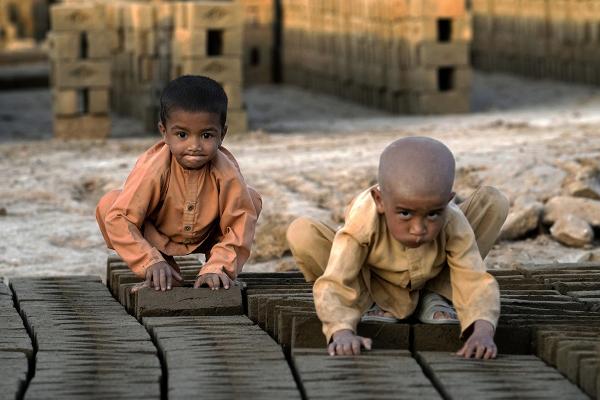
This historical foundation, and now the development of capitalism into capitalism-imperialism, with heightened globalization and the corresponding parasitism (feeding off the exploitation of people throughout the world, and intense super-exploitation in the Third World, involving more than 150 million children): this is the basis on which the capitalist system has “served well” the development of the U.S. economy and the ruling class of this country above all.
(This is analyzed in depth by Raymond Lotta in Imperialist Parasitism and Class-Social Recomposition in the U.S. From the 1970s to Today: An Exploration of Trends and Changes, available at revcom.us.)
As for that commonplace idiocy repeated by Kevin Dowd—that communism (or socialist society under the leadership of communists) “has never worked”—it would take more time and volume of material than is possible here to respond fully to this, but the following are some important elements of a refutation of this idiocy, and its simple-minded substitution of prejudiced ignorance in place of serious analysis. Here I am going to focus on some key aspects of the experience of socialist societies, led by communists, in the Soviet Union from 1917 to 1956, before capitalism was restored there; and China from 1949 to 1976, when capitalism was restored there as well, after the death of Mao.
(For further important background to all this, there is the Interview with Raymond Lotta, You Don't Know What You Think You "Know" About...The Communist Revolution and the REAL Path to Emancipation: Its History and Our Future; and the interview with me The Cultural Revolution in China... Art and Culture... Dissent and Ferment...and Carrying Forward the Revolution Toward Communism.)
Briefly, on the experience of the Soviet Union. This was the first successful socialist revolution in the history of the world, which immediately was up against tremendous odds and obstacles. Almost immediately after the seizure of power by this revolution in 1917, the country was plunged into civil war, waged against this new liberating society by representatives of the old reactionary oppressive society, including capitalists, major landowners, reactionary generals and so on. (And these reactionary forces were aided by a number of capitalist-imperialist countries, including the U.S.) The result of all this was that several million people died and the country was plunged into terrible poverty.
This was what the Soviet Union faced as the revolution succeeded in consolidating power at the end of that decade and going into the 1920s. And tremendous gains were made, tremendous liberating transformations—the development of the economy (which I’ll talk about a little bit more); the liberation of women, including the right to abortion (the Soviet Union was the first modern country to legalize abortion—and this sharply contrasted with the U.S. then, for example); major advances in overcoming poverty, illiteracy and the influence of religious obscurantism among the masses of people, particularly in the countryside; a real florescence in art and culture. All this marked the development of the Soviet Union in the 1920s and into the early 1930s.
There was also the development of the economy in the 1930s. Much as they don’t like to talk about it, the fact is that, while the entire capitalist world was plunged into the Great Depression which lasted the entire decade of the 1930s, the Soviet economy forged ahead, transforming the country economically in major ways. But there were problems with this, some of which Mao pointed out. There was too much emphasis on the development of heavy industry as opposed to all-around development of both agriculture and light industry as well as heavy industry. This continued, and even in some ways accentuated, the difference which can be an oppressive difference, between the city and the countryside and the people living in those two places.
And beginning in the 1930s, while the economy rolled ahead, there was a reversal of some of the major social transformations that had been taking place, including the reversal of the right to abortion. This flowed to a certain degree from Stalin’s statement (Stalin who was the head of the Soviet Union at the time), his statement in the early 1930s that either we catch up with the economies of the imperialist world or they will destroy us. (That’s a paraphrase, but it’s the essence of the viewpoint he put forward.) This guided the rapid industrialization of the Soviet Union in the 1930s.
But, even more specifically, in the Soviet Union in the 1930s, there was, in response to a major development in the world, a significant change. This took place especially around 1934. The big change in the world, and not just in the particular country, was the triumph of fascism in Germany, which was a major imperialist power—and which under Hitler from the beginning had identified the Soviet Union as a major enemy, and did, after a short period of an agreement, launch a full scale invasion of the Soviet Union. The ensuing war resulted in the death of somewhere around 25 million people in the Soviet Union—which, by the way, is 50 times the number of deaths of Americans in World War 2.
It was on the basis of this very significant development—with the triumph of fascism in Germany and the threat it posed to the Soviet Union—it was especially on this basis that things became much more repressive in the Soviet Union. (This also followed the attempt by the Soviet Union, in the mid-1930s, to form a united front against fascist Germany with non-fascist imperialist countries, in particular Britain and France—an effort that was rejected by those countries.) In this situation, during the second half of the 1930s, Stalin increasingly would not allow and moved to repress any kind of opposition, and confounded the difference between criticism and actual enemy action and sabotage. A lot of people were wrongly caught up in this repression, even though all this has been greatly distorted by the apologists and mouthpieces of the imperialist system.
Through World War 2, with all the death and destruction in the Soviet Union, the Soviet Union was—contrary to what we are constantly told in this country—the major force in defeating German Nazi imperialism. Its defeat of Germany in the battle of Stalingrad in the Soviet Union, some few years into the war, broke the back of the Nazi war machine and constituted the major turning point in World War 2 overall.
So, the Soviet Union played this crucial role in defeating the fascists. But on what basis? Here, there are some important negative things to sum up. The war was waged crudely on the basis of rather old-line Russian patriotism, including the singling out of the Great Russian people as the first among the Soviet peoples. And so, coming out of that war, the question of where that society was going to go was sharply posed. Socialism had been significantly compromised in the context of waging and ultimately winning this war. No one should underestimate the tremendous challenge this war and the invasion of the Soviet Union by this Nazi war machine actually represented. Nonetheless, the question of socialism was up for grabs, so to speak, in the period coming out of World War 2. And before long, shortly after the death of Stalin, this contradiction between socialism and old-line nationalism and ultimately capitalism was resolved with the restoration of capitalism under the leadership of Khruschev in the mid-1950s.
It is also important to underline the profound contrast between the situation of the Soviet Union coming out of World War 2 with that of the United States: Once again, the Soviet Union suffered massive destruction and the huge loss of life through that war, with a major front of that war fought on Soviet territory, while war was never fought on U.S. territory and it emerged greatly strengthened through the war. This placed the U.S. at a great advantage in what became a global contest between the U.S. imperialist empire and the emerging Soviet imperialist empire over the next number of decades, until the Soviet Union “came unraveled” by the early 1990s, with a diminished and weakened Russia remaining in its place.
But, returning to the whole idea that “socialism, communism has never worked,” you can see that put to the lie just by what I have briefly outlined here—how this claim is a crude distortion of very rich and important history that people need to learn about. Think about what it would mean if, in this country, something like 50 million people died as a result of a war fought on the soil of this country! How repressive would the government be that waged the war to defeat that invasion (with whatever particular form of warfare it was). This is the kind of situation the Soviet Union experienced as a socialist society through World War 2. And this whole experience of socialism in the Soviet Union has to be evaluated with this historical perspective—from the beginning, from the initial seizure of power, all the way up through World War 2, and with the threat of attack by an atomic bomb-armed U.S. coming out of World War 2.
Here I can make a very controversial statement. So far there has only been one country that has used nuclear weapons—the U.S., with its atomic bombing of two Japanese cities at the end of World War 2 in 1945—only one country has done it and that country only did it once. But certainly it has to be considered whether one of the main reasons that the U.S. didn’t do it more than once is the fact that the Soviet Union also developed atomic weapons shortly after the end of World War 2, and a whole different question got raised about the use of nuclear weapons—even though the U.S. imperialists drew up plans to wage nuclear war against the Soviet Union and China, calculating that this would cost the lives of several hundred million people! This is the nature of these imperialists that we’re dealing with, who bray about how capitalism has been so great for them and how “socialism and communism has never worked,” as they’ve worked forever not to allow it to “work,” and even with all the great advances it has broken through in the face of that.
So let’s look next at China. We hear so much slander of Mao and the Chinese Revolution and the Cultural Revolution in particular—once again, conscious, or at least ignorant, idiocy. What, after all, were the objectives of Mao and the Chinese communists in waging the revolution? What was the situation of the masses of people in China that established the necessity for a revolution and made masses of people supportive of the revolution? The terrible conditions in the countryside, where people regularly starved in the millions; where families had to sell their children, and in particular their young girls, to landlords and others to be exploited and sexually plundered, just in order to try to have a meager existence for the rest of the family; where there were terrible diseases and epidemics that regularly struck China, owing to the backward conditions of the country.
There was the situation in the cities where masses of people were working as exploited proletarians—where the situation of the exploited workers, the proletarians in the factories, was one of desperate conditions as well. Even attempts at trade union organizing by these workers were met with vicious, murderous repression by the ruling regime backed up by the imperialists, the ruling regime headed then by Chiang Kai-shek.
This was in the context of the overall domination of China by imperialism, with all of its different effects, including in the cultural realm, where Mao made the striking statement one time that this imperialist domination and the subordination of the Chinese people was so extreme that it could be said that if a foreigner farted in China, there was always some Chinese who could be found to say that it smelled good. But in a more serious expression of this—emblematic of the larger situation, a concentration of it—was the fact that there was a sign in a major park in Shanghai: “No Dogs or Chinese Allowed.” In a major city of China.
This is what the revolution was aimed at overcoming—and did, in really marvelous ways, overcome—eliminating scourges like drug addiction on a massive scale, diseases and epidemics that had plagued the country for decades and centuries. You can read the Pearl Buck novels about China and see some of the conditions I’m talking about.
Tremendous advances were made in developing the economy. It’s always talked about how many people Mao supposedly killed—and contests to up the numbers from so many millions, to so many times that millions, to so many times that. But think about all the lives that were saved during the period of socialism led by the Chinese Communist Party and Mao. To cite one very meaningful statistic: At the time the revolution came to power in 1949, the average life expectancy was 32 years; and at the time of Mao’s death, less than three decades later, it had risen to 65. The infant mortality rate at that time in the city of Shanghai—remember Shanghai? “No Dogs or Chinese Allowed”—the infant mortality rate in Shanghai at that time was lower than it was in New York City.
So this is expressive of some of the major gains that were made, including the emancipation of women. The elimination of foot binding, where the feet of a woman were forcibly turned under, causing them to have to wobble when walking, making them supposedly more desirable to men. This practice was eliminated.
All these things were eliminated, not by state repression, but by mobilizing the masses of people, including the mass campaigns against disease, against drug addiction, against prostitution, where the people were not victimized and persecuted who had been caught up in this, but there was education and struggle carried out and they were given a new lease on life in a real sense to become productive members of society. Tremendous gains were made—and it’s just disgusting the slander against this and the ignorance that is promoted.
Similarly about the Cultural Revolution. You could have a lot of fun in a certain sense by asking all these people who spread all this garbage about China and Mao: What was the actual aim of the Cultural Revolution? What policy did Mao foster and further during the course of the Cultural Revolution? What was the actual course of the Cultural Revolution? “Blu, blu blub, blub, bluh...” That’s the content and substance of the answer you would get from all these people crudely slandering China—the revolution and in particular the Cultural Revolution. The Cultural Revolution was a mass uprising—yes, led by Mao and elements in the Chinese Communist Party who were on the revolutionary road. But it involved a swirl of debate and struggle, overwhelmingly not violent; and when there was violence, this was opposed by Mao and directives were issued to counter it and steps taken to prevent it and to bring things back to the course of mass debate. And, yes, there were some excesses. There has never been a truly mass upheaval in the world that has not involved some excesses. But it’s not as if Mao were fanning and encouraging the excesses. He was moving to direct people away from them and to get things back on the course that they needed to be on.
In the major cities hundreds, literally hundreds, of mass newspapers were produced by the masses of people rising up and debating the questions of socialism and what road forward for China, and so on. This was the essence of the Cultural Revolution.
And one of the real ironies of the Cultural Revolution—which, of course, all these idiots don’t know anything about or choose to ignore—is this: one important aspect of the Cultural Revolution is that it was an attempt by Mao to deal with the threat to socialism, to deal with the moves to overthrow socialism and restore capitalism, coming from within the Party and the state itself, to counter this and oppose it and defeat it by means other than the kind of massive purges carried out by Stalin in the Soviet Union. Mao had summed up that experience, and the mass struggle of the Cultural Revolution was Mao’s means to take on this problem of forces moving to restore capitalism and the question of transforming the people and their basic values, in a different way than state repression. That’s one of the great ironies of all the vicious attacks on the Cultural Revolution.
During the course of the Cultural Revolution, another great achievement was the creation of revolutionary art and culture, really for the first time in history, on this scale and with the actual backing of a government, with one of its outstanding features women playing a prominent role as revolutionaries, not as playthings for men.
So this was a real struggle which had come to a head in China over which road to take—the road of socialism or the road of capitalism—and, as I said, there were powerful forces within the Chinese Communist Party who were determined to take the country on the road of capitalism, whose involvement even in the Communist Party was always more—was never so much, I should say—actually wanting to advance society on the road of socialism and ultimately the world toward communism, with the abolition of exploitation and oppression, but was really centered on making China a great powerful country.
And for a while, during certain stages of the communist revolution, those viewpoints could somewhat coexist within the leadership of the revolution; but then, once the foreign yoke had been thrown off and the question of, yes, how do you develop the economy and develop the country as a whole came to the fore, those viewpoints increasingly came in conflict with each other. There were those who said, like Deng Xiaoping: “What does it matter whether it’s a black cat or a white cat as long as it catches mice?”—meaning: who cares whether we use capitalist methods or socialist methods, capitalist methods are fine as long as this develops the economy.
Another one of the ironies here is that a slander of Mao commonly repeated by so-called scholars of totalitarianism and authoritarianism, and so on, is that Mao “invented” this danger of capitalist restoration in order to purge a whole bunch of people and carry out repression, so as to further assert himself as the unquestioned leader.
Well here are the facts: Mao said there are forces in the Chinese Communist Party who are moving to restore capitalism, that’s why we need a cultural revolution to defeat them as well as to further transform things on the revolutionary road, including the thinking of the people. The political objective was to defeat this move on the part of powerful forces inside the party and the state to restore capitalism. Supposedly Mao “invented” this danger so he could be an even more powerful tyrant. Well the simple fact is this: what these people have done, beginning with Deng Xiaoping after the death of Mao, is exactly what Mao said they were going to do—exactly moving to restore capitalism in China. And here we see that, once again, what was really at stake was two different roads. Not as an abstraction but how—by what means, on what road—do you, for example, develop the economy, as was recognized generally as a very important goal of the revolution: to develop the economy, to lift the country out of the remaining poverty for masses of people.
Here I can tell a little story. When I visited China in 1971 we went to a dinner, the delegation I was part of, we went to a dinner in Shanghai. And one of the leading people there in Shanghai hosted this dinner for us. Well, prior to this dinner he had regaled us for nearly an hour with statistics about how they were developing the economy in Shanghai and contributing to the overall development of the economy in China. This was not some sort of soulless bureaucrat. During the course of the dinner, for example, the same guy—we had some crab for dinner, and the same guy at one point proclaimed humorously, “The person who invented crabs is a genius!” Now this is not your typical dogmatic communist, or your faceless bureaucratic official. But the reason that we were given such a rundown on the development of the economy was because of all the slanders that the people—Mao and others— who wanted to stay on the revolutionary road, and Shanghai was then a stronghold of that, supposedly they didn’t care about developing the economy; they just wanted to wage “class struggle” and persecute people, and so on and so forth.
So what was at stake was not whether or not to develop the economy, it was on what road. And toward what end? Do you develop the economy on the basis of re-establishing and restoring capitalism and its principles of development—which means basically exploiting people within your country and ultimately internationally? Or do you do it on the basis of moving to overcome exploitation and the profound differences that accompany exploitation—such as the difference between the countryside and the city, where the city tends to dominate the countryside, be more privileged if you will, and the difference between the people living in the two places; the difference between mental and manual labor, between people who work mainly in the realm of ideas and those who work with their backs, mainly. Do you do it in a way that’s moving to overcome these great differences, as well as the differences in income and so on, that are part of that whole picture? Or do you do it by just unleashing all those differences fully?—which is the path China has taken after the death of Mao and with the restoration of capitalism beginning in late 1976.
A lot of talk is made—here’s an irony—all these people who say “socialism has never worked, communism has never worked”: they’ll acknowledge, on the other hand, that China has lifted hundreds of millions of people out of poverty; and that’s under a system that these idiots call “communism,” even though it’s not—even though the Chinese Communist Party continues to be the ruling party, it has long since abandoned any objectives of continuing to transform society and the world toward communism. So here is the big irony on the part of people who say, “communism and socialism have never worked”: this Communist Party-led country in China has lifted hundreds of millions of people out of poverty.
Another kind of irony here is that, even though the ruling class in power in China, since shortly after the death of Mao in 1976, is capitalist, and definitely not “communist,” the foundation on which they have carried out capitalist development was actually built through the development of the economy on a socialist basis, during the period of Mao’s leadership. Without that, China would have remained a backward, deeply impoverished country. At the same time, the restoration of capitalism in China has been accompanied by the re-emergence of profound inequalities and terrible social ills, such as prostitution; and accompanying all this, in the realm of ideology and culture, the slogan “to get rich is glorious” has been promoted in place of the principle popularized in socialist China, with Mao’s leadership: “serve the people.”
Now, let’s speak to this. If the path that Mao charted, the revolutionary path, had been continued, would that have meant that people would not have been lifted out of poverty? Perhaps it would have taken a little longer. But China’s economy was already rapidly developing—that’s reflected in what I cited about the life expectancy. That reflects the development of the economy, or else that could not have happened. And by the way, that was happening while the population was expanding not contracting. They didn’t kill off a bunch of poor people so the life expectancy would be statistically higher. The population was expanding while the life expectancy was doubling. So if they had continued on the road that Mao was fighting for, and those who were with him, they would have also lifted millions, hundreds of millions of people out of poverty—but on a different road. It wouldn’t have been a road of China being a great power exploiting people around the world, in Africa and other parts of the world, as it is doing under the rule of these phony communist— actual capitalist—rulers of China.
So, if you look at the actual experience which I’ve only been able to briefly sketch here—and people should look into it more fully in the works I’ve cited, including the interviews with Raymond Lotta and myself, and see what they were actually up against and what they actually achieved—you can see the complete, yes I’ll say it once again, idiocy, and deliberate fostering or, in any case consistent fostering, of ignorance, to deny people who are feeling the weight of living under this system and hungering for something better: to deny them the whole knowledge of this experience and therefore the understanding that there could be a real alternative.
At the same time, I’ve spoken to some shortcomings, and even some very serious errors in the overall experience of socialist society led by communists—and yes, I’ve used the word “grievous” in speaking of errors on the part of Stalin in particular, but also some significant problems with Mao’s leadership, some shortcomings in Mao’s orientation and approach. For example, through the Cultural Revolution there was recognition of the importance of ferment and debate, carried out as it was on a grand scale, through the Cultural Revolution (as I’ve briefly described here). But the scope of this was still too restricted. It was still too much on the terms of: If you want to get anywhere in this debate, it has to be conducted on the basis of upholding Mao’s leadership and you’re for the socialist road, while those who are opposing you are not. It wasn’t as open-ended and as broad-based a debate as it needed to be.
This was also reflected in the realm of art and culture, even with the very great breakthroughs and tremendous achievements that I briefly described. There was, again, a certain constriction of art and culture to revolutionary themes and not enough florescence and ironically not enough flowering of different tendencies in art, and for that matter, not enough support for art that wasn’t directly political—even while revolutionary art, art that’s directly promoting the revolution, including in the most artistic way, is very important. But there was a certain limitation there and a certain constricture in terms of what would get backing at least.
In the more philosophical dimension, if you will, there was a certain “reification” of the oppressed masses: the common view that had influence, was actually being promoted there, that the oppressed masses by the very nature of their position had, as the current parlance puts it, a particular purchase on the truth—or at least that they would be spontaneously more inclined toward striving for revolution. Now it’s true that where there’s oppression, there’s resistance—but that doesn’t spontaneously lead to people understanding where that resistance needs to go, how it needs to develop into revolution, what’s the character of that revolution and how to deal with the problems of the revolution. All that requires science—it doesn’t reside just in the oppressed masses by virtue of their oppressed condition.
So there was this tendency, which included the idea of “class truth”—as opposed to objective truth. The idea that for the proletariat and other oppressed people there was a truth that corresponded to their interests, and opposed to that a “truth” that corresponded to the interests of their exploiters and oppressors, so you had to go with the “proletarian truth” not the “bourgeois truth.” This is in opposition to the scientific understanding that truth does not have a class character. Truth can be wielded on behalf of a class, but truth itself does not have a class character—it has an objective character. Truth resides in, or represents, an accurate reflection and concentration of objective reality—not the subjective viewpoint of this or that class, whether bourgeois or proletarian.
At the same time, there was, on the part of Mao and that party generally, a sort of an eclectic mix of communism as the main guiding outlook and method, yet secondarily, but significantly, this was mixed in with a fair amount of nationalism. This is understandable, in a certain sense, given the whole oppressed history of China as a country, as a nation (Mao’s sharp comment, which I referred to, and the more brute example of the sign in the park in Shanghai, speak to that). Nevertheless, the outlook of communists has to be internationalist and not nationalist. Yes, you apply that to particular conditions, but the outlook and the overall approach has to be internationalist not nationalist, yet there was kind of an eclectic mix, including in Mao. This was also reflected in the realm of culture, where one of the guidelines that was promoted was “have foreign things serve China.” And this really went to a bad place with a rejection of some “foreign culture” that was actually quite positive, such as jazz and rock and roll in the U.S. then (the 1960s and early 1970s), which was criticized as essentially decadent by the dominant line in China at that time.
This negative nationalist tendency came out very dramatically when, in the early 1970s, with the leadership of Mao, China adopted a policy of the opening to the West—identifying the Soviet Union as the main enemy (a Soviet Union which, again, had since the mid 1950s, been a capitalist country and had developed into a powerful capitalist-imperialist country, but in the name of communism). The Soviet Union was posing a direct threat of invading and even using nuclear weapons against China in the1960s, particularly the late 1960s. In the face of that, in the early 1970s, Mao and the Chinese party adopted a policy of “opening to the West.” In other words, seeking certain relations and even a certain kind of alliance with the U.S. in particular, in order to deal particularly with the threat of the Soviet Union. But this led to all kinds of terrible policies and actions on the part of the Chinese government, including supporting people like Marcos in the Philippines, a brutal oppressor kept in power by U.S. imperialism for a long time. The irony was that there was actually a Maoist revolutionary force waging armed struggle against the Marcos regime in the Philippines—and yet the Chinese Party, as part of this opening to the West, was supporting the Marcos government.
There are many other examples of this. Some of it became rather—well, I’ll use the word, disgusting. I read some of the things that have been retrieved from discussions that Mao held with Henry Kissinger, representing the U.S. government, during this period of the opening to the West in the 1970s, and in these discussions it’s almost hard to distinguish Mao as a communist, to be blunt. So this was an extension of the view that you had to maneuver in this way to deal with the threat of the Soviet Union. The point is not to be dogmatic. It’s one thing if you make tactical alliances even with imperialists—if you don’t compromise fundamental principles. But, unfortunately, too much fundamental principle was compromised as part of this. I can’t go into this more fully here, but it’s a very important experience that needs to be seriously confronted and scientifically dealt with.
So, that’s some important discussion of the historical experience of communism, in particular socialist society led by communists, in the Soviet Union and China. In a real sense, the major work of mine, Breakthroughs: The Historic Breakthrough by Marx, and the Further Breakthrough with the New Communism, A Basic Summary provides a bridge from the historical experience of the communist movement to the further synthesis with the new communism. (Later in this presentation, I will come back to a discussion of some of the key elements of the new communism as a continuation of, but also a qualitative leap beyond, and in some important ways a break with, communist theory as it had been previously developed. And in a two-part interview with me in early 2025—available at revcom.us and thebobavakianinstitute.org—I discussed more fully the basic principles and methods of the new communism.)
But here it is important to come back to this essential point: Once the possibility of a really radical and truly emancipating alternative—a fundamentally different system and way to live, as represented by the communist revolution—once this is closed off, in reality and in people’s minds, all kinds of horrors will continue, and sooner or later those whose minds have been closed to this emancipating alternative will become complicit in, or at least accommodate to, those horrors, one way or another. This is expressed in particularly acute terms now, in the situation where this system is running up against its limits—something which I have spoken to here (and discussed more fully in other places, including my social media message #118.)
But let’s look further at the contradictions of capitalism. Lenin made this very important observation about capitalism and its effect on people who live under the capitalist system: He noted that capitalism forces people to calculate with the stinginess of a miser. You can think about everyday experience and what people are put through. There is not just some inherent human nature of selfishness. The operation of this system constantly pits people against each other in all kinds of ways, and forces them to compete with other people for jobs, for promotions, for admission to college, and on and on. And this does, as Lenin said, foster this tendency to calculate with the stinginess of a miser: “How am I doing vs. all these other people who are competing with me? How am I advancing?” And there are real things at stake. It’s not just people’s careerism in many cases—especially among the more oppressed and exploited masses it’s literally a matter of survival, or at least being able to some way provide for those who depend on you in many cases. So it’s important to understand: It isn’t just that capitalism gives rise to a flourishing of this calculating with the stinginess of a miser—it compels people, as Lenin said, to calculate with the stinginess of a miser.
To draw once again from “Hope For Humanity”:
Here is a very important statement by Marx, from the Grundrisse—one of his major works—as cited in Ruminations and Wranglings:
In the money relation, in the developed system of exchange (and this semblance seduces the democrats), the ties of personal dependence, of distinctions of blood, education, etc. are in fact exploded, ripped up (at least, personal ties all appear as personal relations); and individuals seem independent (this is an independence which is at bottom merely an illusion, and it is more correctly called indifference), free to collide with one another and to engage in exchange within this freedom....
This is a way of elaborating on what Lenin was pointing to in emphasizing that capitalism forces people to calculate with the stinginess of a miser. Particularly important in this statement by Marx is the analysis that this “independence” of people under capitalism is really “an illusion,” which “is more correctly called indifference.” It is often celebrated about capitalism that it gives qualitatively greater scope to the individual than systems like feudalism (to say nothing of outright slavery), where the positions and the restraints on individuals are much more fixed and frozen. Marx is getting at the fact that, while this is a real difference with feudalism, it is nevertheless the case that, within the exchange relations of capitalism (fundamentally rooted in its economic/production relations) the “independence” of individuals is not nearly as real, or as expansive, as it appears, and in the end it is essentially illusory: people are still confined within and conditioned by the fundamental relations of the system.
And the “indifference”—the “not caring,” particularly about other people—relates to the competition between individuals (“free to collide with one another”) under capitalism and the way that, as Lenin put it, this system compels people to calculate with the stinginess of a miser.
There’s all this talk—what we could readily identify as tautological talk, round in a circle reasoning—about human nature. And this was also spoken to by Marx and Engels in The Communist Manifesto. Marx made the point that the development of society involves the continuous transformation of human nature. So whatever is the prevailing system of social and economic relations, and their corresponding ideas and culture and political system, will be the dominating character of “human nature.” In other words, the philosophy or the ideology and the morals of people. “Compelled to calculate with the stinginess of a miser” under capitalism—they made the point, Marx and Engels in The Communist Manifesto, that this is another tautology, another round in the circle argument, that really amounts to saying that under the capitalist system (I’m paraphrasing but this is the essence of it) under the capitalist system, the dominant viewpoint that prevails will be one in correspondence with the capitalist system. Or, as they put it in that work: The ruling ideas of any age are always the ideas of the ruling class.
As I said, Marx made the point that the development of human society and its transformation involves the continuous transformation of human nature—that there is no such thing as unchanging “human nature,” but what is called human nature is ideas, attitudes, outlooks, morals, and so on, that are shaped by the prevailing system. Which people can and do rebel against, but nevertheless, those are going to remain the dominant ideas in the society so long as the society is dominated by a ruling class whose interests lie in promoting those ideas. So this is something very important to understand in opposition to the whole...you know people always say “well, it’s just human...”—if they don’t say “it’s god’s will,” they say it’s human nature, or they say both. And this, of course, is a shackle on people, keeps people from recognizing the possibility of real change, fundamental change. (I speak to this question of “human nature” more fully in my social media message #21: “There is no such thing as ‘human nature.’”)
Now I referred to “Ruminations And Wranglings,” which is an important work of mine, and the full title is: Ruminations And Wranglings, On the Importance of Marxist Materialism (something I’ll come back to), Communism as a Science, Meaningful Revolutionary Work, and a Life with Meaning. The specific reference here is to the section, “More on Individuals and Social Relations,” which contains important discussion of this question of individualism and the contradiction between people’s existence as individuals and as part of fundamental economic and other social relations.
This is a basic contradiction of bourgeois (capitalist) society—and in fact of all societies, but this takes a particularly pronounced expression in capitalist society: people obviously exist as individuals, while at the same time they are part of larger social relations, most fundamentally production relations, and under capitalist society that’s production relations and social relations of exploitation and oppression.
Further from “Hope For Humanity” on this contradiction:
As I have pointed out, in Ruminations and Wranglings (and in other works), the contradiction that people exist as individuals, but they also exist in a larger social context and are largely shaped by that social context, is a complicated contradiction that is important to handle correctly. And this contradiction is acutely expressed today in the fact that while people do exist as individuals, the terrible suffering of the masses of humanity and the urgent challenges facing humanity as a whole as a result of the escalating destruction of the environment by this system of capitalism-imperialism as well as the possibility of nuclear conflagration that continues to loom as an existential threat over humanity—all this cannot be seriously addressed, let alone actually solved, by each person pursuing their particular individual interests, and in fact people acting in this way constitutes a major obstacle to bringing about the necessary solution.
It’s worth repeating this part: this contradiction is acutely expressed today in the fact that while people do exist as individuals, the terrible suffering of the masses of humanity and the urgent challenges facing humanity as a whole as a result of the escalating destruction of the environment by this system of capitalism-imperialism as well as the possibility of nuclear conflagration that continues to loom as an existential threat over humanity—all this cannot be seriously addressed, let alone actually solved, by each person pursuing their particular individual interests, and in fact people acting in this way constitutes a major obstacle to bringing about the necessary solution. (Continuing the quote from “Hope For Humanity")
Individualism is a significant factor and “unifying element” in much of the negative trends that play a major role in keeping people from recognizing the reality and depth of the horrors continually brought about by this system—and recognizing the urgent need to act, together with others, to abolish and uproot all this, at its very source. This highlights and heightens the fact that individualism, which is encouraged and expressed in extreme forms in this particular society at this time, is a profound problem that must be confronted and transformed.
With the extreme parasitism of this country, and (to borrow a phrase from Marx), the culture conditioned thereby, it is hardly surprising that extreme individualism is extensively promoted and constitutes a serious obstacle to positive social transformation.
What compounds the problem is that the “workings”—the dynamics as well as relations and institutions—of this system work to create the conditions in which “in normal times” there is not just a definite “spontaneous” inclination, but a strong material necessity and compulsion, for individuals to act on the basis of their own individual interests (and those in their close circle). It is in rare times and circumstances of serious crisis for the system and disruption of the “normal functioning” of society, that the basis comes into being for masses of people to act more broadly in the interests of larger concerns. And, once again, this is one of those rare times and circumstances.
Along with the individualism so characteristic of this society is the problem of infantilism (the infantilization of younger and even somewhat older adults—treating and conditioning them to think and act like dependent, and in some cases pampered, children, even as they are often burdened with the “expectation” that they must “succeed” according to the terms and standards of this system—a real “toxic combination”) along with the widely promoted philistinism: a disregard for or disgust with knowledge and the pursuit of knowledge (serious knowledge, as opposed to rumors and gossip). Or, in other words, just plain dumbing down, including through the influence of much of social media.
“Woke identity politics” is in effect a species of individualism: The individualism is extended to the “identity” of which one is a part (a race, gender, etc.) while the different “identities” are posed (objectively and in many cases consciously) in opposition to each other, despite attempts by some to overcome this through “intersectionality” of different identities. This is expressed, in terms of epistemology (theory of knowledge) with the notion that each “identity” has its own particular “truth.”
As I discuss in “Breakthroughs,” in a society like the U.S., based as it is on exploitation and oppression: “The ruling class repeatedly seeks to pit different sections of the people against each other and, contrary to the illusions of ‘intersectionality,’ the ruling class has many powerful ways to do that if you’re not proceeding from the point of view of the emancipation of humanity as a whole,” but rather from the standpoint of different “identities.”
In opposition to all this, as emphasized, again, in my January 2021 New Year’s statement:
To understand why we are confronted with the situation we are, it is necessary not merely to respond to—and in effect be whipped around by—what is happening on the surface at any given time, but to dig beneath the surface, to discover the underlying mainsprings and causes of things, and arrive at an understanding of the fundamental problem and the actual solution. This means coming to the scientific understanding that we are living under a system, and what that system actually is (the system of capitalism-imperialism); working to grasp the deeper relations and dynamics of this system and how this is setting the framework for how different sections of society spontaneously think and react to events in society and the world; and what is the possible way forward to transforming all of this in the interests of the masses of humanity and ultimately humanity as a whole.
And:
This means fully breaking with and moving beyond an approach of merely embracing truths—or supposed truths—with which one is comfortable, while rejecting, dismissing, or evading actual truth which may make one uncomfortable. One important dimension of this is rising above and repudiating methodologically the philosophical relativism of “identity politics,” which does a great deal of harm through its own version of reducing “truth” to partial, unsystematized experience and subjective sentiment (“my truth”...“our truth”...) in opposition to real, objective truth, which is correctly, scientifically arrived at through an evidence-based process, to determine whether, or not, something (an idea, theory, assertion, etc.) corresponds to actual material reality. While politically this “identity politics” may be proceeding from a desire to oppose various forms of oppression—even if this is often characterized, and vitiated, by people of different “identities” seeking to claim “ownership” of opposition to oppression—in terms of epistemology (the approach to understanding reality and arriving at the truth of things) “identity politics” has a lot in common with the reliance on “alternative facts” (assertions that are in opposition to actual facts, often wildly so) that is the hallmark of the fascists. Even as it is important to recognize the political distinctions involved, the situation is far too serious, and the stakes far too high, to allow ourselves to fall into, or conciliate with, any form of opposing the scientific method and its pursuit of objective truth about actual reality.
Closely related to the flawed epistemology of “identity politics,” in opposition to the scientific method and its pursuit of objective truth about actual reality, is “post-modernist” insistence that it is not possible to arrive at objective truth, and even that there is no such thing as objective truth. This is refuted at some length in “Breakthroughs,” while the following from my article “Philosophy And Revolution,” Part 1 also provides important refutation of this:
Ultimately, the test of any theory, etc., is whether or not what it projects about reality is borne out (or not). At the same time, a scientific theory, correctly wielded, can—on the basis of accumulated historical experience and knowledge—accurately project what would likely result from a developing trajectory of things. This, for example, is the basis on which climate scientists can make essentially correct projections about what will develop from historical and current trends. And this is why it can be scientifically asserted that the overthrow of capitalism, and its replacement by communism, is in the fundamental interests of the masses of humanity, and ultimately humanity as a whole.
At the same time—and far more dangerous than “identity politics” and its flawed epistemology—is the attack on intellectualism (and even on certain expressions of individualism) by fascist “intellectuals” (such as JD Vance, and a number of tech billionaires, rightly described by someone as the “tech reich,” referring to the Nazi third reich) in the service of today’s fascism, “U.S. style.”
Along with all this, within “movements” opposing (or posturing as opponents of) the existing political system, (with some claiming to be opposed to capitalism—but, don’t actually know what capitalism is, as I put it in my social media message #38), there is what I refer to as PIE: Parasitic Imperialist Economism.
This is an approach to politics—and specifically electoral politics—that argues for backing and elevating people running in the Democratic Party on a platform of “affordability” as the pivot, with other, social (or “cultural”) issues as essentially secondary accompaniments to that.
As an explanation of the essential, and fundamental, problem with this approach, there is the following (from “Breakthroughs”):
As Marx pointed out, one of the distinguishing features of reformists—including reformist “socialists”—is that, insofar as they identify the economy as the source of inequality and other social maladies, they tend to locate the problem in the sphere of distribution, whereas the fundamental source of the oppression and inequality that characterize an exploitative society, such as capitalism, resides in the sphere of production, and more specifically the relations of production.
In today’s world, these production relations are fundamentally international relations, with the wealth that reformists seek to “re-distribute” (through increasing taxes on the super-rich, etc.) resting on the extreme parasitism of “the U.S. economy” as an international system of exploitation and super-exploitation. Along with that—and along with the fact that much of this “economist” program would actually undermine the functioning of this system and the competitive position of U.S. imperialism in the world—is this awful truth that may be ignored but cannot be avoided in reality:
At his rallies against “Oligarchy,” Bernie Sanders has revived the “Occupy” formula of the “99 percent” against the “one percent” of super-rich. But the problem is that nearly half of the “99 percent” are fascists. Why? Because, as I have pointed out before, it is not just their economic position but also their social position that they are worked up about. For the ranks of the MAGA fascists, even beyond their economic situation, a powerful, perverse motivating factor is their insistence on white supremacy and male supremacy, hatred of LGBT people and of immigrants (especially immigrants from “shithole countries,” in Trump’s disgusting racist terms). This is what these fascists mean by “Make America Great Again.” And all this is wrapped up with and driven by blatant lies, anti-scientific lunacy and crazed conspiracy theories—with vulnerable groups made into targets of hatred and persecution, like immigrants denounced as “dangerous criminals” and trans people treated as perverted predators. [This is from my social media message #114.]
With the development and heightening of capitalism into capitalism-imperialism, Lenin spoke to the consequences of this for the revolutionary movement in what he wrote about Imperialism and the Split in Socialism. He talked about how with this development of what we would today recognize as the parasitism of imperialism (in fact that was Lenin’s term, gotta be fair to Lenin, Lenin was the one who talked about parasitism, excuse me) anyway, with the parasitism of imperialism, Lenin recognized that there was a section of the working class that was bribed from the spoils of this parasitic imperialism, and more or less bourgeoisified. Now, he didn’t write them off totally in terms of the revolution—he said that with the development of events, we’ll see where different parts of these bourgeoisified workers fall out—but he emphasized the importance of building the revolutionary movement in the lower and deeper sections, the more bitterly exploited sections of the working class, of the proletariat.
But in these social democrats today, like the DSA—Democratic Socialists of America—we see once again the attempt to actually build a movement based on imperialist parasitism; that is the heart of their “affordability” appeal. It’s not that the conditions of the masses of people, even in the middle class, let alone the bitterly exploited, should be ignored. It’s not that there are not real problems with that. But to try to base a movement to change society on “affordability” means that the changes you’re seeking are going to be very limited and are ultimately going to be incorporated within this parasitic imperialist system. So this is a fundamental distinction between social-democrats like the DSA, who are basically a part of and seeking to take over the Democratic Party as an instrument of imperialist rule, on the one hand, versus actual socialism and its ultimate aim of communism throughout the world.
The basic and profound truth is that this system of capitalism-imperialism cannot be “reformed”—it cannot somehow be made into a just system acting in the interests of the masses of humanity.
This system rests on, and cannot do without, vicious exploitation, here and (super) exploitation around the world, particularly in the Third World (Latin America, Africa, the Middle East and Asia).
It is rapidly destroying the environment, at an accelerating pace.
It is once again propelling things toward the existential threat of nuclear war.
In this country itself, very real and literally murderous oppression is built into the dominant system and its essential relations: white supremacy, patriarchy and male supremacy and other savage inequalities and brutal oppression.
And now, as a perverse attempt to preserve the rule of this system and the dominance of U.S. imperialism in the world, there is the rise to power of fascism. This involves what is, in essence, a “revival” (or, continuation) of the Confederacy: along with the “resurrecting” of Confederate monuments and “heroes,” there is even talk by fascists that slavery was not such a bad thing, was even a good thing. This fascism also prominently involves attacks on Trans and other LGBT people, along with forcefully asserting the subordination of women (not only ripping away the right to abortion and threatening birth control, but even with some fascists openly arguing that women should once again be denied the right to vote).
This fascism has, as a battering ram, the attack on immigrants, on the basis of an “immigration crisis” that is being grossly exaggerated—and even to the degree that it is real, this reality is being crudely distorted. This fascism openly defies and tramples on the rule of law, both within the country and in international relations, with the open declaration that it refuses to recognize, or be restrained by, any national or international law regarding the waging of war, including through the deliberate and wanton targeting of non-combatants. This fascism is continually committing, and escalating, all manner of atrocities, deliberately at a dizzying pace, in order to disorient and demoralize those who would oppose this.
While defeating—removing from power—this fascist regime is an immediate and urgent objective, it is necessary, once again, and critical to understand this: Any hope that relying on and tailing the Democratic Party can bring about a just solution to the crisis, any attempt to make the Democratic Party something other than what it is—a ruling class party—and, more broadly, any attempt to “work within this system” as a means of ending its terrible oppression and ruthless exploitation, its existential threats to humanity through environmental destruction and the danger of nuclear war—any such hope, any such attempt, is fundamentally bankrupt and bound to result in failure, with the resulting continuation, indeed accentuation and acceleration, of all too real horror.
So let me end the first part of this presentation with this very important conclusion:
So long as people, not just in one or another country but in the world as a whole, remain locked within the framework and confines of this system of capitalism-imperialism, there can be no good resolution to the already terrible situation with which humanity is now confronted and the suffering to which the masses of humanity are continually subjected—and humanity will continue to be forced marched into an even worse disaster, into an even more awful abyss, and possibly even to extinction.
The Solution: Wrenching a Radically Emancipating Revolution Out of This Madness
First, what is meant by revolution? The following, from “Something Terrible, Or Something Truly Emancipating,” speaks to the essence of this: “the institutions of violent suppression of this system must finally be broken apart, defeated and dismantled by an organized revolutionary force. That is what is necessary for things to go beyond just mass protest, however militant and determined, and become a real revolution.” And, quoting from the revcom “Declaration And Call”:
A revolution means a force of millions, drawn from many different parts of society and organized for an all-out fight to overthrow this system and replace it with a radically different and much better economic and political system, a socialist system, based on meeting the needs of the people and carrying forward the fight for a communist world where there will finally be an end, everywhere, to the exploitation, oppression, and destruction of the environment that is built into this system of capitalism-imperialism. Anything less than this revolution will completely fail to deal with the root of all the problems or lead to the actual solution.
In short: In today’s world, to fundamentally change society, you must seize power—overthrow the existing state power and establish a new state power.
In “normal times”—or, to put it another way: with the exception of extraordinary times when the basic functioning, relations and “rules” of the system are seriously disrupted and their “permanence” is seriously brought into question not just among a few people but more broadly throughout society—people are shaped and confined within, “locked into,” the existing dominant system. This is why, as a general phenomenon (but not something to be made into a dogma) it is in times of acute crisis that fundamental change becomes possible.
So, what then are the necessary conditions for revolution? As explained in “This Is A Rare Time When Revolution Becomes Possible”:
A revolution becomes possible, even in a powerful country like this, when three main factors have been brought into being:
A crisis in society and government so deep and so disruptive of the “usual way of doing things,” that those who have ruled over us, for so long, can no longer do so in the “normal” way that people have been conditioned to accept.
A revolutionary people in the millions and millions, with their “allegiance” to this system broken, and their determination to fight for a more just society greater than their fear of the violent repression of this system.
An organized revolutionary force—made up of continually growing numbers of people, from among the most oppressed but also from many other parts of society—a force which is grounded in, and is working systematically to apply, the most scientific approach to building for and then carrying out revolution, and which is increasingly looked to by masses of people to lead them to bring about the radical change that is urgently needed.
These factors for revolution, as a whole, clearly do not exist right now—but, again, this is one of those rare times when these factors for revolution could be brought into being.
Without being mechanical about this, there is a definite importance to understanding, in a living way, the role of these three conditions—and their ongoing interconnection, or dialectical relation as we would say—in relation to the possibility of revolution. The first condition essentially exists now, and this situation is continually intensifying—particularly through the accelerating juggernaut of the Trump fascist regime.
As for the second and third conditions, these are seriously “lagging” behind the development of the first condition. In regard to the second condition, while there are millions, and tens of millions, who are deeply disturbed and outraged by the escalating outrages of the Trump/fascist regime, there has been, up to now, very little (there is a near complete lack of) hunger and searching for a radical solution outside the framework of the existing system. Closely interconnected particularly with the status of things in regard to the second condition, while revolutionary communist forces based on the new communism do exist, at this point they are far short of what they urgently need to be, quantitatively (very small numbers) and qualitatively (a very uneven grasp of and application of the new communism).
In the context of the deepening, and overall intensifying, situation relating to the first condition, with the dialectic between the atrocities of the regime and resistance against this, initiative must be seized to transform the second and third conditions, through struggle—both struggle against the oppressive system and the intensification of its atrocities under the Trump fascist regime, and fierce ideological struggle to raise people’s sights beyond the narrow confines of this system, to win rapidly growing numbers of people (including among those not presently in motion) to recognize and seize on the necessity and the possibility for a real revolution to sweep away this system as a whole—which, among its overall ongoing atrocities, has given rise to the Trump fascist regime.
As has been previously emphasized in works of mine (and others) what is needed is a repolarization—for revolution—which involves the crucial struggle against the Trump fascist regime but also the recognition that this fascism has arisen out of the particular development of the system of exploitation and oppression in this country, in the context of the larger world, and it is this whole system of capitalism-imperialism that has to go.
Once again, the reality is that this is a rare time when the revolution to abolish and uproot this system, and bring into being a fundamentally different and far better system, is possible. And this rare time must not be squandered—wasted, thrown away—but must be seized on, and acted on, by all those who, at any given time, are hungering and searching for a whole different, really liberating and uplifting, way that people could be living and relating to each other.
While the objective reality—in particular the domination of this system over people, not only in the material form of exploitation and oppression, but also in terms of culture and ideology and how people are conditioned to think—while all this is a major factor in the difficulty we are experiencing in winning people to revolution, with the new communism as its foundation and guideline, the fact is that significant shortcomings among the new communists have been responsible for this as well. Essentially, this is a matter of consistently proceeding, or not, on the basis of the new communism, above all its scientific method and approach, and on that basis carrying out the necessary work, and waging the necessary struggle, to win people, on that solid basic foundation, to the understanding of the profound need, and the real possibility, of an actual revolution—yes, even in this most powerful capitalist-imperialist country—and why there is nothing more meaningful than working to bring about this revolution. To the degree that this has not been consistently done, it is a major reason why the ranks of the new communist revolutionaries are not overcoming the very real obstacles that need to be overcome in order to continue to be strengthened, quantitatively as well as qualitatively, in the way they urgently need to.
To put things in terms that are stark—but scientific—it is not only humanity that is at the brink...it is also the “communist project,” and the further breakthrough with the new communism, which represents the only path to a future worth living in for the masses of humanity and ultimately humanity as a whole.
I will come back to this profound reality—and to the overall question of what is to be done in seriously striving to transform the situation. But, first and as the foundation for this, it is important to go further into how all the horrors with which people are now being confronted have fundamentally arisen out of the very nature and dynamics—driven by the basic contradictions—of the capitalist system, particularly now when this system has become a system based on worldwide exploitation—the system of capitalism-imperialism.
And it is important, in turn, to speak to the basic scientific orientation, method and approach that leads to this critical understanding.
This involves the necessity and importance of taking up and systematically applying the scientific method of dialectical and historical materialism, in opposition to all kinds of unscientific notions and rationalizations that serve to maintain this monstrously outmoded system.
In basic terms, materialism is the recognition that all of reality consists of matter, and nothing else—no supernatural forces or beings, nothing which does not have real, material existence (as one important expression of this, human thought is itself the result of real material processes within human beings, especially their nervous systems and in particular their brains, in interaction with the larger material world). Dialectics refers to the fact that material reality (including human society) is not static but is full of contradiction, is constantly changing, and in certain circumstances can undergo a major, qualitative change (from one form of matter to a qualitatively different form—like the everyday experience where water that is boiled becomes steam; or when a new species emerges in the process of natural evolution; or when a revolution in human society brings into being a qualitatively new system—for example, when socialism results from the overthrow of capitalism). Historical materialism is the application of dialectical materialism to the development of human society (as well as nature generally).
Let’s start with this: mode of production... mode of production... mode of production!
This refers to the economic system—the way in which it functions—the way things are produced, exchanged and distributed. This constitutes the foundation for, and ultimately determines the character of, the society overall: the social relations, political institutions, dominant ways of thinking and culture. The following, from “Breakthroughs,” provides an important explanation of the relation between the economic base of society (the mode of production) and the superstructure (the politics, including laws, as well as ideology and culture) and why the superstructure is, and has to be, in basic accordance with the economic base:
Here we get to another important component of Marxist scientific understanding: the relation between the economic base of society and the political and ideological superstructure (the political structures and institutions, and the dominant culture and ideas). Ultimately—not in the mechanical sense that everything can be immediately reduced to this, but ultimately and fundamentally—the superstructure of society has to correspond to the underlying production relations. The economic base of society, the “mode of production”—how society actually carries out the production and reproduction of the material requirements of life and enables people to reproduce—that sets the terms for what the political institutions and processes will be and what the prevailing ideas and culture will be. And I’ve made the point, for example in Birds Cannot Give Birth to Crocodiles, But Humanity Can Soar Beyond the Horizon, that if the superstructure is in any significant way and over any period of time out of whack with, in conflict in any essential way with, the economic base, society will grind to a halt....There is an interconnection between the two; there is a certain “life of its own” to the ideas and culture of society and to the political institutions and processes, but they are also interwoven closely with, and ultimately determined by, the production and social relations.
Once again, if the superstructure is in any essential way and over any period of time out of whack with the underlying production relations, it will cause society to grind to a halt, and then forces will intervene to try to restore “order” by one means or another, including by the most extreme means.
To illustrate this basic point, I have used the question of “the right to eat”—why such a “right” cannot be an operating principle of the capitalist system: As I spoke to earlier, under this system, if people who cannot afford food and other basic necessities of life were to declare that, no matter what, they had the right to those basic necessities, and proceeded to take those necessities without paying for them, the whole system of capitalism would be thrown into profound crisis and cease to function. This is an expression of the critical point that Marx emphasized: rights are determined by, and cannot be in fundamental conflict with, the basic character and relations of the economic system (the mode of production); and the superstructure of politics, ideology and culture, including the law, will be an expression of this profound reality. Or in Marx’s own words: “Right can never be higher than the economic structure of society and its cultural development conditioned thereby.” (In “Birds and Crocodiles” as well as “Breakthroughs,” the interview with me in early 2025 and an earlier interview on the RNL [Revolution, Nothing Less] Show in 2022, I get more extensively into the relation between the economic base and the superstructure and why, in any system, the superstructure must be in essential correspondence with the economic base, the mode of production.)
The mode of production of any given society, at any given time, is not static and unchanging, but is constantly undergoing development and change, as the development of the productive forces brings forth changes. (The productive forces refers to land, raw materials, buildings, machinery and other technology used in production—and people with their knowledge and abilities, who bring about changes in the productive forces.) At certain points, the development of the productive forces requires a major, qualitative transformation of the relations of production—which in turn requires a revolution in the superstructure, to abolish the political system, in particular the state power, that is enforcing the old economic system (or mode of production).
All this is true of all modes of production, including the capitalist mode of production, which is what needs to be focused on here.
(In the interview in early 2025 I discussed what capitalism is—and is not—the basic relations and dynamics of capitalism as a system and how this finds expression on a global scale now that capitalism has long since developed into the system of capitalism-imperialism. Here, I am going to touch on some key aspects of this.)
There is a basic and crucial contradiction inherent in (built into) capitalism as a system of commodity production and exchange. As explained in my article Commodities & Capitalism—And The Terrible Consequences Of This System, A Basic Explanation, a commodity is something that is produced in order to be exchanged, not something consumed by the person who produces it (for example, if food is grown to be sold on the market, that food is a commodity; but if it is grown to be consumed by the person who grows it, it is not a commodity). With the capitalist system, things are produced and exchanged overwhelmingly as commodities.
Another distinguishing feature of capitalism is that labor power (the ability to work in general) is a commodity. (This is what happens when people apply for a job: they are seeking to sell their unique commodity, their labor power—their ability to work—in exchange for a wage, or salary.) This means not just a particular kind of work in a particular situation, but the ability to work in general. That’s an important understanding and distinction.
This is different from slavery and other forms of exploitation. Under slavery the distinguishing and defining feature is that the exploited class is owned by the exploiting class—literally chattel slavery. Under feudalism, for example, the exploited class—in particular the serfs, the peasants on small parcels of land—are fixed to that land in relations from which they cannot easily or readily escape.
On the other hand, the exploited class under capitalism, the proletariat, is a much more mobile class, because of the nature of capitalism. Under capitalism it is not profitable for the exploiting class, the capitalists, to actually own those it exploits, because that requires a big investment in purchasing those that one owns, and then you have to make that back. Under the capitalist system it’s much more dynamic than that, and you’re likely to be driven out of business by some other force if you actually tried to purchase and own as slaves the people that you exploit. So this is an important distinction. Given the nature and dynamics of capitalism, it is in the capitalist’s interests to pay the workers wages over the course of the time that they are working for the capitalist—and creating wealth for the capitalist: This leaves the capitalist free to lay off workers, if it is in the capitalist’s interests to do so, without having laid out a considerable sum to actually purchase the workers, as actual slaves, before they have created wealth for the capitalist. This is an important difference between outright slavery and capitalist exploitation—which, again, has to do with the basic nature and dynamics of capitalism, in contrast with slavery.
The exploited class under capitalism, the proletariat, as I’ve said before, has to be free in two senses. It has to be free of any ownership of the means of production, so it has no other choice but to work for someone who does. It can’t own a factory, it can’t own a small business, it has to have no other means to live other than being exploited by a capitalist. That’s a “freedom” of the proletariat under capitalism: freedom from any ownership of means of production. Otherwise, you could never force people to work under the conditions of capitalist exploitation. The other freedom is this: it has to be free to be mobile, to move, to go from one place to another, even traveling far away from where it was at one point. And it has to be mobile so that it can be laid off and then re-employed/re-exploited (and vulnerable, in its unemployed condition, to being even more bitterly exploited, as the condition for being employed again by some capitalist).
All these are things that set capitalism, and the form of exploitation under capitalism, apart from other systems of exploitation.
What is in common is that wealth of the exploiting class is created and accumulated on the basis of the exploitation of the class subordinate to it. That’s what is common to all systems of exploitation.
But what is particular about capitalism is important to understand, because it has to do with the dynamism of capitalism: how it is compelled to rapidly transform the very conditions of production, and to seek new arenas of exploitation within the country—for example, moving factories from the North to the South—or even internationally. This is how capitalism has become a global phenomenon, having spread its tentacles throughout the world—encompassing, and enchaining, masses of humanity and ultimately all of humanity.
Then there is the fundamental contradiction of capitalism—which is different, again, from all other exploiting systems—this contradiction between socialized production and private accumulation. Under capitalism you will see factories with literally thousands of people under one roof, with a division of labor—people carrying out different particular tasks, for example, on an assembly line—and overall you have millions and ultimately billions of people involved in the production and transportation of things produced, including through the supply chains of international capitalism, and so on, and so forth. That is different, again, than in the other systems of exploitation; even while there were groups of people working together under slavery, or whatever, that is different than the massive socialization of production under capitalism, which is a defining feature of capitalism. But, the accumulation of what is produced and the wealth thereby is not social—it is private, in the hands of different and competing capitalists. And that “different and competing” is important because it results in, or contributes to, the anarchy of capitalism, where things are constantly being disrupted and businesses are taking over other businesses. We see these giant mergers now taking place in the media, and so on, and so forth. This is a very dynamic system in that way. And its dynamism has, as Marx pointed out, actually created the material basis for a different, radically different and much better system, where the contradiction between socialized production and private accumulation is resolved by society as a whole, through its government, socially appropriating the means of production and wealth that is produced, and then using this in the interests of the masses of people to meet their fundamental needs, not only materially but culturally, intellectually and so on. (The means of production under capitalism are themselves the result of social production.)
This basic contradiction of capitalism—between socialized production and private accumulation (or private appropriation)—leads, or contributes to, the anarchy of capitalism because of the fact that the private accumulation is not one capitalist class accumulating together but distinct and competing capitalists accumulating in rivalry with each other. And ultimately this takes shape on an international scale, including in the form of different capitalist countries in rivalry and contention with each other, even to the point of warfare, which has already resulted twice in two devastating world wars.
In addition to analysis of this in Breakthroughs, the basic character and contradictions of the capitalist-imperialist mode of production are expanded upon in the article by Raymond Lotta in Demarcations number 3, On the “Driving Force of Anarchy” and the Dynamics of Change, A Sharp Debate and Urgent Polemic: The Struggle for a Radically Different World and the Struggle for a Scientific Approach to Reality.
To go back to commodities: At the core of all this, all the essential contradictions of capitalism, is the contradiction inherent in commodities, built into commodities. Marx, for a very important reason, started his major work, Capital, examining the development of commodities. Because the contradiction of commodities is ultimately at the core of the contradictions of capitalism. What do I mean by that? In order for a commodity to bring remuneration, to bring back something in exchange, there are two qualities it has to have. It has to have use value: in other words, it has to be useful to some person or group of people, or large numbers of people (that can be in terms of something they prefer, it doesn’t have to be use in the narrowest sense materially, meeting a material need). But it has to be useful to people. It has to have use value. And it has to have realized exchange value: it has to actually be sold or exchanged on the market in order for the exchange value to be realized. (The exchange value of a commodity is determined by the amount of socially necessary labor that goes into its production.)
In other words, to put it simply, you create things and they have to be sold—or you’re in big trouble. The reason you’re in big trouble is because you don’t start at zero when you put commodities on the market. A lot of expenditure went into creating the commodity in the first place. Getting the raw materials, working on them, paying people, paying for the facility in which this takes place, and so on, and so forth. So already this commodity, when it goes on the market, has a lot of value in it (value that, again, is determined by the amount of socially necessary labor, at each stage, that went into its production) but that value also involves expenditure that you, as a commodity producer, have laid out (and if you’re a capitalist you’re exploiting other people to get this commodity produced, or these commodities produced). So it goes into the market, but the problem is that you’ve already laid out the expenditure for this, but nobody can know—because of all the competing capitalists, nobody can know how much of your product, or if your product at all, is actually going to be consumed, if it’s actually going to realize its potential exchange value.
So this contributes to the anarchy of capitalism, because all these different capitalists are putting products into the market in competition with each other, but all kinds of things can influence whether their particular product, or even the products generally, actually find something in exchange, namely money, in some form or another as the most common form of exchange. So again, beginning with this basic cell of capitalist society, which generalizes commodity production, this basic cell of the commodity, you see all the contradictions that unfold in capitalism around the need to actually rely on the use value in order to realize exchange value—in other words, in order to get back what you put into it, and hopefully get more so that you can expand and compete.
Now, this is the kind of thing that’s hidden, obviously, in everyday life and from most people. They have no understanding. The common understanding—and social-democrats and progressive people, and all these people that say, “I don’t like capitalism, I hate capitalism, I’m against capitalism,” they think it’s just greed. But there are internal dynamics of capitalism that lead to anarchy, lead to the bitter competition and lead to conflict, not only between the exploiters and exploited but also among and between exploiters themselves, including on the level of capitalist states contending and warring.
Yet it is all rooted ultimately in this contradiction inherent, built into, commodities which are generalized under capitalism. Very rarely, it’s a very small part of the picture, that people produce and utilize (consume) the things that they themselves produce without putting them on the market and getting something in exchange. But in a highly developed capitalist system, all this is obviously not readily apparent to people. You know, you take your phone, you put it up there to pay, and you don’t realize that underneath all that is a whole bunch of labor going on and a whole bunch of exchange of commodities, including the commodity labor power.
So there are tremendous consequences of this system which have now become extremely expressed under this system of imperialism, especially as it’s running up against its limits, this capitalist-imperialist system. Not only consequences for those who are bitterly exploited, like the children in the Congo, or the women in Bangladesh, and people in Egypt and all around the world, in Latin America, but also the consequences for the environment, the danger of nuclear war—the consequences for society in general in terms of how it’s perverted to conform to the dynamics of capitalism.
For those who are exploited under this system, the only fundamental means of coming out from under and doing away with their exploited condition is to abolish the system as a whole. If you do not do that, then you are constantly going to be forced back into the terms of the system. That’s why I use the term people are being “forced marched.” They are being conditioned, compelled, confined and forced marched in a certain way by the dynamics of the system. And as long as you’re within the enslaving confines of that system, as individuals you have no real alternative and no real options, or they’re very limited. Maybe particular individuals can change their position but, as Marx pointed out, for the masses of people they cannot change their conditions except by abolishing the oppressive system.
I have put so much emphasis on mode of production... mode of production... mode of production, because it is fundamental. But it would be dogmatic and wrong to approach this in a mechanical way, as if the mode of production and the relations encompassed in it were the only important relations in society. With regard to “4 Alls” that Marx spoke of, he includes the social relations that correspond to the production relations on which class exploitation is based, or class relations are based. And this is one of the things that people say by way of supposed critique of Marxism: “Well, Marxism only deals with class, it doesn’t deal with race, it doesn’t deal with women...” No! As represented by those “4 Alls,” it deals with everything. It recognizes that the mode of production is fundamental, but also that there’s a whole complex of relations that are interconnected with and ultimately grounded in the mode of production as the foundation, but also have a life of their own, to put it that way, and a culture which is developed in relation to them. It’s not just that the prevailing ruling culture only reflects the mode of production, in a linear sense; it also reflects all the different social relations—racial oppression, the oppression of women, gender oppression generally, and so on. And it reflects the approach to the environment. All that gets reflected in the culture, in the superstructure, in the ideology and politics of the society that is ultimately, essentially and fundamentally, grounded in the mode of production, but is not reducible to that. It’s very important not to be reductionist about this.
So we have two important points here. Mode of production...mode of production...mode of production—that’s fundamental. At the same time, there’s a whole complex of social relations bound up with this, which should not and cannot be ignored if you’re trying to bring about any kind of positive change.
(Again, these relations are discussed more fully in “Breakthroughs” as well as Birds Cannot Give Birth To Crocodiles, But Humanity Can Soar Beyond the Horizon, which can be found in my Collected Works.)
Returning to the question of revolution to transform society—and this applies especially to the communist revolution as the most fundamental transformation, an historic transformation—this takes place, and must take place, can only take place, in the superstructure. You don’t make a revolution in the mode of production. You can’t fundamentally change the mode of production without changing the system overall—and in particular the system of rule, the state power, that maintains and enforces the mode of production (and the corresponding social relations). You make a revolution in the superstructure, which enforces that mode of production, so that you can break that enforcement, and then go to work on the mode of production and the social relations. You have to overthrow the old, capitalist state power, the actual dictatorship of the bourgeoisie, which enforces exploitation and oppression, and you have to bring about the establishment, in its place, of socialist state power (the dictatorship of the proletariat)—aiming for the abolition of exploitation and oppression, not just in a particular socialist country itself, but ultimately and fundamentally in the world as a whole. With the achievement of communism, throughout the world, will finally come an end to any need or basis for dictatorship of any kind, and in place of that a world community of human beings, based on principles of cooperation and collective decision-making, and giving increasing scope to the flourishing of human beings on that foundation and in that framework.
The most decisive objective and fundamental necessity of this socialist revolution and new socialist state power is the radical transformation of the economy (the mode of production), to uproot the basis for any exploitation, for any situation in which one part of society is accumulating wealth, and power, through controlling, dominating, and profiting from the labor of others. This transformation of the economy is the basis on which the transformation of social relations (racial, sex and gender, and other social relations) can and must be transformed, along with the prevailing culture and morality, to eliminate oppressive divisions. I have spoken, once again, to how this has to be approached dialectically, not mechanically or in a reductionist way.
The transformation of the mode of production is also the foundation—not the entirety, but the foundation—for carrying out the internationalist orientation and responsibility to support the advance of communist revolution throughout the world, based on the scientific understanding that ultimately the thorough elimination and uprooting of exploitative and oppressive relations can only happen with the achievement of communism, which in turn can only be achieved on a worldwide basis. (While delving further into key aspects of internationalism and the advance to communism, worldwide, is beyond what I can get into here, in a number of works available at revcom.us—for example, “Breakthroughs,” “Birds and Crocodiles,” and “Putting An End to Exploitation, and All Oppression,” including the footnotes to that article, which are themselves important—there is some important discussion of this. There is also very important discussion of this in the polemic “Communism or Nationalism?” by the Revolutionary Communist Organization, Mexico, which appears in the online theoretical journal Demarcations, Issue No. 4.)
At the same time, as I have been emphasizing, there is not a “static” and “one-way” relation between the economic base of society (the mode of production) and the superstructure of politics, ideology and culture, as well as the social relations. There is a dialectical relation—a back-and-forth relation, in which the economic base is the foundation, which overall sets the terms of things, but other social relations, and the superstructure, impact and influence the character and direction of the economic base. If there is the intention to develop the mode of production based on relations that do not involve exploitation, but the social relations are oppressive, and the politics, ideology and culture promote oppression and exploitation, the development of a non-exploitative mode of production will be seriously undermined, and ultimately reversed.
The following (from the book The New Communism, also quoted in “Breakthroughs”) summarizes the essential dynamics involved in the relation between the mode of production and the transformation of social relations to abolish oppression:
Ultimately, the mode of production sets the foundation and the limits of change, in terms of how you address any social problem, such as the oppression of women, or the oppression of Black people or Latinos, or the contradiction between mental work and manual work, or the situation with the environment, or the situation of immigrants, and so on. While all those things have reality and dynamics in their own right, and aren’t reducible to the economic system, they all take place within the framework and within the fundamental dynamics of that economic system; and that economic system, that mode of production, sets the foundation and the ultimate limits of change in regard to all those social questions. So, if you want to get rid of all these different forms of oppression, you have to address them in their own right, but you also have to fundamentally change the economic system to give you the ability to be able to carry through those changes in fundamental terms. To put it another way: You have to have an economic system that doesn’t prevent you from making those changes, and instead not only allows but provides a favorable foundation for making those changes.
All this, once again, can only be achieved on the basis of a revolution, in the superstructure, to establish socialist state power (the dictatorship of the proletariat) in place of the capitalist state power (the dictatorship of the bourgeoisie).
From the fundamental point of view of moving beyond the horrors of capitalism-imperialism—and, in more immediate terms, in order to open the way to the possibility of any decent relations within this country and in the world overall—it is crucial to defeat and remove the fascist Trump regime, on the basis of massive, nonviolent but sustained and determined mobilization, involving people with many diverse political perspectives, as has been called for and actively worked for by Refuse Fascism.
With regard to this fight against Trump/MAGA fascism and the fight for the future, the following are possibilities:
** First, fascist consolidation with all that means: the Trump regime remains in power and brutally enforces its reign of terror and atrocity, within the country and in the larger world. Things are already very far along in this direction—and this further emphasizes the critical importance of massive mobilization against this regime with the aim of actually removing it from power.
** Second, through a combination of massive nonviolent but determined struggle from below interpenetrating with very real, sharp and deepening contradictions at the top, the regime is driven from power.
** Third, the swirl of events leads to a situation where revolution, to abolish the whole system, becomes immediately and sharply posed as the necessity, even in order to remove the Trump fascist regime from power. Or, the regime is removed from power, short of revolution. In that case, the ouster of the regime would likely lead to at least a temporary cooling off of the struggle from below, giving rise to illusions, and new challenges—but a fundamental revolutionary resolution still could be possible (although certainly not guaranteed, especially in more immediate terms). At the same time, an actual civil war is a real possibility in that situation, if fascist forces, among the ruling class as well as in society more broadly, refuse to accept the defeat and removal of the Trump regime and turn to civil war to re-establish fascist rule.
It is in light of this, and the overall consequences of allowing this fascist regime to remain in power, what I emphasized in my social media message #111 is crucially important: “We revcoms are serious—and all decent people need to be serious—about actually defeating this Trump/MAGA fascism.” And:
One of the most fundamental principles of the new communism I have developed is the need to consistently approach things in a serious, scientific way—and this means being open and honest about what our objectives are. As I said at the beginning, we revcoms (revolutionary communists, based on the new communism) are serious about defeating this fascism—because this fascism represents a very real horror not only for the people in this country but for people throughout the world.
At the same time, as I have repeatedly emphasized, this fascism has been brought forth by—has grown out of the very soil of—the system of capitalism-imperialism and its development through the history of this country. By its very nature, this system has continually brought forth horror after horror; and only an actual revolution can open the way to finally ending the terrible atrocity and needless suffering constantly caused by this system.
We revcoms will continue to work urgently to win people, in the thousands and then millions, to see the need—and to act on the need—for revolution. If it turned out that a massive movement actually succeeded in defeating Trump/MAGA fascism, without that involving the revolutionary overthrow of the whole system of capitalism-imperialism, then we would certainly not somehow be “disappointed”! We would recognize the great importance of this victory, for the cause of humanity. And we would continue to work tirelessly to carry forward the struggle toward the goal of revolution which is necessary to end the endless horrors of this whole system of capitalism-imperialism, and bring into being a much better system—as set forth in the Declaration at revcom.us: WE NEED AND WE DEMAND: A WHOLE NEW WAY TO LIVE, A FUNDAMENTALLY DIFFERENT SYSTEM.
The present situation is one where the efforts to drive out the Trump regime, as focused in Refuse Fascism’s Call and mobilization to D.C. last November, have not succeeded, at least in immediate terms. In light of this, while resistance against the regime’s overall onslaught (and different particular egregious outrages, such as the ICE raids) must and will continue, the attention of decent people will increasingly be drawn (spontaneously and through the action of the Democratic Party and those aligned with it) toward the 2026 mid-term elections (and even beyond that toward 2028). In relation to this, there are also different significant possibilities:
* Through a combination of factors, a profound and acute crisis for the regime could arise which would prominently, and more or less immediately, put its removal, through one means or another, “on the agenda.” In this connection, there is once again the real question of whether, in the event of a serious move to remove Trump, this could lead to a civil war in some form, with the Trump/MAGA fascists, including figures within the ruling structures, refusing to accept this and moving to armed rebellion.
* The Trump regime could move to prevent (or “delay”) the mid-term elections.
* The regime could move in (other) ways to maintain Republican control of both houses of Congress: “rigging” the elections and/or refusing to accept results that allow the Democrats to win a majority in one or both houses of Congress.
* Somehow, as a result of those elections, the Democrats become a majority in at least one house of Congress while the Trump regime remains in power otherwise, very likely with the continued backing of the fascist-dominated Supreme Court.
In relation to all these (and other possible) scenarios, it will be crucial to maintain active resistance and a basic “organizational structure” to give orientation and effect to the overall fight against the Trump fascist regime.
In any case, what is said in my social media message #141 will be continually borne out:
“Every day this is driven home more and more forcefully and cruelly: There is no living with this Trump/MAGA fascism.”
It is not possible, at this point, to determine which of these scenarios—or perhaps some other situation—might develop. But this orientation is crucial: While the resistance against the fascist regime must continue, the advocates of the new communism, while continuing to be actively involved in this resistance, must be firmly oriented and prepared to carry out ongoing work for revolution—theoretical, political, practical and organizational work—even as this will need to be done under the conditions that will likely be qualitatively more repressive and difficult.
A very important question in relation to this is: what are the forces for revolution?
One definite and potentially very important factor is that among those actively opposing the Trump fascist regime, there is a fairly widespread questioning of “what should come next,” after this regime is no longer in power—and a fairly widespread sentiment that “just going back to what was before” is not the answer—even if, at this point, this thinking and questioning still remains within the framework of the existing system. So, while uniting broadly to defeat and remove the Trump fascist regime, it is vitally important to deeply engage, and carry out principled discussion and struggle over, the question: what has given rise to this fascism and what is the fundamental solution to all this?
Key forces and critical problems.
Black people.
My January 2021 New Year’s Statement speaks to this major development:
Since the end of World War 2 (75 years ago), the situation of Black people has dramatically changed....Over the past several decades, due to heightened globalization and automation of production, interacting with continuing discrimination, there has been the elimination of a great deal of factory employment which provided Black men (and some women) with better-paying jobs in the urban areas. At the same time, as a result of the civil rights and Black liberation struggles of the 1960s/early ’70s, and other factors, there has been the growth of the Black middle class. But there has also been an increase of the so-called “underclass,” concentrated and contained in urban ghettos and more or less permanently locked out of regular employment in the “formal” economy.
Unable to provide a positive resolution to acute contradictions bound up with these changes—unable to end systemic racism which involves degrading discrimination against even economically better-off sections of Black people—unable to integrate large numbers of Black people into the “formal” economy—the ruling forces in society have responded to this situation with mass incarceration of millions of Black males (and growing numbers of females) with arrests, trials, convictions and sentences embodying yet more discrimination and injustice, and by unleashing and backing systematic police terror, which is especially directed against Black people in the inner cities but can target any Black person, anywhere, at any time. The attempt to brutally enforce “law and order,” given that a more just solution is impossible under this system, heightens the volatility of this whole situation, leading to further upheaval—including completely justified and righteous protest and rebellion—which, in turn, is seized on by fascist forces in promoting their grotesque white supremacist portrayal of the masses of Black people as “criminals” and “uncaged animals.”
The Trumpite fascists seize on the existence of crime, gang conflicts and violence in the inner cities as part of their overall aggressive assertion of white supremacy and vicious repression, not only in justifying the ongoing rampant murder by police, especially of Black people and Latinos, as well as Native Americans, but also now the mobilization of National Guard and other military forces against the people in urban areas with large populations of Black people, and Latinos. The truth is that, as I stated in my social media message #130: “This is not about ‘fighting crime’ but is about enforcing police state fascist rule and carrying out the racist terror that is at the heart of Trump/MAGA fascism.”
These fascists—and, for that matter, all sections and representatives of the ruling class—fail, or refuse, to recognize and acknowledge that the conditions that are the fundamental source of crime and violence are rooted in the basic relations, and the dominant ideology and culture, fostered and enforced by this monstrously criminal system of capitalism-imperialism.
(Two important articles of mine, “Racial Oppression Can Be Ended—But Not Under This System,” and “Police and Prisons: Reformist Illusions And The Revolutionary Solution,” go into these questions in some depth—showing how all this is fundamentally rooted in this system, and why this cannot be fundamentally transformed through reforms within this system, but can be through an actual revolution to sweep away and uproot this system and the relations and conditions it forcibly imposes on masses of oppressed people and on society overall.)
On the one hand, the major changes in the situation of Black people, since the end of World War 2, involved an end to legal segregation and the open subjugation of Black people in the status of (at best) “second-class citizens,” while at the same time these changes have created new difficulties for Black people overall and the struggle for their complete emancipation from centuries of racist oppression and terror. The growth of the Black petite bourgeoisie (middle class) has led to the increase of Black intellectuals, more than a few of whom have done important scholarly work to expose not only the history but the present reality of the terrible oppression to which Black people continue to be subjected. At the same time, there is the phenomenon that is discussed in “Hope For Humanity,” referring to Marx’s important insight that every class viewpoint identifies the particular interest of the class it represents with the general interests of society. In “Hope For Humanity” I specifically spoke to how this applies to Black people:
Black people as a whole suffer horrific oppression in many forms, including one of the most egregious expressions of this, murder by police, as well as rampant discrimination and racism throughout the society; but different classes, strata and sections of the Black population experience this differently and respond to it differently. You can see it in people like Beyoncé and Jay-Z. The basic outlook they hold, and propagate, is essentially this: The way to deal with all this is to get big bank—get that paper, that’ll deal with all this. Well, this is obviously the outlook and the aspiration of bourgeois strata, what have become bourgeois strata among Black people. And then there are other manifestations of the same kind of outlook among the more bourgeois and petit bourgeois strata of Black people who see the solution as working within the system and getting a better place within this system. That is their spontaneous inclination, their spontaneous view of the problem and the solution. And, among other things, this explains why there has been such enthusiasm for having Obama as the first Black president.
Along with this, among the Black middle class, and with significant influence among Black people generally, there is the phenomenon of “identity politics,” which involves an incorrect understanding of the fundamental cause of, and the actual solution to, the oppression of Black people.
Among the masses of Black people who are not part of the Black middle (or upper) class, and especially the youth, there is definitely the influence of what is promoted by Jay-Z and Beyoncé (and the general idea of “making it” within this system—or in any case making it “out” of the terrible conditions to which especially more impoverished Black people are subjected—no matter what it takes). And the changes among Black people over the last number of decades—including the growth of the Black middle class, the elimination of more stable factory employment for large numbers of Black men especially, and the break up and break down of what were more cohesive Black communities that had existed even under terrible conditions of brutal oppression—all this has, in the short run, undermined the basis for the kind of powerful Black liberation movement that arose in the 1960s. (In the movie Bulworth, the character portrayed by Halle Berry gives voice to some of this, even if not in a fully developed, scientific way.)
Along with all this, there have been the accompanying putrid ideological and cultural influences constantly promoted in the “entertainment” media and by the system overall. In “Breakthroughs,” part 2, there is a further discussion of this. One of the phenomena it points to is “Reaganism” among the masses of Black people (and others): the notion of getting rich by any means necessary (to invoke a perversion of Malcolm X’s defiant stand against oppression).
(This “Reaganism,” of course, has not been limited to Black people, nor to the recent period in American history. In the first part of the 19th century, the French historian Alexis de Tocqueville, in his book American Democracy, noted that, among other distinguishing traits of the people in this country was a particularly pronounced acquisitiveness, a restless quest to acquire wealth. While this has been a feature of “the American character,” from the beginning, it has reached new heights—or depths—with the heightened parasitism of this capitalist-imperialist country, particularly since the 1970s.)
Along with this “Reaganism,” certain hustlers, “influencers” and others promoting themselves and their narrow interests, often do so in the name of Black people, even as this “influence” and promotion is actually in conflict with, and working against, ending the continuing oppression of Black people overall.
In “Fight the Power,” Chuck D proclaims: “most of my heroes don’t appear on no stamps.” And the reality is that those searching for a real way out of the madness, will not find “heroes” in the dominant rotten “culture” that is relentlessly promoted, in all kinds of ways, by this system.
Desperate Conditions, Demoralization, a Logic of Defeat—Yet, Despite Everything...
Here is some important understanding of major changes over the past period, since the 1960s, the continuing potential for revolution, and the crucial importance of a scientific approach to all this:
We have seen the possibility of a world without oppression powerfully expressed in the not-too-distant past, during the radical upsurge that took place within this country and throughout the world during the 1960s and early 1970s. Within this country, the struggle of Black people was at the forefront of all this, and as that struggle became more radical in opposition to the system itself, and groups like the Black Panther Party, driven by the impatience and daring of Black youth, grew and gained influence, the advanced role of the struggle for Black liberation exerted an even more powerful positive role. And, as a very significant part of the widely and strongly held conviction that it was not only necessary but possible to put an end to the nightmare that had been endured for so long:
[A]mong Black people—who we’re always told are just sort of inherently religious—there was a massive turning away from religion, especially among the youth. Why? Because people were filled with hope, they didn’t believe that there was no hope for a better world. They were full of hope for a better world right in this world. And so, among Black people, there was, on the part of the youth in particular, a major turning away from religion and from all the old conventions that went along with religion that were conservatizing influences holding down the people....**
But the great promise of the 1960s radical upsurge, and the hopes that it raised, were not realized—fundamentally because things did not go all the way to an actual revolution. And, over the decades since then, through conscious policy by the ruling powers to foster the growth of more bourgeois and petit bourgeois strata among Black people, while at the same time maintaining and containing the masses of Black people in conditions of deprivation, oppression and vicious repression, this bitter reality has resulted:
Among the basic masses of people, including Black people.... there was a tremendous amount of demoralization and sense of defeat, and the introduction (including through deliberate ruling class policy and action) of massive amounts of drugs further intensified the desperate conditions of the basic masses and further reinforced the sense of demoralization. A lot of people were dying or being reduced to broken wretches on the basis of turning to drugs out of despair—the lack of hope, or the death, in immediate terms, of the hope that inspired so many people, on a real basis, through the course of the 1960s upsurge, which had now ebbed and been transformed. And this situation was made even more desperate and demoralizing with the growth of gangs in the ghettos and barrios of this country (as well as internationally), with youth drawn to the gangs in conditions of increasing deprivation and desperation and what was for most the illusion of getting rich, with the orientation of “get rich or die trying,” fueled by the growth of the drug trade and the influence of the putrid culture promoted throughout society that fostered and extolled the exploitation and degradation of others as the means for making it big, whether on Wall Street and on the world stage, or on the streets in the neighborhoods of the inner city.**
In the face of all this, amidst a feeling of fatalistic hopelessness, there has been, on the part of large numbers of Black people, a retreat into religion. It is often claimed that religion is what has allowed Black people to endure and persevere through all the trials and tribulations—the very real horrors—they have been subjected to throughout their experience in America, and that this remains the case now. But this is a logic of defeat—it rests on the underlying assumption (spoken or unspoken) that the system will basically remain as it has been, and that Black people will continue to be despised and discriminated against, persecuted, brutalized and terrorized, and the best they can hope for is to somehow survive, and strive to thrive, through all this—or, if you suffer in this life but you “get right with the Lord,” or submit to Allah, you will be rewarded in some “next life.”
Once more, the question is sharply posed: How can Black people be finally and fully emancipated from centuries of oppression, and how does this relate to ending all oppression, of all people, everywhere?
The answer is that the possibility of this is real, but it can happen only on the basis of a scientific approach to changing the world and the scientifically-grounded understanding that this oppression is rooted in and caused by the system of capitalism-imperialism—the same system that is viciously exploiting and murderously oppressing people not just in this country but all over the world and is plundering the natural environment—and that this system must and can be overthrown through an actual revolution and replaced by a radically different and far better system: socialism, whose final goal is a communist world, without any oppression or exploitation of anyone, anywhere....
Religion may seem to give people comfort in the face of the oppression and anguish they are forced to endure, or to make people feel that with religion they can keep from “doing wrong”—or, even though they may “do wrong,” they still have some worth. And it is true that, for some people, their religious views are a motivation to fight against various forms of oppression, and many people who approach things from a religious standpoint have insights and knowledge that it is important to know about and learn from. But it is also true that, as a way of thinking and a guide to acting, religion relies on the invention of supernatural beings that do not exist but which are said to ultimately shape and control reality, including the fate of human beings. Religion calls on people to submit to those imaginary supernatural beings (or, to very human authorities speaking in the name of those imaginary supernatural beings) and to follow scriptures that in reality do not lead to ending oppression but actually promote and reinforce all kinds of degradation and horror. (This is something I have illustrated very concretely in the book Away With All Gods! Unchaining the Mind and Radically Changing the World, particularly with regard to the three main monotheistic [one-god] religions: Judaism, Christianity, and Islam.) In this way religion stands in direct opposition to taking up a consistently scientific approach to understanding reality and waging a scientifically-grounded fight to end all oppression....
It is neither possible nor principled—and no one should ever try—to force people to give up beliefs they hold at any given time. In the most fundamental terms, emancipation—from every form of slavery and oppression—must be the voluntary and conscious act of people. But there is a great need and importance to waging ideological struggle, in a principled way but as sharply as necessary, to win people to take up a scientific approach to understanding, and changing, the world and break with ways of thinking that actually contribute to keeping them, and others, oppressed.
Again, it is true that many religious people take part now in important struggles against oppression; and it is also true that many religious people will be among the millions taking part in the revolution to do away with this whole oppressive system. But this revolution, and the continuing struggle to end all oppression and bring about real and complete emancipation, must be led by those, among the most oppressed, and others as well, who have taken up a scientific approach to changing the world and have cast off the mental slavery of religion, along with every other way of thinking that promotes, or at least rationalizes and objectively justifies, oppression.
(This is from my article Bob Avakian “On Emancipation From Mental Slavery And All Oppression.” The parts indicated by ** are quotes from Hope For Humanity On A Scientific Basis, Breaking with Individualism, Parasitism and American Chauvinism. There is also important analysis relating to this in social media messages #91-94 @BobAvakianOfficial, on the critical question of “A Profound Fight for the Soul of Black People: A Defeated People—Or, A Revolutionary People?”)
Despite everything this system has subjected Black people to, and all the ways it has worked to degrade them, there remains, deep in the souls of Black people, a “deeply, deeply felt desire to be rid of these long centuries of oppression.”
Given the overtly racist nature of the Trump regime—and the fact that the revival of the most crude, grotesque, and vicious racism is at the heart of this regime’s fascist onslaught—“Black People Should Be Among the Front Ranks in the Fight to Defeat Trump/MAGA Fascism,” as I put it in my social media message #116. It is a definite fact, borne out every day, that:
The Trump MAGA fascists would have been on the side of the Confederacy in the Civil War, fighting to maintain, and expand, slavery....
After the defeat of the Confederacy in the Civil War, these Trump/MAGA fascists would have been with the Ku Klux Klan, with its repeated lynchings and other terror to reinforce open segregation and brutal discrimination. [This is from my social media message #113.]
Even more fundamentally, Black people have a crucial role to play in bringing about a thoroughgoing, truly emancipating revolution. And it is a profound truth that:
There is the potential for something of unprecedented beauty to arise out of unspeakable ugliness: Black people playing a crucial role in putting an end, at long last, to this system which has, for so long, not just exploited but dehumanized, terrorized and tormented them in a thousand ways—putting an end to this in the only way it can be done—by fighting to emancipate humanity, to put an end to the long night in which human society has been divided into masters and slaves, and the masses of humanity have been lashed, beaten, raped, slaughtered, shackled and shrouded in ignorance and misery.
And let me repeat an important part of this:
Putting an end to this in the only way it can be done—by fighting to emancipate humanity.
Another important aspect of the situation today is that, in fundamental terms, the same big changes that have been brought about by the operation of the capitalist-imperialist system have created the soil for the growth of religious fundamentalism, as well as gangs, especially in the Third World, but also among the oppressed masses in imperialist countries like the U.S. Both gangs, cartels, and so on, as well as religious fundamentalism among the masses of people, arise out of the upheavals and dislocations, as well as deprivations, created by this system, on a world scale as well as within particular countries. And the only alternative to all this, which is actually in the interests of the masses of people caught up in this situation, is revolution to overthrow this system and uproot the conditions it is imposing on those masses, and ultimately on humanity as a whole.
Immigrants.
As is cruelly enacted every day, immigrants, especially those from what Trump considers “shit-hole countries” in the Third World, are targeted by ICE, and other repressive forces of the Trump regime. This includes not only undocumented people but those with legal status, and even citizens (with Trump braying about eliminating the citizenship of many).
To repeat the opening line of my social media message #124: “Donald Trump’s whole fascist regime is caught in a contradiction of its own making: his continual Big Lies”:
From the day he returned to power, in January of this year (2025), Trump has repeatedly violated the Constitution and due process of law, viciously trampling on what are supposed to be basic rights of the people, whether undocumented immigrant, legal resident, or citizen.
A concentration of this has been the Trump regime’s rounding up of immigrants, and moves to quickly deport them—including to a torture-chamber prison in El Salvador—without a hearing or even the chance to speak to a lawyer....
A leading edge of Trump’s campaign [in 2024] was a repeat of his racist lies in his first (2016) campaign for president—slandering millions of immigrants as criminals, rapists, murderers—when the vast majority of immigrants, undocumented as well as documented, are just ordinary people who are seeking a better life for themselves and their families, and who make important contributions to society.
So, since the reality is that there are not hordes of monstrous immigrant criminals, in order to carry out his perverted campaign “promise” to persecute and mass deport immigrants, Trump’s thugs are targeting immigrants, including children, just going about their daily lives—where they work, at school, or a store, or a church, in their homes—or when they are showing up at their regularly scheduled immigration status hearings!
All this has called forth sustained, massive protest and resistance. This has involved immigrants from Latin America, as well as other parts of the world, including those who themselves are citizens but have relatives and friends whose status is less secure; and this has drawn forward people from other parts of society as well.
All this demonstrates the potential of immigrants, both documented and undocumented, as a powerful force, not only in the immediate fight against the Trump fascist regime but, beyond that, in the revolution against this system of capitalism-imperialism, which is fundamentally responsible for the conditions that have driven masses of people to migrate, often over large distances and in the face of great danger—a system which continues to exploit, discriminate against and persecute them in the countries into which they have emigrated.
Students and “educated youth.”
The struggle against oppression and injustice requires the active involvement of youth, including “educated youth” in colleges and universities. To paraphrase a statement by V.I. Lenin, leader of the Russian Revolution in 1917: while people of different ages need to be actively involved, it is an essential truth that revolutions are made by people under 30. People under 30 often have more freedom, they’re not so plugged in and locked into the system as older people, and they also have physical conditions and other attributes that enable them to play the most important role in an actual revolution.
At the height (so far) of the opposition to Israel’s genocide against the Palestinian people, and U.S. backing for that genocide, there were significant protests involving college students around the country, in which foreign students, particularly from the Middle East, were a driving force but many other students also took part—protests which were met with vicious repression, which has continued, and been intensified, with the return to power of the Trump fascist regime.
But now, in the massive demonstrations that have taken place against the Trump fascist regime, college students and other youth have been largely missing. What explains this—and the general phenomenon that youth, and in particular college students, have not, in recent times, been a prominent and driving force in positive political protest and rebellion against the injustices of this system, let alone a force for revolution, as they have been in the past, in this country and more generally?
There are significant material factors involved. As opposed to earlier generations, recent generations of college students have faced significant financial difficulty, being saddled with very heavy debt which takes a long time to pay off, and which funnels and channels them toward jobs, and even toward education which prepares them for jobs, which enable them to more readily pay off the debts. So that’s one material factor.
But there are also cultural and ideological factors: the individualism I’ve spoken about, the relativism and identity politics, the influence of dumbing down social media. And the question does arise: how educated, after all, are these “educated youth” today? This is a real question.
At the same time, there is defeatism and depression among youth, including college students. The instances of depression as well as anxiety among this section of society are at an all time high, from all indications.
But again, there’s the “Reaganism,” the imperialist parasitism and American supremacism that influences all sections of society, not excluding the youth. This American supremacism is often not included, by “progressive” people, among the very harmful “supremacies,” such as white supremacy and male supremacy, but it is a very real and powerfully influencing factor.
Then there is the question of “masculinity,” which has been promoted in the most grotesque ways over several decades now, including through these “podcast bros” and their audiences. The misogyny among male youth, including college students, is a marked factor of the political and ideological terrain.
In her book Jesus and John Wayne, How White Evangelicals Corrupted a Faith and Fractured a Nation, Kristin Kobes Du Mez makes this important, succinct summation regarding the white “evangelical” Christian fundamentalists who are the backbone of present-day American fascism:
White evangelicals have pieced together this patchwork of issues, and a nostalgic commitment to rugged, aggressive, militant white masculinity that serves as the thread binding them together into a coherent whole. A father’s rule in the home is inextricably linked to heroic leadership on the national stage, and the fate of the nation hinges on both. [emphasis added]
The brute fascism of Trump and his backers has become so undisguised and unapologetic that the billionaire co-founder of the tech company Palantir has openly called for the return of public hangings in the U.S., as an important means of re-establishing “masculine leadership”! (Palantir is already negatively notorious for its surveillance technology in coordination with ICE and the overall repressive moves of the Trump regime.)
Some have told me that I shouldn’t say this, but I’m going to say it anyway: The absence of college students, as a general phenomenon, from the crucial struggle against the Trump fascist regime is a disgrace. And I’m going to go on to say: If this were happening in earlier times—for example, the time of the civil rights and Black liberation struggles, and the anti-war movement of the 1960s—every campus across the country would have been shut down and students would be flooding into the streets in sustained protest.
“OK, boomer”—I know that’s the likely response. But, first of all, I have to say, I’m not actually a “boomer.” I was born before the beginning of the boomer period in 1946—during, not after, World War 2. But more significantly, this “OK, boomer” thing is a complete distortion of what that generation has been about and the tremendous contribution it made to the struggle against oppression, not only in this country but throughout the world, in its involvement in the Civil Rights and Black Liberation, women and gay rights movements, the struggle against the despoliation of the environment, the war in Vietnam, and on and on. That is the actual legacy it’s left, even if some, in fact far too many, from that generation have retreated from that into pale reformism.
At that time there was a whole generation, or the defining element of a generation, that was determined to bring about radical change and was supportive of a revolution, however they conceived of revolution.
The notion, widely held among the generation today, that earlier generations just fucked up the world so badly, and left this as a legacy for youth now, does not speak to the actual reality, and cannot be legitimately invoked as a rationalization for not actively taking part in the struggle now to change the world in a positive way.
Thanks to Tom Hanks and Tom Brokaw, we’ve heard a great deal of talk about the World War 2 generation as “the greatest generation.” Bullshit! The greatest generation so far was the generation of the 1960s. Not only was it the greatest generation, it can honestly be said, it was the first generation that in its defining quality recognized and acted on—that is, acted in opposition to—the actual nature of the system in this country, up against the power of this system.
But let me say this: All that I’ve said about “disgrace,” and so on, should be taken as a prod to transform this. It would be a great thing for other generations to surpass “the '60s generation.” Take this up as a challenge. Break out of the confines, both material and ideological, and join in the struggle against the Trump fascist regime and for a better world through revolution.
Still, fundamentally this is not a matter of “generations”—it is a matter of the system. The following gets at the deeper reality behind all the talk about “generations”:
It is very common these days to hear things posed in terms of generations, and for generations to be pitted against each other....
Generations are real societal groupings, and particular generations do have common experiences that differ from other generations. But, first of all, generations are not “homogenous”—they are made up of different classes, nationalities (or “races”), genders, and so on. And, even more fundamentally, everything that is experienced by people, of all different generations, is shaped by the system that people live within—most of all, by the economic system (the mode of production) and its basic relations and dynamics, as well as the corresponding social relations (for example, racial and gender relations) and the political system and the dominant culture and ideas that reflect and enforce these economic and social relations. (This is from my article “‘Boomers’—‘X,Y,Z’: The Problem Is Not ‘Generations,’ It’s The System.” Also very relevant in this regard is the article “Bob Avakian Responds To Mark Rudd On The Lessons Of The 1960s And The Need For An Actual Revolution—Infantile Expressions of Outrage, or Accommodation to This Monstrous System, Are Not the Only Alternatives.”)
With all the very real contradictions, there are, in this country, the potential forces for a truly emancipating revolution. Along with what has been said here regarding Black people, as well as Latinos and other immigrants, as I pointed out in “Breakthroughs,” the potential “bedrock” and key driving forces for revolution are those who catch the worst hell under this system, those impoverished and bitterly oppressed and repressed masses, who do exist in their tens of millions in this country, particularly though not only among Black people, Latinos and immigrants and other oppressed people—even as the revolution cannot, and must not, be limited to that, but must also involve people broadly from other parts of society, including in particular, yes, youth and students, who constitute what must become a crucial force in the revolutionary process. As has happened in the past, an upsurge of not just spontaneous rebellion but the growth of revolutionary forces among the bitterly oppressed, and a culture giving expression to that, can inspire and call forth growing numbers of people from other parts of society.
In sum, and in basic terms, the challenge is this: through struggle—both struggle against the oppressive system, and struggle against the harmful ways of thinking among the people that actually reflect and reinforce the oppressive system—bring forward the basic, bedrock driving forces for the revolution, while drawing forward forces among all sections of the people.
A little later, I will come back to a key force for revolution, in this country specifically as well as more generally in the world, which I have not spoken to yet. But, first, this key problem:
Strategic Orientation in a Changed World.
In a number of works, including “Breakthroughs,” I have spoken about the separation of the communist movement from the labor movement. It is a hallmark of reformist socialists that they attempt to base things, at least to a significant degree, on what Lenin identified as more bourgeoisified, or at least unionized, workers, which also happens to be a very small part of the proletariat in this country and is not what is the actual social base for revolution among the working class—namely the lower, deeper sections of the proletariat that Lenin identified in speaking about imperialism and the split in socialism.
There is clearly a role for that lower and deeper section of the proletariat in the revolutionary process, but the revolution will not be conducted and the advance to socialism will not be achieved as a result of a general strike, or just by relying upon that section—and certainly not by pitching things to the more narrow and immediate interests of the working class.
And there is the fact that in the world overall, “old models” for revolution won’t work now, even in the Third World as a general rule. The model of the Chinese revolution, which so many have tried to repeat—even though Mao said don’t repeat what we do—that model of waging an armed struggle in the countryside and then eventually carrying it into the cities has run up against very significant changed objective conditions which have posed very formidable obstacles to that strategy.
If you look at the experience, for example, of Peru in the 1980s and '90s and Nepal into the early 2000s, they both made advances in the countryside where the rule of the oppressive regime is less evenly imposed, where there’s more room to maneuver around the ruling structures, and where the people are heavily impoverished; all those things meant that it was possible to make certain significant advances in waging an armed struggle in the countryside and in bringing forward a lot of support among the masses of people for that armed struggle, which is why it wasn’t crushed quickly in the countryside. In short, the rule of the system was less uniformly imposed and not as powerful in the countryside, and the conditions of the people also combined with that to provide a favorable material basis for revolutionary armed struggle to have a lot of support.
But in both cases, both in Nepal and Peru, they ran into serious contradictions that they were not able to overcome once the attempt was made to carry the revolution from the countryside into the city, where you face the backbone of the state, of the armed forces of the oppressive regime. And in neither case were they able to break through. In fact, there were sort of opposite poles of the same error made in this context: In one case, the revolutionaries in Peru attempted to carry out armed struggle as the main form of struggle in the city, before the conditions had been created for that, and this led them into some bad situations where they were actually carrying out violent actions against people against whom they shouldn’t have been carried out; and this made it easier to repress them. On the other hand, when the Nepalese revolutionaries got to the same basic place, they gave up the armed struggle altogether and went for elections, to get elected to the government, which they did in the short run, but nothing fundamental changed, including the character of the society overall and the character of the state and specifically the armed forces enforcing the system.
Now, both of these struggles had very positive qualities to them, as well as serious mistakes, which were also related to ideological problems and errors, which I won’t get into fully here.
But the point is: without, again, making a dogma out of this and turning living science into dogma, it has to be recognized that you can’t just simply repeat a model when, first of all, the Chinese revolution itself was something of an exception—it was not in every Third World country that revolution was able to be made this way; but even beyond that, the fact is that conditions have radically changed in the world and in the Third World specifically, including the fact that for the first time in the history of humanity, the majority of people live in the urban areas, and the countryside has been significantly depopulated. That, along with the growth of bourgeois classes in these Third World countries and their ability to enforce their interests, as well as their collaboration with the imperialists—all these are dramatically changed conditions. So, as Mao himself actually said, you can’t just copy and repeat something which was successful before, even as the Chinese revolution in an overall sense was a tremendous inspiration and support for revolution throughout the world, especially at its high point.
Related to this in this country is what we can refer to, and have referred to, as the “George Jackson question” or the “George Jackson contradiction.” George Jackson was a Black prisoner who became a revolutionary while in prison, and then was ultimately murdered by the authorities on the basis of his having become a revolutionary, in essence. And he posed things this way, or one of the important contradictions he posed was this: to a slave (I’m paraphrasing, but this is the essence of it), to a slave who does not expect to live past tomorrow, talk of revolution in some vague abstract distant way, has no meaning. This is both true and an acute contradiction for revolution in general, but also particularly and acutely in this country.
If we could initiate the all-out struggle, and sustain and advance it, beginning now, that would go a long way toward dealing with this contradiction. It would create the basis to win large numbers of youth in particular, among the most bitterly oppressed but also among other sections of the people, and would create a favorable basis to wage the struggle to transform their thinking—their world outlook. (This happened in the Chinese revolution, even from the beginning of the armed struggle there.) We could transform not only the situation, but the basic outlook, orientation and morality of masses of oppressed youth, and others: what they are willing, and determined, to dedicate their lives to struggling for, and if necessary give their lives to.
But we can’t do that now—and an attempt to initiate some form of all-out struggle now, when the conditions do not exist to make it possible, would lead to a serious defeat, not only in more immediate terms but more strategically, with the demoralization that would involve among masses of people.
A fundamental principle of a real revolution is that it must have the active involvement and support of masses of people, and cannot be carried out—and must not be attempted—by a small group isolated from and lacking that mass involvement and support.
In line with that, what we can do, and need to do, is to actively prepare, ideologically as well as practically: preparing minds and organizing forces—fighting the power (actively resisting oppression and injustice) and transforming the people, for revolution—with all of this aimed at creating the basis so that, when the conditions come together, or can be brought together, the rare opportunity for revolution will not be missed, or squandered, but actively seized on. This is important as a basic orientation and approach—and it is particularly and acutely important in the present situation, which is a rare time when revolution could become possible. Through all this, while working consistently on this basis, it is necessary and crucially important to remain tense to the possibility of openings to make leaps in preparing for revolution, and tense to signs that the coming together of factors that make revolution possible is developing.
In the short run, and even most of the time, the desperate conditions especially of the most bitterly downpressed, actually can work against their active involvement in revolution—because they are, of necessity, consumed and weighed down by the desperate struggle to keep from going under and being able to provide for those close to them—but their condition of being downpressed by this system, and their longing for a way out, is strategically favorable for revolution. Grasping and acting on this understanding—dealing, in a living way, with this contradiction—is especially important in the times and circumstances we are living in now, when everything could come to a head and “come up for grabs,” and people broadly are forced out of their “normal routine.”
In terms of the basic approach to working for and then seizing on the situation where the all-out struggle for power can be waged, in works at revcom.us—including the 5-part series Revolution: A Real Chance To Win, and Revolution, Building Up The Basis To Go For The Whole Thing, With A Real Chance To Win: Strategic Orientation And Practical Approach—there are important elements of the necessary strategy for an actual revolution, yes in this most powerful capitalist-imperialist country. But, at the same time as it is crucially important for anyone seriously considering (or questioning) the possibility of this revolution to dig into these works, it is also true that there is a need for ongoing work to further develop and refine this strategic approach to revolution, especially given the way in which the conditions in this country, and the world overall, continue to profoundly and rapidly develop and undergo major changes.
Women.
To turn to a crucial force for revolution to which I alluded earlier: Another very important factor, with tremendously favorable potential for the radical transformation of society, is the pivotal role of the fight against patriarchy—and gender relations overall among all sections of the people.
The conditions that this system has created and continues to enforce, resulting in horrific oppression of women in many different forms, has as its other side the potentially crucial role of women in bringing about a positively radical, revolutionary solution. Yes, the deeper source of the oppression of women is the exploitative and oppressive nature of the system as a whole, and the contradiction between men and women, resulting from the unequal, dominant relation of men in relation to women, is a part of that larger and more fundamental oppressive nature of the system as a whole—and, yes, the spearhead of the struggle needs to be directed against the system as a whole—but that does not negate or eliminate the fact that in the relationship between men and women, men often act in the role of the oppressor, and this relationship needs to be radically transformed as part of the revolution to radically transform the world.
The crucial relation between the liberation of women and a revolution aiming for the emancipation of all humanity from all relations of oppression and exploitation, is captured in the following:
You cannot break all the chains, except one. You cannot say you want to be free of exploitation and oppression, except you want to keep the oppression of women by men. You can’t say you want to liberate humanity yet keep one half of the people enslaved to the other half. The oppression of women is completely bound up with the division of society into masters and slaves, exploiters and exploited, and the ending of all such conditions is impossible without the complete liberation of women. All this is why women have a tremendous role to play not only in making revolution but in making sure there is all-the-way revolution. The fury of women can and must be fully unleashed as a mighty force for proletarian revolution. (BAsics 3:22, from the talks and writings of Bob Avakian)
Today, in this country, and in the world as a whole, there is indeed the powerful potential of women—and the fight against the oppression of women, in so many hideous and horrendous ways—to be unleashed as a mighty force for proletarian (communist) revolution, with its fundamental aim of putting an end to all forms of oppression and exploitation, everywhere throughout the world.
What I wrote in “Something Terrible, Or Something Truly Emancipating” needs to be given powerful, liberating expression now, in opposition to the Trump/MAGA fascism, and the whole system that has given rise to this fascism:
Even with all the ways that the heavy chains of hundreds, and thousands, of years of oppressive tradition weigh down on the masses of people—and place a heavy burden particularly on the half of humanity that is female—there is a deep yearning to be free of all this, which not only leads to imaginary hopes of supernatural salvation but also erupts in unrestrained fury right in this real world. And that fury needs to be fully called forth, given a scientific, revolutionary expression—focused toward the emancipation of all the oppressed and exploited of the world, and ultimately all humanity—directed to fighting against the fundamental source of all the suffering: this system of capitalism-imperialism, with its suffocating and brutal, patriarchal male supremacy, along with all its other outrages. This takes on even more powerful meaning and urgent importance in the current situation in this country (and others), where the forceful assertion of raw misogyny (hatred of women) and patriarchal subjugation of women is becoming more blatant and unbridled, focused to a significant degree now in the escalating moves to even further deny women control over their own lives and their very bodies, with the right to abortion, and even birth control, being brought under mounting attack. Right now, this slogan and call needs to be taken up broadly and made a powerful material force: Break the Chains, Unleash the Fury of Women as a Mighty Force for Revolution!
As I have spoken to previously, there have been profound changes in the situation and social position of large numbers of women, both within this country and internationally. To cite one important dimension of this, much of the sweatshop labor in the Third World involves women, forced to work under horrific conditions. At the same time, tens of millions of women and girls are ensnared and literally enslaved in the horrific conditions of international sex trafficking and prostitution. (This, in its full terrible dimensions, is analyzed in the essay by Raymond Lotta The “Industrialization” of Sexual Exploitation, Imperialist Globalization, and the Descent Into Hell, available at revcom.us.)
In this country, changes in the functioning and structure of the economy (as part of the increasingly globalized world economy) have led to extensive employment, and exploitation, of Black women (and other women of color), in the service and retail sectors in particular. There have also been significant numbers of women, including Black women, employed in government agencies—something that has been crudely slashed, cruelly reduced under the Trump fascist regime. At the same time, not only is there more opportunity for large numbers of women (especially white women, but some women of color as well) to find positions in the professions and in business, but this has also become a necessity in order for their families to maintain a “middle class way of life.” This situation where great numbers of women are employed outside the home, including a significant increase in the number of women in better-paid middle class positions, has seriously strained and significantly undermined the “traditional” patriarchal (male-dominated) family and patriarchal relations in society overall.
Yet the elimination of male supremacy is impossible within the confines of this system. This is true because male supremacy has been deeply woven into the fabric of this society, and because this system is based on capitalist commodity relations and exploitation—things are produced to be exchanged (sold), through a process in which masses of people work, for a wage or salary, to create profit that is accumulated by capitalists who employ them and control their work—a system in which the patriarchal family unit remains an essential economic and social component and requirement, even as it is being put under increasing strains. And the fascist section of the ruling class has, over a number of decades now, waged a relentless attack on Constitutional rights, and mobilized their social base of religious fundamentalist fanatics, to forcefully and often violently assert “traditional” patriarchal oppression—with the assault on the right to abortion, and even birth control, a major focus of this attempt to essentially enslave women.
What has gone along with the changing position of women has been an increased possibility and “space” for the assertion of gender “identity” and relations that run counter to the traditional oppressive gender relations—and, in vicious opposition to that, the often violent move to reassert and reinforce the traditional relations and to suppress anything that does not conform to this. Now, the Trump fascist regime has directed its venom against LGBT, and in particular Trans, people, underlining and accentuating the fact that the forceful imposition of “traditional gender roles and relations” will be a sharp focus of the overall contention over which direction society can and must take.
Another striking manifestation of the move to forcibly impose traditional roles and relations is the manifestations of “revenge” against the gains that women have made in the struggle against traditional oppressive patriarchy in many different forms. One prominent, vile manifestation of this is the degradation of women through the widespread promotion of pornography, often in the most grotesque and violent forms, along with the open assertion of “rape culture”—“your body, my choice” as fascists chanted after Trump was re-elected.
What I wrote 40 years ago now is all the more profoundly true and sharply posed today:
The whole question of the position and role of women in society is more and more acutely posing itself in today’s extreme circumstances—this is a powderkeg in the U.S. today. It is not conceivable that all this will find any resolution other than in the most radical terms and through extremely violent means. The question yet to be determined is: will it be a radical reactionary or a radical revolutionary resolution, will it mean the reinforcing of the chains of enslavement or the shattering of the most decisive links in those chains and the opening up of the possibility of realizing the complete elimination of all forms of such enslavement.
Dealing with repression.
In relation to all this, there is the importance of confronting and moving to not only oppose but actually defeat the severe repression the Trump regime is threatening, and is moving rapidly to enforce—for example, with its targeting of so-called “antifa” as a dragnet and broad framework in which to go after anybody who is (as they say) “anti-capitalist,” “anti-Christian,” “anti-American,” taking supposedly “extreme positions” against deporting immigrants, and so on and so forth. It is only realistic and scientific to expect this repression to take leaps, and very likely in the near future. So it is necessary to be prepared, actively as well as ideologically in terms of orientation, to meet and defeat this repression, broadly mobilizing people in opposition to it, including people who have political disagreements with those targeted at any given time.
And through this fight, it is necessary to win more people, building up more organized forces, for the fight against Trump/MAGA fascism, in terms of the immediate situation, and for the fundamental goal of revolution—giving life to what we describe as the R/CR/More R phenomenon (that is, revolution and resistance against the system, met by the counter-revolution of the repression of the regime, and met in turn by calling forth more powerful resistance and building for revolution). This is going to be an extremely acute focus and front of the struggle against the Trump regime and for the possibility of something even more fundamental to change. So it is necessary, as I said, to be prepared both ideologically and practically, and to make this a mass question, and give life to the orientation of uniting all who can be united against this repression, regardless of even significant differences among those so united—but, at the same time, not allowing this, even as serious as it is likely to become, to cause people to panic and to backtrack on struggling against the regime and for more fundamental change.
This is obviously a very difficult and will be increasingly intense contradiction to deal with, and it requires the best application of science and of the necessary principles in order to handle it correctly. But handling it correctly is necessary and crucial in terms of everything that’s being talked about, and any possibility of a decent way forward and fundamentally a revolution.
Some essential features of the new communism.
So, in the context of everything I’ve said so far, I want to turn to the question of the new communism as a continuation of, but also a qualitative leap beyond, and in even some important ways a break with, communist theory as it had been previously developed. (Here it is important to note that important grappling with major contradictions involved in the history of communism, including questions of epistemology and its relation to the communist revolution, is contained in the 2004 document Bob Avakian in a Discussion with Comrades on Epistemology—On Knowing and Changing the World.)
In “Breakthroughs,” at the start of the second part, on the new communism, this critical point is emphasized:
communism is not only not a religion, it is not a philosophy or an ideology in the wrong (that is, the subjective, unscientific) sense, something unmoored from, and ultimately in opposition to, a scientific method and approach. It is fundamentally and essentially a scientific method and approach for analyzing and synthesizing human social development and its prospects. But there have been unscientific tendencies that have developed within communism, which to a significant degree have run counter to its fundamentally scientific foundation.
And in the first of the Six Resolutions of the Central Committee of the Revolutionary Communist Party, USA, January 1, 2016, there is this important statement:
The new synthesis of communism brought forward by Bob Avakian, on the basis of 40 years of revolutionary work, represents a qualitative advance in the scientific approach to making revolution and emancipating humanity. It provides the foundation and point of departure for a new stage of communist revolution that is urgently needed in the world today.
This further leap with the new communism is of decisive importance, because as this Resolution makes clear:
Where there is oppression, there will be resistance—the masses of people will continually rise up against their conditions of oppression and those who enforce this oppression. But, without the necessary scientific theory and leadership, the struggle of the oppressed will be contained, and remain confined, within the system which is the source of oppression, and the horrors to which the masses are subjected will go on, and on. The new synthesis and the leadership of Bob Avakian represents and embodies the scientific understanding and approach the masses of the oppressed need to make the revolution they need—a revolution whose ultimate goal is a communist world—to emancipate themselves and ultimately humanity as a whole.
As Bob Avakian himself has emphasized, the new synthesis:
represents and embodies a qualitative resolution of a critical contradiction that has existed within communism in its development up to this point, between its fundamentally scientific method and approach, and aspects of communism which have run counter to this.
“Breakthroughs” includes an important discussion of the different dimensions of this crucial leap in the development of communism as a consistently scientific method and approach, contrasting this with how, in secondary but significant ways, previous communist theory had “run counter” to its fundamental scientific method and approach.
Prominent in this is the extremely important point that is driven home in “Breakthroughs” concerning the need to consistently pursue the truth, even when it makes you uncomfortable, and the relation between this and the overall goal of communism:
In terms of the new synthesis—the new communism, and the further development of communism through this—it is important to focus on epistemology, the theory of knowledge. The question of what your theory of knowledge is and how you proceed to determine the truth—or whether you even think there is such a thing as objective truth—is obviously pivotal and central to whether or not you are going to have a scientific approach to things. This statement of mine, which is found in Observations on Art and Culture, Science and Philosophy, concentrates a great deal, including fundamental dividing lines in epistemology and the overall approach to reality and its radical transformation: “Everything that is actually true is good for the proletariat, all truths can help us get to communism”....
What’s being spoken to here is the dialectical, and sometimes acutely contradictory, relation between going for the truth and carrying forward the struggle for communism, and the insistence that even when, in the short run, going for truth might cause you to suffer setbacks and cause you more difficulties, you still have to do that because otherwise you’re never going to get to the goal of communism.
Along with this crucial breakthrough in the development of communism as a consistently scientific method and approach, there is the firm rejection of a tendency that has all too often marked, and plagued, the communist movement:
And here we see the close interconnection between epistemology and morality. The orientation and principle that “Everything that is actually true is good for the proletariat, all truths can help us get to communism” is not only extremely important itself but is also closely related to the fact that the new communism thoroughly repudiates and is determined to root out of the communist movement the poisonous notion, and practice, that “the ends justifies the means.” It is a bedrock principle of the new communism that the “means” of this movement must flow from and be consistent with the fundamental “ends” of abolishing all exploitation and oppression through revolution led on a scientific basis.
A central and defining element of the new communism is concentrated in the formulation solid core, with a lot of elasticity, on the basis of the solid core as a basic principle and method in leading a process, including socialist society. In the Constitution for the New Socialist Republic in North America this principle is spoken to and applied in terms of its relevance and application in socialist society and the transition toward communism on a worldwide basis. But it is also a more general principle beyond just its application in socialist society, as important as that is. It speaks to the need for a solid core around the basic objective of what all this is for—namely, advancing beyond exploitation and oppression, getting to a whole new stage of human development where there will not be the division and oppression between masters and slaves and all the terrible consequences of that. So that is necessary, on the one hand: the solid core has to have that objective firmly in mind, in terms of advancing to communism. But also incredibly important is the basic scientific method and approach for waging and for leading that struggle. That method and approach, and the principles connected with it, has to be at the core of leading the whole process. But, at the same time, this has to give scope and initiative to all kinds of tendencies and all kinds of pursuing different ideas and trends—thrashing through them to determine what will actually lead where things need to go. It is this dialectic between the solid core and the broad elasticity that’s based on that solid core, but has a life of its own—it’s the correct handling of that very complex and at times intense dialectic that is crucial in terms of actually being able to continue to make the advance toward communism, even when you’ve gotten to the stage of socialism.
This involves a principle that I’ve also given emphasis to: the willingness to be prepared to go to the brink of being “drawn and quartered,” particularly in socialist society. What is meant by that? “Drawn and quartered” refers to a barbaric means of executing people in prior times, where literally people’s bodies were pulled apart in quarters. This is speaking metaphorically here, referring to the extreme tension that comes from actually not only allowing, but encouraging, the necessary elasticity: people pursuing different trends, working their way through and struggling over different ideas and trends, and so on, which is necessary to make socialist society the living thing it needs to be and have a basis to advance and not be turned back, to actually move toward the goal of communism. To apply that principle all along the way, including but not limited to socialist society, can become extremely intense, and there will be times when it feels like you’re being—if you’re at the center of this, leading this whole process and being involved with the solid core and applying that solid core, you can feel like you’re literally being pulled apart. It’s going to the brink, in other words, of losing everything without allowing that to happen. And again, handling that contradiction, that very complex and at times intense contradiction, is going to be one of the crucial things that a growing core of leadership has to develop the ability to do.
I’ll speak to this a little more shortly, but contrary to all the attacks by people who don’t even know what principle is, I have no desire to be, and there is nothing positive that can come from, a one-man show. Yes, you need leadership, and when you have outstanding leadership that’s a great thing. But you need a growing core of people who are applying the same principles—and, yes, struggling with each other over how to apply them to the living and changing world.
This whole approach that I’ve talked about, epistemologically and in terms of solid core with a lot of elasticity on the basis of the solid core, represents an important advance beyond the previous experience of the communist movement and socialist societies led by communists, including the revolution and socialist society in China and the Cultural Revolution there.
Another key aspect of the new communism is what we’ve referred to as meeting the material needs of the people and of the revolution, not only in the particular country but throughout the world, without “turning out the lights.” Now an interesting thing that I learned of recently is that when some of our people led a discussion of this with new people (people who are completely new to this whole new communism), a number of these new people actually took this “not turning out the lights” literally. They thought it meant, literally, that you couldn’t lose electricity. Well, that’s an important thing, part of meeting the material needs. But “not turning out the lights” is a metaphorical way of saying: not suffocating the life out of things. You know, giving people room to breathe, room to express themselves and air to breathe. That’s what it means. It means giving rise to, encouraging and fostering, intellectual and cultural ferment, even when it isn’t directly in line with the policies of the government at any given time in socialist society, for example. That’s what it means: not “turning out the lights.” It means not having everything go dark in the sense of things becoming depressive and repressive and suffocating. So, that contradiction is identified as one of the key questions to focus on, both even in building the movement toward the revolution to overthrow the old system and bring into being the new system, but in the concentrated way this finds expression in socialist society itself and for the leadership of that socialist society.
Now, returning to the question of the application of “solid core, with a lot of elasticity on the basis of the solid core,” there is the emphasis in the Constitution for the New Socialist Republic in North America on the importance of dissent as well as intellectual and cultural ferment, which I have spoken to—not “turning out the lights.” The Declaration from the revcoms, We Need And We Demand: A Whole New Way To Live, A Fundamentally Different System speaks to important aspects of this:
As set forth in this Constitution for the New Socialist Republic in North America, the people in this new society will not only be allowed but encouraged and enabled to fully speak their minds politically, to express themselves freely through artistic and other means, to dissent and protest with constitutional and institutionalized protection of their right to do so. They will be provided with the means for doing this, because this is an important part of creating an atmosphere where people can “breathe” and feel at ease, and where they will be inspired to join with others in grappling with what will, and what will not, contribute to the emancipating transformation of society and the world as a whole.
This is why I have not hesitated to make this no doubt controversial, but also profoundly true and important, statement:
It is a fact that, nowhere else, in any actual or proposed founding or guiding document of any government, is there anything like not only the protection but the provision for dissent and intellectual and cultural ferment that is embodied in this Constitution [for the New Socialist Republic in North America], while this has, as its solid core, a grounding in the socialist transformation of the economy, with the goal of abolishing all exploitation, and the corresponding transformation of the social relations and political institutions, to uproot all oppression, and the promotion, through the educational system and in society as a whole, of an approach that will [quoting the Constitution] “enable people to pursue the truth wherever it leads, with a spirit of critical thinking and scientific curiosity, and in this way to continually learn about the world and be better able to contribute to changing it in accordance with the fundamental interests of humanity.” [end of quote from the Constitution] All this will unchain and unleash a tremendous productive and social force of human beings enabled and inspired to work and struggle together to meet the fundamental needs of the people—transforming society in a fundamental way and supporting and aiding revolutionary struggle throughout the world—aiming for the final goal of a communist world, free from all exploitation and oppression, while at the same time addressing the truly existential environmental and ecological crisis, in a meaningful and comprehensive way, which is impossible under the system of capitalism-imperialism. (This is originally from my 2021 New Year’s Statement.)
(Again, in the interview with me in early 2025 I discuss more fully the basic principles and methods of the new communism, as a continuation of, but also a qualitative leap beyond, and in some important ways a break with, communist theory as it had been previously developed.)
Now, here are some of the crucial elements that are necessary in order to actually apply the new communism and build the movement toward not only the defeat and removal of the Trump fascist regime, but toward the fundamental goal of revolution. There is a need for a cadre of revolutionaries with a much deeper and more solid foundation in the scientific method and approach of the new communism, including its analysis and synthesis on the history of the communist movement. This is an immediate and critical need, and a real leap needs to be made through struggle to bring about this core—this cadre of revolutionaries that can be a leading core.
Then there’s the question of leadership itself, which is again a controversial question, especially with all the individualism afoot in the world, and particularly concentrated in this society, this parasitic imperialist country. The question of having a communist party, an organized vanguard, as the necessary and critical leadership for what is a truly world-historic communist revolution whose fundamental aim is nothing less than emancipating all of humanity from thousands of years of tradition’s chains—and with the achievement of communism actually doing away with the need for special groups acting as a vanguard. But not until those conditions have been created.
So this brings us to the controversial questions of vanguards and of individual leaders in the revolutionary process which are closely bound together (as the objections to this are closely bound together).
By way of introduction and foundation for a scientific discussion of this crucial question, there is the following:
In the Manifesto from our Party, Communism: The Beginning of a New Stage, the parallels are drawn between development and change (evolution) in the natural world and change in human society. In the words of that Manifesto, the dialectical materialist understanding of human society and its historical development:
provides the basic answer to those who raise: Who are you to say how society can be organized, what right do you communists have to dictate what change is possible and how it should come about? These questions are essentially misplaced and represent a fundamental misunderstanding of the dynamics of historical development—and the possible pathways of change—in human society as well as in the material world more generally. This is akin to asking why birds cannot give birth to crocodiles—or why human beings cannot produce offspring that are capable of flying around the earth, on their own, in an instant, leaping tall buildings in a single bound, and having x-ray vision that can see through solid objects—and demanding to know: Who are you to dictate what can come about through reproduction, who are you to say that human offspring will have particular characteristics and not others? It is not a matter of "who are you" but of what the material reality is and what possibilities for change actually lie within the—contradictory—character of that material reality.
In speaking to why vanguards are necessary, and at the same time the contradictions bound up with this, “Breakthroughs” contains this important observation: “In THE NEW COMMUNISM [that is, the book] it was put this way, and it is important to focus on this: the very contradictions that make a vanguard necessary are also the contradictions [particularly in the condition of socialist society, after the overthrow of capitalism] that can lead that vanguard back onto the road of capitalism.”
What is this speaking to and why is this important? Among other things, it has to do in particular with the role of intellectuals. Much as there has been in the so-called movements of socialism or progressive movements a lot of anti-intellectualism, the fact is that intellectuals are indispensable to any serious transformation of society. At the same time, there is a tendency for intellectuals to become divorced from the actual reality and the actual struggle that needs to be carried out to transform the world. So that is a matter of struggle and whether those intellectuals will remain grounded in a scientific method and approach and in the orientation of what this is all for—moving beyond all exploitation and oppression—or whether they turn against that or turn away from that toward more narrow, particular and personal interests.
But the fact is, you are not going to make a revolution without grappling with complex reality on a continual basis and sometimes in very intense circumstances. And you need a core of intellectuals to lead the process of doing that. Those intellectuals generally come from the more privileged parts of society, to put it that way, people who have the opportunity to get a formal education. But at times they also come from among particular individuals, including people in very desperate conditions, who somehow turn toward and carve out a space to develop as intellectuals, including people, for example, in prisons, as has happened and as we’ve seen in our own ranks of the revolution. So, from one source or another, you need this core of intellectuals.
Why do you need it? Why do you need a vanguard in the first place? Because the conditions to which the masses of people are subjected under this system, as I’ve spoken to here, prevent them from acquiring the basis and being able to consistently devote themselves to actually scientifically grappling with the questions of what is the cause of what’s going on in the world, and what possible means are there to actually transform that in a way that would be in the interests of the masses of people, and ultimately of humanity as a whole. This is a complex process in an ongoing way. And, again, you’re not going to be able to do this without a leadership, including a core of intellectuals that is capable of and applies itself to grappling with this. So to put it in concise terms, it is the very contradictions of the capitalist system (and all oppressive systems for that matter) that create the need for a vanguard. Because of this inequality, these divisions, the rare circumstance of a small part of society having the opportunity to develop in this way, while the masses of people do not: it is that which make a vanguard necessary.
On the other side of the picture, that difference carries over, and sometimes it’s a yawning gap, not just a minor thing, that carries over into the socialist society and it can be taken one way or the other: moving toward the eventual overcoming of this mental/manual antagonism, to put it that way, or it can reinforce the dominant position of those who, because of the contradictions of the old society which can’t be eliminated all at once, remain in a position above the masses of people, objectively. And I’ve made this point before, there is a real pull—and I saw this in reading Mao’s discussion with Kissinger, for example—there’s a real pull when you’re dealing in the realm of rarified ideas, or even practical questions but on a big scale, you get together and you can be talking in the realm of rarified ideas and you can get detached from and forget what it is you are supposed to be all about in doing that. You can get pulled over to either losing track of, or even turning back against, what gave rise to your being in that position in the first place.
So this is a constant struggle, but it can’t be resolved by doing away with vanguards. All that will do is guarantee that you will be remaining within the terrible confines of the existing system.
Again, returning to the basic point, the contradictions that make a vanguard—and yes a core of leaders—necessary are also the contradictions that could lead that to turn into its opposite; yet you can’t do away with that by not having that core of leadership. But you have to wage continual struggle to keep it going on the road where it initially started out and where it needs to keep going.
In “Breakthroughs” there is an extensive discussion of this contradiction, which is definitely important to dig into. Here I am going to focus on some key aspects of this which, especially in today’s conditions, are particularly controversial, even as they are very important.
To begin, there is the fact that, along with the leadership role of communist vanguards, in certain circumstances individual leaders stand out in their particular role, as a concentration of the role of such vanguards—and, as a matter of fact, a concentration of objections to this type of vanguard leadership.
A frequently repeated complaint in the opportunist attacks on the revcoms and myself is the focus on the importance of my leadership, and the claim that therefore we are a “cult,” and I am a “cult leader.” In a number of places, including articles at revcom.us, I and others have shown how this is crude and deliberate distortion. A particular distinguishing feature of these opportunist attacks is that they starkly reflect an overwhelming—in many cases, entire—and often deliberate ignorance of what I and the revcoms actually stand for and are working for, and specifically the content of the new communism, which has resulted from decades of work I have carried out, summing up the positive and negative experience of the communist movement and drawing from a broad range of human endeavor.
One of the variations of these opportunist themes is that I want to be a dictator. As the hour is indeed getting late (to paraphrase a line from Bob Dylan), let me speak clearly to this. The fact is that I have no desire or interest in being a dictator—but I do have a profound interest in and determination to bring about the dictatorship of the proletariat (socialist state power) as the political means through which to bring about the fundamental transformation of society and ultimately the world overall, with whole new dimensions of human freedom, with the abolition of all relations of exploitation and oppression.
So let’s get directly into this question of outstanding individuals and individual leaders. It is a fact, which is generally recognized broadly by people, that outstanding individuals do emerge in all kinds of areas of society. There are even cults around them: Taylor Swift being one among the latest. But there is something different, and people react differently, when it gets to the realm of politics and actually or potentially “running society.” There, people recognize that the role of outstanding individuals will have a disproportionate influence on the way society is—and therefore on them, how this affects them. But, spontaneously, people have an unscientific understanding of this. It often gets expressed—again, especially with the extreme individualism—as: “I don’t want anybody to tell me how to think.” (Even sometimes: “I don’t even want anybody to tell me what books to read.”) This kind of nonsense. As though you’re not being told every day and every minute what to think by the operation of this system, which is working on you constantly, even as some people refuse to recognize it. The fact is, you’re being shaped by this system and its dominant relations and ideology and culture and political institutions and the operation of the system. You’re being shaped in how you think all the time. That is, once again, why people think there’s “human nature.” Because there is a way that people think and act on the basis of being shaped by the system—and the less they’re aware that that’s happening, the more they are vulnerable to it, and held in its sway.
So the question, really though, is not telling people what to think, but there is a real question of struggling with people over how to think. That is, whether to think on a scientific basis, with a scientific method and approach, or whether to go for any kind of subjective thing—usually more or less directly influenced by the operation of this system, or by people who are reflecting the outlook and values, and ultimately the relations, of this system. So, it’s not a matter of telling people what to think, and it’s not a matter of telling people how to think in a narrow sense; it’s a question of how people need to think in the broad sense—whether they apply an approach to objective reality of actually scientifically analyzing and synthesizing, looking at the patterns and the deeper relations, and drawing the necessary conclusions from reality, and then comparing that to reality by applying it. Whether they apply that method—or they just go for all kinds of personally pleasing subjective inclinations: that is the real question.
People can readily recognize, they can have a debate, “who’s the GOAT” in basketball. Is it Michael Jordan, is it Lebron James, or is it Wilt Chamberlain? They can have all kinds of debates about who’s the GOAT in basketball. But sometimes people say, “well, why do we have to put so much focus on an individual—isn’t science a collective process?” Yes it is. Just like revolution is a collective process. But it has leadership. Any team of scientists that is proceeding the way it needs to, needs to have and does have leadership.
Why is it called “Darwinism”? Because Darwin—there were others who were moving toward similar conclusions—but it was Darwin who synthesized and brought forward the scientific understanding of evolution. That’s why evolution is associated with Darwin, because Darwin actually was the one who made this breakthrough and popularized it. Why do people talk about “well, you don’t have to be an Einstein” to do this and that? Because Einstein made a big breakthrough in the science of physics. And you can go down the line. People can recognize that.
Of course, this doesn’t mean that, when a breakthrough is made—is firmly established on a scientific basis— the science stops. No, the need to continue to apply the scientific method continues, but it continues on the basis of the breakthrough that has been made (even as this may, and often does, involve further development of what is involved in that breakthrough, as is the case for example with the science of evolution).
The same applies in the realm of social relations and transforming society and the larger objective world. But people object because their individualism tells them, “Uh, oh, this might affect me, it might actually compel me to come to terms with what’s actually going on in the world, instead of just going by any old subjective thing that I saw on social media yesterday, or some idea that popped into my head, or ‘what everybody knows,’... ‘many people say...’” This is the kind of struggle that needs to be waged over what kind of outlook and method are people going to be applying. And when that outlook and method is associated with a certain group or a certain person who’s made a breakthrough—if that’s actually applied for the emancipation of humanity, that is a great thing, not a bad thing. It’s a great thing if that happens.
And speaking for myself, everything that I’ve done has been about furthering the possibility and the emancipating character of the transformation of society. People can take it or leave it—but it’s there, it’s given: I’m not charging a price for it, and I have no interest in being remunerated for it. It’s there to be taken. As I said, that is what I’m about, and this is what we collectively are about, not about imposing our rule over people and being a “dictator” in the unscientific sense in which people talk about that.
So, let’s get clear, the emergence of people in these different fields, including the field of communism, of the radical transformation of society to uproot and eliminate exploitation and oppression, is not a matter of “individual genius” isolated from the rest of the world and the rest of society. There are particular characteristics that people have. But it’s much more than “individual genius” or some special abilities and qualities in some “reified” sense; it’s much more a combination of factors, individual but above all social, including the role of accident, in how particular people come forward to play a certain leading role in different fields at different times.
It’s necessary to understand this scientifically as well. The basic question that should be examined by everyone is: What is the content of this? What is it aiming for? What are the methods and principles that it’s acting upon and applying? What is it calling on people to do, and where will it lead if people do take it up and go with it? These are the questions that should be central in evaluating the matter of individual leaders. When we wrote this polemic answering this attack, this low level attack by this Hannah Zeavin, our response posed the question: BA has a whole body of work; which works of BA has Zeavin (who by the way, is in academia), which of these collected works of BA has she seriously engaged (or engaged at all)? And I don’t think it takes a lot of imagination to answer that question.
This is typical of these opportunist attacks. But on the other side, the point is: There it is, there’s the new communism. It’s open to everybody. The invitation is to everybody to engage it, to struggle to determine what it’s actually about and where it would lead. And to do so not only individually, but collectively with others. And then draw the conclusions on that basis. This is what we have to struggle for.
So, once again, vanguards—and, yes, at times, individual leaders—are both a necessity and a great thing for the cause of the emancipation of humanity if that’s what they’re actually based on, working for and making an outstanding, and a necessary, contribution.
We can put it this way. In terms of the fairly widespread (and at times quite virulent) opposition to individual leaders, regardless of the content and role of such leaders, it has to be said, once again, that a big part of this objection to individual leaders is the individualism that is so rampant in this most parasitic of all capitalist-imperialist countries. In essence, a lot of this objection amounts to“what about me—how can anyone be more important, play a more important role, than me?!”
In relation to all this, the following from Ardea Skybreak, in the interview with her, Science And Revolution, is very relevant:
And then there’s this other idea that some people put out: “Isn’t everyone equal?” Or shouldn’t our goal be to “make everyone equal”? Why do people say such stupid stuff?!
[she laughs] Look, it’s one thing to say that all human beings are “equal,” in the sense that every human being is a full human being and should be recognized as such. There’s no such thing as an “illegal” human being, there’s no such thing as a human being that’s only “one-half, or three-fifths,” of a human being, there’s no such thing as some kind of inherently “inferior” human being. All human beings are full human beings. That’s one thing. But when somebody poses the question, shouldn’t everyone be equal, what they’re really asking is shouldn’t everyone be able to throw their weight around to the very same degree, shouldn’t everybody be able to have the very same influence on things? Well, that’s not reality. I don’t know what kind of dream world you live in, but the reality is that different people in human societies have different degrees of influence, for good or bad reasons.
You know, there are some bad reasons why some people have disproportionate weight and influence. For instance, the people who run the government, who run this society, who run the police and the military, you’re not equal to them. OK? [laughs] The bosses where you work, who have the ability to throw you out on the sidewalk, you’re not equal to them either. Not because you’re a less valuable human being, but because you’re objectively not equal to them in terms of the social position you occupy and the influence you are able to wield. So these are examples where you can see that everybody’s not “equal,” since some people clearly wield disproportionate weight and influence of a negative nature.
The other side of this is that there are also people who wield disproportionate weight and influence of a positive nature, including in ways that can contribute positively to society, that can “serve the people” in various ways. Think of people who are “tops” in their fields, like a “top” doctor or lawyer or a “top” auto mechanic or a “top” athlete or musician. I don’t think of them somehow being “better” human beings than me, but I have no problem acknowledging that I don’t have their skills and experience in those fields and therefore that we are not all “equal” in that sense and therefore I wouldn’t expect to be wielding the same degree of authority or influence as those “top” experts in an operating room, on a basketball court, or on a concert stage, just to use those examples. But I’m not worried about that. I don’t feel threatened by that. We don’t need to be “equal” in every dimension of life. And the reality is we’re not all “equal” in terms of experience, skills and abilities. And in relation to positive things, it’s OK, it’s more than OK, if some people can wield more weight and influence. Which gets me back to BA. It’s not only OK, it’s more than fine, if BA is able to wield disproportionate weight and influence inside the Party he leads, in the larger movement for revolution, in the broader society at large. If he has the experience, skills and abilities that put him at the “top of the field” with regard to the analysis of the biggest social problems of this era and what to do about it, if he is objectively at the “top of the field” with regard to the development of the science of revolution and communism, then I, for one, want him to be able to wield as much disproportionate influence as possible!
(Ardea Skybreak is a scientist with professional training in ecology and evolutionary biology, and an advocate of the new synthesis of communism. She is the author of, among other works, the very important book The Science Of Evolution And The Myth Of Creationism: Knowing What’s Real And Why It Matters.)
This brings us back to the question of “breakthrough leaders” and the relationship between “breakthrough leaders” of this kind—outstanding people who do emerge in this way, as the quote from Skybreak was just speaking to—and the larger collective process. Both are indispensable if there’s going to be a successful revolution and a transformation of society that actually leads to emancipation.
But there’s been an historic problem in the experience of the communist movement in this regard, going back to the beginning. For example, with the development of the socialist movements at the time of Marx, after a certain point, seeing how these people were not at all putting forward what he was about, but doing it in the name of that, Marx was forced to make the comment: One thing I know is that I am not a Marxist. Now, obviously, this is an ironic comment. But it reflects the objective contradiction that people in the name of Marx and Marxism were putting things forward that were actually very divergent from and in many ways opposed to the actual thing that Marx was bringing forward, the breakthroughs that Marx made that were of historic importance.
Or you can look at the example of Lenin. He was surrounded by people who were not with him to a large degree through the course of building up the revolution and even afterward, but in an acute way, right at the point where the seizure of power was objectively on the agenda and Lenin recognized it while none of the others did. It was so intense that at one point Lenin had to threaten to resign from the Central Committee of the Bolsheviks if they did not unite with him to carry out the insurrection when it was ripe to be carried out—or the opportunity would have been lost, which would have been an historic crime.
The same thing with Mao. Mao had a certain small core of people with him at the very end, but, by and large, the majority of the leadership of the Communist Party, for the reasons I touched on earlier—including that many of them were just in it to make China a powerful country, once again, and not really for advancing to the emancipation of all humanity with communism—Mao found himself alone and isolated a lot, especially at the end. He made the ironic comment to someone who interviewed him, when they said, “Oh you’ve changed the world so much,” he said I’ve only changed a few kilometers around Peking (or Beijing, as they call it now).
So this is an historic contradiction that, once again, is finding expression in the context of the new communism. And this is something that has to be transformed. We can’t repeat the experience that I just summarized with these other leaders of the communist movement and the breakthroughs or crucial advances that they were leading and fighting for. Yes, there is going to be a difference—it’s important to talk about this objectively and I’m not talking about it personally—there is going to be a difference when outstanding leaders emerge and there are others who are not on the same level. But that can’t be made into a principle, and it can’t be allowed to spontaneously increase. It needs to be worked on so that more and more people are in line with and striving to be on the same level, even if they don’t actually reach the same level, but striving to be on the same level and be part of a collective process where, in that sense, yes everyone is equal—in the sense that all ideas have to be equally evaluated, no matter who is the source of them, on the basis of whether or not they actually are true. Whether or not they actually conform to reality as it is and is moving and changing, and where they will lead.
So, here’s an acute contradiction that needs to be addressed directly—and breakthroughs, further breakthroughs, need to be made. On the one hand, you have outstanding leaders. On the other hand, you can’t have a one-man show. You need a constantly expanding collectivity with a core, yes a solid core, of people who are firmly with that and who are striving to be on the same level, and in the context of that collective process all ideas are equal. Everybody’s contributions have to be evaluated on the basis that I just said and not on the basis of “well, you’re an outstanding individual and you’re not.” So this is an acute contradiction that has historic expression that we need to find a means quickly to transform in the positive direction, rather than allowing the spontaneity of it to take it in a negative direction.
Right now, in the ranks of the revcoms, there is very real and pressing need for a further leap—right now—in forging a collective core of scientifically-based leaders, firmly grounded in the method and approach of the new communism, consistently applying it and grappling with how to apply it to a complex and continually changing reality. This is necessary in order to draw forward and solidify—in a “finite” time frame, not in an amorphous time frame—a “critical mass” of dedicated, scientifically-based revolutionaries with a continually expanding, increasingly steeled cadre of “strategic commanders”—which is capable of drawing forward and leading continually growing broader revolutionary ranks with a solid foundation in the scientific method and approach of the new communism and correspondingly an ability to creatively apply it, capable of and oriented to confidently and energetically waging the fight to win growing numbers of people to this, including by waging principled and compelling struggle against unprincipled opportunist opposition and attacks.
So this is the essence of communist leadership and what people need to rise to: scientifically analyzing and synthesizing reality; identifying and ranking contradictions in any given situation, as well as overall, and knowing how to focus on the main contradiction at a given time, but handling correctly, in relation to that, secondary but still important contradictions. Keeping in mind that this, yes, involves learning from while leading real human beings—learning from while leading real human beings—not machines or objects. Keeping clearly in mind and proceeding on the basis of the emancipation of humanity as the fundamental goal, applying the science of the new communism, and specifically the method and approach of the new communism, toward that goal. And, once again, handling correctly the relationship of ends and means which is not only complex at times, but can become extremely acute, as we’ve seen in the history of the communist movement and socialist society.
It’s not some minor thing that the Soviet Union and then China, even with Mao’s leadership, took certain steps and went in certain directions that actually worked against what they were for overall, with the way that World War 2 was handled in the Soviet Union and the opening to the West, for example, by China. There were real compelling reasons. Nuclear weapons are not a joke. The slaughter of 25 million people in the Soviet Union is not a minor matter. These are real, and at times extremely acute, contradictions with monumental implications. And that’s why it’s all the more important to remain firmly grounded in, and struggle collectively to apply, the necessary scientific method and approach to deal correctly with the relationship of contradictions. What’s principal and what’s secondary at a given time? How might that be changing? How do you handle all that in the direction that leads where things need to go, even when in the short term things can be in contradiction to the fundamental goal? But you still have to handle that in such a way that overall advances things toward the fundamental goal of the emancipating communist revolution.
So, in conclusion, to return to an important point: the bloody (and repressive) nature of the bourgeois (capitalist) revolutions, including the American Revolution, is something that needs to be recognized. One of the things that’s driven home, in watching the Ken Burns series on the American Revolution, is how bloody it was. How much violence—you know they’re always talking about, “oh we can’t have violence”—how much violence there was in that American Revolution. How much brutal repression there was, including different forces taking revenge on people on the other side—back and forth between those who were loyal to the British Crown and those who were in the American Revolution fighting for independence, and so on. If you watch that series, which is definitely worth watching, you can see how bloody and brutal this revolution was, in a way that we actually don’t want the revolution we’re working for to be—and we have to work so that it’s not bloody in that way, with vengeful reprisals even against civilians. But that doesn’t eliminate the fact that the American Revolution was bloody for a reason. Revolutions, as Malcolm X said, are bloody. There’s no getting around the fact that that’s the character of revolutions—fundamentally because of the resistance of the existing ruling classes to revolution, their bloody violence to brutally enforce their rule. But if you watch the Ken Burns series, you see that this was a bloody and, yes, repressive and at times vengeful revolution, which was in fact led by and serving above all the interests of slave-owners, and aspiring capitalists of various kinds—and, as comes out in this Ken Burns series, that revolution marked the beginning of the quest for an American empire, including the expansion to the West (which took place at the same time as that revolution) with the actual genocide of native peoples. So this was at the same time the launching of an empire of cruel exploitation and, yes, blood-soaked oppression.
And there is all the terrible destruction and horrific suffering brought about by the capitalist system, as it has developed from that time (and in its even earlier origins) into a worldwide system of vicious exploitation and bloody oppression.
What is on the “historical agenda” now, if there is to be a way forward for humanity to a future worth living in—what is desperately needed now to make this possibility a reality—is a revolution to abolish this system that was brought into being through events like the initial American revolution. A revolution in this era to abolish this system of exploitation, oppression and massive destruction, and replace it with something far more emancipating. Despite the claims of the Ken Burns series that the American Revolution was the most emancipating thing and provided the inspiration for the most emancipating things in the history of the world, that was puny in comparison to the emancipating character of the communist revolution. Not only was it puny, but it was full of, and gave further impetus to and unleashed, vicious and horrific oppression and exploitation. Whereas the communist revolution needs to make a leap beyond all that, to the abolition of all that.
This is a revolution to abolish this system of exploitation, oppression and massive destruction, and replace it with something far more emancipating, especially as this capitalist-imperialist system has become completely outmoded (long past its expiration date) and poses an existential threat to humanity, as I’ve spoken to here.
The revolution that is needed now depends on a revolutionary situation: a profound crisis affecting all of society and its dominant and ruling institutions—and this revolution must involve not the acts of isolated individuals or of small groups disconnected from masses of people, but the increasingly conscious and determined action and support of masses, of millions, led by a far-seeing, scientifically-based force with deep ties and a powerful organized basis among those masses. And again—unlike all previous revolutions led by exploiting classes (such as the American, or even the French Revolution of a previous era)—this communist revolution must aim to transform all of society, and ultimately the world as a whole, to bring about the abolition and uprooting of all exploitative and oppressive relations everywhere and enable human beings, at long last, to give the highest expression to their humanity.
So, with all this in mind, the following, from my 2025 New Year’s Message, speaks to the essential reality and the urgent need and challenge:
[Trump/MAGA fascism] was spawned by this system of capitalism-imperialism—a system which, by its very nature, perpetrates continuing horrors, on a level far beyond what even most “informed people” have been led to believe....
The Trump/MAGA fascism... having arisen out of the soil of this whole system (and the whole history of this country), will unleash all this horror more fully and in more blatant ways, while at the same time the basic nature and dynamics of this system as a whole are subjecting the masses of humanity to terrible suffering, destroying the environment at an accelerating rate and heightening the danger of all-out war between the U.S. and its rivals in Russia and China—all nuclear-armed imperialist powers.
What I have sharply stated before stands out all the more urgently now:
We can no longer afford to allow these imperialists to dominate the world and to determine the destiny of humanity. They need to be overthrown as quickly as possible.
There is a whole new way to live—with a fundamentally different system.
There is no good reason why the world has to be the way it is, with all its very real horrors.
There is no good reason why, beyond the massive death and destruction of World War 2, in the time since that war ended (in 1945) more than 500 million children have needlessly died from starvation and preventable disease, fundamentally because of the way the world, and in particular the poorer countries in the world, have been dominated by capitalism-imperialism, with the USA the “number one” imperialist predator.
There is no good reason why anyone, anywhere in the world, should go hungry, or be without decent housing, health care, and other basic necessities—or live in constant fear of going without these necessities.
No good reason for the endless wars and accelerating destruction of the environment, for which this system is fundamentally responsible.
No good reason why the dominant culture and ways of thinking should serve to reinforce murderously oppressive relations, while drilling into people’s heads the ridiculous notion that there is no positive alternative to all this.
No good reason why the long night continues in which human society has been divided into masters and slaves, and the masses of humanity have been lashed, beaten, raped, slaughtered, shackled and shrouded in ignorance and misery.
There is no good reason for all this, but there is one basic reason: the fact that the world and the masses of humanity are still forced to exist under the domination of this system of capitalism-imperialism.
This system is completely absurd—criminally, monstrously absurd—and completely outmoded: long past its expiration date, past the time when it can lead to anything positive for humanity—and, on the contrary, it stands as the direct barrier to the emancipation of humanity from all this madness, atrocity, and unnecessary suffering. The rise of fascism, in many other countries as well as in the U.S. itself, is a glaring sign of the thoroughly outmoded nature of this system and the heightened danger it poses to humanity as a whole.
We are now at the point where it is more and more urgently necessary to move beyond this whole monstrous system—beyond a situation where people are forced to struggle just for individual survival, with everyone compelled to be in competition and conflict with others, and the masses of people everywhere are chained down by outmoded oppressive relations, while the future, and the very existence, of humanity is increasingly endangered.
And it is possible now to move beyond all this.
A whole different way of living is possible: a whole different way to organize society, with a radically different economic foundation and political system, emancipating relations among people and an uplifting culture—all of this oriented to meeting the basic needs and fulfilling the highest interests of the masses of people. This is set forth, in both a sweeping and concrete way, in the Constitution for the New Socialist Republic in North America, which I have written. Summaries of basic points in this Constitution—shining a light on the truly emancipating way we could be living—are laid out in the Declaration WE NEED AND WE DEMAND: A WHOLE NEW WAY TO LIVE, A FUNDAMENTALLY DIFFERENT SYSTEM. (This Declaration, as well as the Constitution for the New Socialist Republic in North America, is available at revcom.us.)
Becoming part of the organized ranks of revolutionaries taking up the challenge of making this real—joining with THE REVCOM CORPS For The Emancipation Of Humanity, working actively and urgently for this revolution—putting our lives on the line not for ourselves alone, or for a narrow circle or clique, but for the emancipation of humanity: that is something truly worth living for and dedicating your life to.
IN THE NAME OF HUMANITY, WE REFUSE TO ACCEPT A FASCIST AMERICA!
THIS WHOLE SYSTEM IS ROTTEN AND ILLEGITIMATE—WE NEED AND WE DEMAND A WHOLE NEW WAY TO LIVE, A FUNDAMENTALLY DIFFERENT SYSTEM!
Key Works by Bob Avakian:
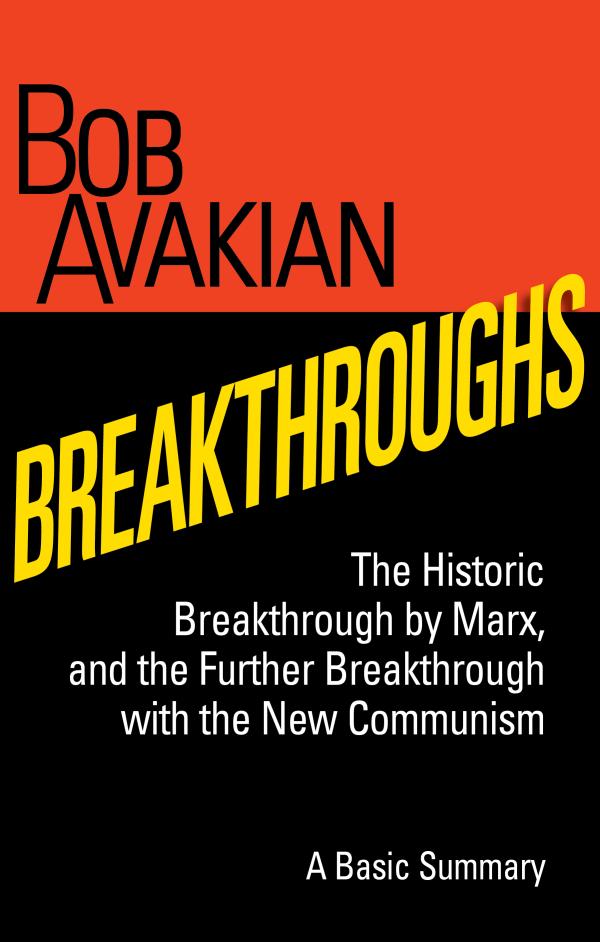



Bob Avakian on Social Media:


Interviews with Bob Avakian:

"Humanity Does Not Have To Live This Way" (2025)
Up Close and Personal with Bob Avakian, Heart and Soul & Hard-Core For Revolution (2022)
Also available at revcom.us: