The title of this article is an echo—and refutation—of this famous passage from the Declaration of Independence:
We hold these Truths to be self-evident, that all Men are created equal, that they are endowed by their Creator with certain unalienable Rights, that among these are Life, Liberty, and the Pursuit of Happiness—That to secure these Rights, Governments are instituted among Men, deriving their just Powers from the Consent of the Governed.
As I will show in this article: Every major part of this statement, and this statement as a whole, contains inventions and distortions of reality and history, which have been utilized in the service of real and repeated atrocity, on the part of those who have “governed” this country, throughout its history.
On the most obvious level, there is the striking hypocrisy of signers of the Declaration of Independence, many of whom were slave-owners—including Thomas Jefferson, the author of this Declaration. (The main author of the U.S. Constitution, James Madison, was also a slave-owner, and the same is true of four of the first five presidents of this country: Washington, Jefferson, Madison and Monroe.) As further graphic illustrations of the glaring hypocrisy of prominent people in the American Revolution, along with Patrick Henry, who proclaimed “Give me liberty, or give me death,” while he himself was a slave-owner, there is also the example of Richard Henry Lee, who conducted a public parade in Virginia denouncing the British-imposed Stamp Act’s “chains of slavery,” while he literally used his slaves to hold the protest banners!1
Rights Do Not Come From (Are Not “Endowed By”) “God.”
At the same time, the problem with the Declaration of Independence involves more than just glaring hypocrisy—so let’s take apart the famous statement from this Declaration that I included at the beginning.
First of all, there is the basic fact that rights are not “endowed” by “god”—for the simple reason that there is no god. But, if it were true that a god (or gods) existed—and that rights come from some “god”—there would be the big question of which “god” supposedly “endows” people with these rights: the “god” of the Christian Bible...or the “god” (Allah) of Islam...or some other “god?” (In my book, Away With All Gods!—Unchaining The Mind And Radically Changing The World, I analyze in depth the terrible and bloodthirsty oppression that is advocated by the writers of the Bible, speaking in the name of the Judeo-Christian “god,” and by Muhammad, author of the Qur`an, speaking in the name of Allah. The barbaric things advocated in these scriptures include slavery, the forceful subjugation of women, and other atrocities. So, those “holy scriptures” and the “god” they speak of, can in no way be considered a source of what any decent person would consider basic rights.2)
But let’s move ahead from that, because there are other, fundamental ways in which what is set forth in the Declaration of Independence is a basic distortion of history and reality, which has served as rationalization for terrible atrocity. In this regard, it is critically important to understand scientifically the emergence and development of human beings and human society.
To “Secure Rights” Is Not The Reason, Or Basis, For The Establishment Of Governments
In the actual history of humanity, as human beings first came into being as a result of natural evolution, they existed in small groups that lived by hunting and gathering food (and other basic necessities). After thousands of years, owing to environmental and other changes, human societies emerged that were based on settled populations carrying out farming and related activities, which produced a surplus beyond what was immediately needed to meet the basic requirements of life. Together with this, there arose class and other social divisions and antagonisms, which often included the seizing of people as slaves and subjecting them to forced labor, as well as the oppressive male supremacist division between men and women. (In a previous article, speaking to why revolutionary socialist state power is crucial, and emancipating, I explained this: Antagonistic social divisions refers to a situation where the basic interests of one part of society require that the basic interests of other parts of society be fundamentally suppressed. This is the case in all systems based on exploitation, including capitalism as well as slavery—and it is the case, in a fundamentally different way, in socialist society, where attempts by part of society to exploit others are suppressed and prevented, and the corresponding exploitative outlook is criticized and struggled against.)3
Together with—and as a means of enforcing—exploitation, oppressive social division and antagonism, there arose not just governments, but more specifically states: state power, exercised as the dictatorship of the economically dominant class in society, controlling and wielding a monopoly of political power, and more especially a monopoly of “legitimate” violence, embodied in the armed forces, police, and other institutions which enforce this rule of the economically dominant class, as violently as deemed necessary. (As I also explained in the article on why revolutionary socialist state power is crucial and emancipating: The economically dominant position of a particular class, in a society marked by class divisions, is based on that class’s ownership and control of the major means of production—including land, raw materials and other resources, technology, physical structures that are involved in production, and so on—and its exploitation of masses of people who do not own these means of production.)
This has been the history of humanity for thousands of years, through different forms of exploitative and oppressive society, including slavery, feudal monarchies (with large land-holding lords exploiting impoverished serfs working the land), and capitalism, where dictatorship is exercised by the economically dominant capitalist class.
Under these systems based on exploitation and oppression, if the masses of people have any “rights,” these are dependent on, conditioned and restricted in accordance with, the basic interests and dictates of the ruling class.
Returning again to the situation that gave rise to the American Revolution (250 years ago), in basic and essential terms this involved the increasingly antagonistic conflict between two different exploitative and oppressive forces: on one side, the British empire, headed by a king, and on the other side, American slave-owners, along with merchants and other elements of the developing capitalist class. As I stated clearly in my recent work HUMANITY ON THE BRINK:
At the beginning of this country, at the initiation of the war of independence (which they like to call a revolutionary war), it was declared that “all men are created equal.” But the whole history of this country from that time forward has proven that it is definitely not the case within this country that there is equality for all. Even at the time when the Declaration of Independence and then the Constitution were written, there were huge numbers of slaves. There were Native Americans whose land was being stolen and who were being subjected to genocidal atrocity. There were women who basically had no rights, and certainly none equal to men. ... [P]eople without property ... didn’t have the same rights as rich men.
As a basic summation of this situation (once again from HUMANITY ON THE BRINK): “There was, in short, a system of exploitation which was given further impetus by breaking free of British colonialism.”
At the same time, I emphasized that
[T]he point is not to "be nihilists—just thoughtlessly negating everything about the American Revolution and the founding documents of this country. As I’ve pointed to before, there are certain things in the U.S. Constitution, particularly in the Bill of Rights (the first 10 Amendments to the Constitution), which can be learned from—and I have incorporated some of this into a fundamentally different framework in the Constitution for the New Socialist Republic in North America. The point is that, despite some positive elements at the time of the founding of this country, it was even then a system of vicious exploitation and literally murderous oppression; and all this had within it the seeds and elements of where it has gone—to a terrible place, with the system of capitalism-imperialism now."4
The point is that the “individual rights” that were supposedly “guaranteed” in the Constitution of the “United States” were, at the beginning and for some time, explicitly restricted to certain parts of society, while others were excluded from those rights, to varying degrees and with varying degrees of force and brutality. And, as I also wrote in HUMANITY ON THE BRINK, drawing from a statement by Karl Marx about the character, and the limits, of individual freedom under capitalism:
It is often celebrated about capitalism that it gives qualitatively greater scope to the individual than systems like feudalism (to say nothing of outright slavery), where the positions and the restraints on individuals are much more fixed and frozen. Marx is getting at the fact that, while this is a real difference with feudalism, it is nevertheless the case that, within the exchange relations of capitalism (fundamentally rooted in its economic/production relations) the “independence” of individuals is not nearly as real, or as expansive, as it appears, and in the end it is essentially illusory: people are still confined within and conditioned by the fundamental relations of the system.5
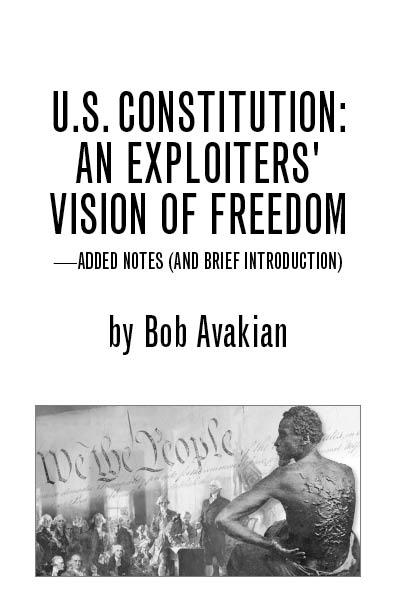
This basic understanding applies as well with regard to what is often proclaimed as the most basic right in a capitalist (bourgeois) democracy: the right to vote. As I have analyzed here (and extensively in other works), what essentially exists in capitalist democracy is the rule—the dictatorship—of the capitalist class (the bourgeoisie). Voting in this system does not negate, or do away with—but in fact is incorporated within and actually serves—the dictatorship of the ruling capitalist class. The following, from U.S. Constitution: An Exploiters’ Vision Of Freedom, makes this clear:
[A]s for voting, as I pointed out in Democracy: Can’t We Do Better Than That?:
On the most obvious level, to be a serious candidate for any major office in a country like the U.S. requires millions of dollars—a personal fortune or, more often, the backing of people with that kind of money. Beyond that, to become known and be taken seriously depends on favorable exposure in the mass media (favorable at least in the sense that you are presented as within the framework of responsible—that is, acceptable politics)…. By the time “the people express their will through voting,” both the candidates they have to choose among and the “issues” that deserve “serious consideration” have been selected out by someone else: the ruling class….[emphasis added]
But that is not all:
If, however, the electoral process in bourgeois society does not represent the exercise of sovereignty by the people, it generally does play an important role in maintaining the sovereignty—the dictatorship—of the bourgeoisie and the continuation of capitalist society. This very electoral process itself tends to cover over the basic class relations—and class antagonisms—in society, and serves to give formal, institutionalized expression to the political participation of atomized individuals in the perpetuation of the status quo....[T]he very acceptance of the electoral process as the quintessential political act reinforces acceptance of the established order and works against any radical rupture with, to say nothing of the actual overturning of, that order. [emphasis added]
At the same time, moving to basically rob people of the right to vote—as is being done by the fascist regime in this country with regard to Black people—represents the attempt to exercise undisguised and unapologetic dictatorship over those denied this right. This is a country with a long history of viciously and violently denying Black people the right to vote—and the fascist regime in power is determined to once again sabotage this right, along with other rights that Black people have gained through determined struggle. (This basic robbing of the right to vote for Black people today has been done by the fascist-dominated Supreme Court, gutting the Voting Rights Act of 1965, resulting in the fact that Black votes, particularly in the southern states, have been rendered ineffective through the elimination of voting districts that have involved a concentration of Black people and merging them with districts where Black people will be outnumbered by “conservative” white people. This has awful significance, especially in the “American South,” with its particular history of slavery and then brutal segregation and Ku Klux Klan terror.)
A recent article, at revcom.us—“The Fascist Rush To Rig The 2026 Election: Decimating The Black Vote and Terrorizing Election Workers—What to do… and what not to do”—speaks to the significance of the Supreme Court’s gutting of the Voting Rights Act, as does Part 1 of this series on the Declaration of Independence, “Profound Inequality, Brutal Oppression—and Crude Distortion of the Actual Foundation and Nature of this Country,” which includes (at the end of the footnotes) this important conclusion: “the moves by Republican-dominated legislatures across the South to gerrymander voting districts (specifically eliminating districts with heavy Black populations) is in a real sense another application of the Republicans’ 'southern strategy' to enforce and benefit from white supremacy.” The Republicans' “southern strategy,” which they have applied since the 1960s, is a direct appeal to white supremacy—to the racism of white people, particularly (though not only) in the southern states, who are enraged that Black people are not “staying in their place.”
As I have emphasized before, what is required in this kind of situation is, at one and the same time, an understanding of the very terrible thing that is involved in ripping away the right to vote, and accordingly the need to vigorously defend this right, while at the same time understanding the actual role of elections under this system, and the importance of not reinforcing the rule of this system by becoming trapped within, and acting in accordance with the “logic” and dynamics of, its electoral process.
The Problem—and the Solution: A Scientific Approach
In all this, what is crucially important is to be consistently scientific: applying the scientific method and approach of dialectical and historical materialism, which, as applied to human society and its historical development, involves analysis of the basic contradictions—the relations, dynamics and “laws of motion”—of different societies as they have emerged, developed, and in turn given rise to other forms of human society, often as a result of revolutions that overthrew the old system and established a new system in its place.6
What is especially important to understand, scientifically, is this: with all the very real changes that have been brought about through revolutions in previous periods of history (such as the American and French revolutions of the late 18th century), what was essentially involved was the overthrow of one system of exploitation and oppression (such as a feudal-monarchal system) and the establishment of a new system of exploitation and oppression—including capitalism, which through the American Revolution, beginning in 1776, rose to the ruling position together with the system of slavery centered particularly in the southern states. What is radically different now is that the revolution that has become possible, and urgently necessary, is a revolution—the communist revolution—whose fundamental aim is to do away with all exploitation and oppression, everywhere.
With the method of dialectical and historical materialism, it is possible to understand scientifically why and how the “rights” that have—and have not—existed as a result of the American Revolution correspond to the fundamental nature of the system that emerged through the triumph of that revolution.
By applying dialectical and historical materialism, it is also possible to understand scientifically why there have been significant changes in this country over the 250 years since the Declaration of Independence was proclaimed. Obviously, a profound change was brought about through the abolition of slavery as a result of the Civil War in the 1860s. But what is the fundamental reason this Civil War came about, and why did it finally lead to the abolition of slavery? It is not that Abraham Lincoln just decided to wage the Civil War, on behalf of the Union, and then just decided to “free the slaves.” In basic terms, the Civil War arose because, over the course of nearly 100 years since the founding of the “United States” of America, changes within the country (and in the larger world) resulted in the fact that the two different economic systems (modes of production) that had existed within this country from the beginning, went from mainly reinforcing and benefitting each other to becoming fundamentally antagonistic (the basic interests of the one required the defeat of the other). In this particular case, the basic interests of the southern states, whose economies were based on slavery, required that they separate from the northern states, form an independent country and deal with the rest of the world on that basis; while the basic interests of the northern states, whose economy was based on a developing capitalism, required restricting the spread of slavery and maintaining the country as a whole, including the southern states, under one government—and, through the course of the Civil War, it became clear that the basic interests of the northern states required the abolition of slavery.
On the one hand, the defeat of the Confederacy did result in the preservation of the country as a whole, with slavery outlawed. But, at the same time, after a brief period of Reconstruction (beginning in the mid-1860s, with the end of the Civil War), which provided certain basic rights for Black people, this was reversed only a decade later, with Black people subjected once more to the vicious exploitation of white plantation owners (many of them former slave-owners) and the terror of the Ku Klux Klan and the power structure in the South in particular, with the collaboration of the ruling capitalist class as a whole.
Why did this happen? As I analyzed in Breakthroughs, this was the only way the capitalist class centered in the North could maintain the USA as one unified country:
[T]hey had to put the country back together as a whole country, and the only way they could do that, given the prevailing production relations and social relations, was to make all kinds of “principled compromises,” once again, with the Southern aristocracy, the large landowners, who were, to a very large degree, former slave owners. So this is why Reconstruction was reversed, before very long after the Civil War, and the masses of Black people were betrayed again.7
Since that time, there have been significant changes in the situation of oppressed people in this country—significant concessions have been made to the struggle against the oppression of Black people, women, LGBT people and others—even as this oppression continues overall, since all this has remained within the confines of this system of capitalism, which has now become an international system of exploitation, capitalism-imperialism, and which has all this oppression built into it.
As I have examined in other works, these concessions—this extending of certain rights, particularly in the decades following the end of World War 2 (in 1945)—as much as they resulted from the heroic struggle and sacrifice of masses of people, have also been based on the needs of the ruling class of this country, in terms of the functioning of the economy and the stability of rule of the capitalist-imperialist system, in the context of international competition and rivalry. And now, a section of that ruling class—a fascist section—has emerged and risen to power which is determined that reversing much of these gains, and trampling on basic rights and legal principles, within the country and internationally, is necessary for the maintenance of this system within the country and its dominant position in the world, in the face of serious challenges, especially from China. (Shortly after the death of Mao in 1976, socialism in China was overthrown and capitalism restored, and in the decades since then China has developed as an increasingly powerful capitalist-imperialist country.)8
From all this, it should be clear: With regard to whatever rights different sections of society did, and did not, have within different systems, and within different historical periods—none of this was “endowed by” some “god”—nor was it the case that governments, and more specifically states (dictatorships), were established to guarantee these rights—nor have governments derived their powers from the consent of the governed. Rather, governments—and in particular states (dictatorships)—have arisen, and exercised their rule in society, fundamentally in correspondence with the particular mode of production that has come into being as the basic foundation of society; and both the rights and the denial of rights for the people who are governed, are, of necessity, in accordance with the interests of the ruling class (as determined by its political representatives).
All of this, once again, is fundamentally grounded in the basic economic way of life (the mode of production), the relations of production of that mode of production (for example, slave or capitalist relations of production) and the social relations which, of necessity, correspond to those relations of production.9
In this light, it can be seen how the Declaration of Independence—and the distortions it contains—have been used to “justify” all manner of vicious oppression and atrocity: legitimizing government (and in particular the state) ruling over and oppressing masses of people, on the basis that this rule is supposedly an expression of the will of some “god”—or that, in any case, this government has been founded on and maintains its legitimacy, with all its terrible crimes against humanity, on the basis that it supposedly exists through the consent of those it exploits and oppresses (“the governed”).
(The American Crime series at revcom.us, chronicles and analyzes in depth the war crimes and crimes against humanity continually committed by the U.S., throughout its history and throughout the world, as well as “at home.”)
Significantly, the following from the Declaration of Independence (which comes immediately after what I quoted at the start of this article) is something that the ruling fascist regime (and, for that matter, more “mainstream” representatives of the ruling class) will not wish to see applied to the rule of their system of capitalism-imperialism:
[W]henever any Form of Government becomes destructive of these Ends [providing basic rights, and deriving its power from the consent of the governed] it is the Right of the People to alter or abolish it, and to institute new Government, laying its Foundation on such Principles, and organizing its powers in such Form, as to them shall seem most likely to effect their Safety and Happiness.
Leaving aside the somewhat archaic (outdated) use of language, and the unscientific terms, of this passage—which reflect the limitations of the time and the outlook of the signers of the Declaration of Independence—the fact is that not only the form of capitalist government (actual dictatorship) ruling in this country, but the underlying, exploitative mode of production and oppressive social relations that this dictatorship enforces, have become destructive of the basic interests—and indeed pose a growing threat to the very existence—not just of people in this country but of humanity as a whole. And what is sharply posed now is the urgent necessity, as well as the actual possibility, of a far more radical, deep-going and fundamentally emancipating revolution: the communist revolution.10
Through this revolution, with the achievement of the final goal of communism, worldwide, a whole new concept and whole dimensions of freedom will become possible, far beyond the narrow horizons of capitalism (and all other systems of exploitation).
In the next part (3), I will further examine and refute rationalizations for outmoded systems and their real and repeated atrocity.
_______________
FOOTNOTES:
1. My article “The American Enterprise—Property and Slavery, Peculiar Notions of ‘Freedom’ and Profound Contradictions” (which is available in BA’s Collected Works at revcom.us) includes the following:
In his book A Slaveholders' Union, Slavery, Politics, and the Constitution in the Early American Republic, George William Van Cleve captures, with biting and incisive irony, a contradiction which in fact gets to the very essence of this country and its posturing as the champion and model of freedom. Here is what Van Cleve writes about the very foundations, and "founding fathers," of the United States of America:
Consider, for example, the conduct of Richard Henry Lee, the Virginia leader who moved the formal congressional resolution declaring American independence in June 1776. There is no evidence that Virginians thought it ridiculous for Lee to conduct a public parade in Virginia against the Stamp Act's "chains of slavery" while literally using his slaves to hold his protest banners. ...leaders such as Lee and Patrick Henry, like [American] Revolutionary leaders in other major slave colonies, saw their state's untrammeled ability to control slavery as a central part of what the Revolution was about. [back]
2. In Part One of Away With All Gods, the section “The Bible, Taken Literally, Is a Horror,” contains a fuller accounting of the truly monstrous crimes that are “not just upheld, but advocated, commanded and celebrated” in the Bible. And in Part Two, the section “Islam Is No Better (and No Worse) Than Christianity” analyzes how the Qur’an advocates the same kinds of terrible oppression and atrocity that are found in the Christian Bible. [back]
3. The article ANSWERING IGNORANT AND IDIOTIC IDEAS, Part 2: “Only with Revolutionary Socialist State Power Can a Truly Emancipating Society Actually Exist,” is available at revcom.us. Part 1, “Yes—There Is Objective Truth—and It Is Possible To Know What Is True,” is also available at revcom.us. [back]
4. HUMANITY ON THE BRINK: A Forced March Into the Abyss, or Forging a Way Forward Out of the Madness? is available at revcom.us, and online at Google Books and The Internet Archive. [back]
5. The following is the longer passage from HUMANITY ON THE BRINK speaking to the character, and limitation, of individual freedom under capitalism, part of which is quoted above, in the main body of this article:
Here is a very important statement by Marx, from the Grundrisse—one of his major works—as cited in Ruminations and Wranglings:
In the money relation, in the developed system of exchange (and this semblance seduces the democrats), the ties of personal dependence, of distinctions of blood, education, etc. are in fact exploded, ripped up (at least, personal ties all appear as personal relations); and individuals seem independent (this is an independence which is at bottom merely an illusion, and it is more correctly called indifference), free to collide with one another and to engage in exchange within this freedom....
This is a way of elaborating on what Lenin was pointing to in emphasizing that capitalism forces people to calculate with the stinginess of a miser. Particularly important in this statement by Marx is the analysis that this “independence” of people under capitalism is really “an illusion,” which “is more correctly called indifference.” It is often celebrated about capitalism that it gives qualitatively greater scope to the individual than systems like feudalism (to say nothing of outright slavery), where the positions and the restraints on individuals are much more fixed and frozen. Marx is getting at the fact that, while this is a real difference with feudalism, it is nevertheless the case that, within the exchange relations of capitalism (fundamentally rooted in its economic/production relations) the “independence” of individuals is not nearly as real, or as expansive, as it appears, and in the end it is essentially illusory: people are still confined within and conditioned by the fundamental relations of the system. [back]
6. In HUMANITY ON THE BRINK, there is the following basic explanation of dialectical and historical materialism:
In basic terms, materialism is the recognition that all of reality consists of matter, and nothing else—no supernatural forces or beings, nothing which does not have real, material existence (as one important expression of this, human thought is itself the result of real material processes within human beings, especially their nervous systems and in particular their brains, in interaction with the larger material world). Dialectics refers to the fact that material reality (including human society) is not static but is full of contradiction, is constantly changing, and in certain circumstances can undergo a major, qualitative change (from one form of matter to a qualitatively different form—like the everyday experience where water that is boiled becomes steam; or when a new species emerges in the process of natural evolution; or when a revolution in human society brings into being a qualitatively new system—for example, when socialism results from the overthrow of capitalism). Historical materialism is the application of dialectical materialism to the development of human society (as well as nature generally). [back]
7. Breakthroughs: The Historic Breakthrough by Marx, and the Further Breakthrough with the New Communism, A Basic Summary is available as well at revcom.us. [back]
8. Further analysis concerning the reasons for these changes, with regard to the rights of different people who have been oppressed historically in this country, is contained in HUMANITY ON THE BRINK, as well as Breakthroughs and the book THE NEW COMMUNISM, The science, the strategy, the leadership for an actual revolution, and a radically new society on the road to real emancipation. [back]
9. Why and how the dominant social relations and culture, as well as the political system, in any society, must in fundamental and ultimate terms correspond to the mode of production is analyzed in depth in HUMANITY ON THE BRINK, Breakthroughs, and other works available at revcom.us. [back]
10. In Part 2 of ANSWERING IGNORANT AND IDIOTIC IDEAS, I examined in depth why the establishment and maintenance of socialist state power (the dictatorship of the proletariat, the exploited class under capitalism, whose emancipation from exploitation requires the abolition of all exploitation and oppression, everywhere) is necessary for the final achievement of communism, on a worldwide basis. As I analyzed in that article:
Only with revolutionary socialist state power can a truly emancipating society actually exist, be sustained, and advance toward the fundamental goal of abolishing and uprooting exploitation and oppression, everywhere, with the achievement of communism, throughout the world. [back]