Celebrate 250 Years of America? NO! America Was NEVER “Great”
We Need an Emancipating Revolution!

Updated

This year, the 250th anniversary of the founding of the United States, will see an ugly torrent of red-white-and-blue celebrations of America as a “great country”—spearheaded by Donald “Make America Great Again” Trump. This is a celebration of America now led by fascists. But the truth is that America was NEVER “great,” whoever was heading up the government. 

As revolutionary leader Bob Avakian said, if people are stung by that truth about America, they need to look at reality:

This “Republic” to which we are supposed to pledge allegiance was founded on slavery and genocidal robbery: keeping millions of Black people in chains for generations... killing off huge numbers of Native Americans and stealing their land... waging a war that ripped off half of Mexico, greatly expanding slavery.

So, was this a great country all during that time—when millions of people were enslaved—owned by bloodsuckers who constantly whipped the slaves to make them work harder under horrific conditions, slave-owners who raped masses of enslaved women? Was this country great then?!

Was it great when, for generations after slavery was formally ended, Black people as a whole were segregated, discriminated against, and continually terrorized, with repeated massacres of Black people and thousands of Black people lynched? Was it great when, all during that time, LGBT people were “illegal,” when women were legally treated as inferior to men—and men could legally rape their wives? Was it a great country then?!

Or is it great, now, when people are everyday denied basic rights? When the police kill a thousand people every year, especially people of color, and in the 60 years since Civil Rights Acts were passed, segregation and discrimination has remained as bad, or worse, as it ever was, and thousands of Black people have been killed by police—even greater numbers than all those who were lynched during all the years of Ku Klux Klan terror after the Civil War!

Has this country ever been great, when, right from the beginning and down to today, the whole thing has literally been built on the broken bodies, the blood and bones, of millions and now billions of people, worldwide—cruelly exploited, used and abused, by this system—with all this backed up by murder on a massive scale carried out by the police and the armed forces of this country?

No, this country has never been great. It has always been a horror for masses of people. 

(from social media message REVOLUTION #2: When has the U.S. been a “great country”?)

It’s way past time for this system—capitalism-imperialism—that rules in this country, dominates the world and now has spawned fascist rule, to be thoroughly abolished, through an actual revolution.

Below is Part 4 of a series that highlights aspects of how 250 years of America has been nothing but a horror for the masses of people, here and around the world. We call on our readers to send in your contributions to this series—articles, video, audio, artwork, social media posts. Email revolution.reports@yahoo.com or message @therevcoms via social media.

See also: 

Part 4: American Crime Case #6: Lynching in America—
The Torture, Mutilation and Murder of Thousands of Black People and the Terrorizing of Millions More, 1865-1950

Duluth, Minnesota, three black men were lynched for the alleged rape of Irene Tuskin, a white woman, while a crowd of thousands watched.


June 15, 1920, Duluth, Minnesota: three Black men lynched for the alleged rape of Irene Tuskin, a white woman, while a crowd of thousands watched.

Read the transcript of this excerpt here

THE CRIME:

For over 100 years, from the Civil War period into the 1950s and beyond, thousands of Black people have been lynched in America. Lynchings are violent, public acts of torture, often mutilation, and murder, carried out by white people to terrorize and traumatize Black people. They are lawless actions, often carried out in broad daylight, with thousands taking part and none of the lynchers getting arrested or punished. Cops and government officials often took part.1

When people think of lynching, they think of people being hung from trees or poles. This was part of what took place, but lynchings were also carried out by beating or torturing Black people to death, or shooting them down. Innocent people were even lynched by being burned alive, dragged behind cars, or thrown off bridges.

Black men, women, and children were lynched—sometimes whole families. Sometimes hundreds were massacred and whole towns or neighborhoods destroyed. A few examples:

Tulsa, Oklahoma. In 1921, the Greenwood District of North Tulsa was a self-sufficient, relatively prosperous Black neighborhood known as “Black Wall Street.” On May 31, after false rumors of a Black man assaulting a white woman were spread, a white lynch mob gathered outside the courthouse jail where he was being held and demanded that he be turned over to them. Around 10 p.m., 75 armed Black men, including military veterans, came from Greenwood to the courthouse to protect the man from the mob, which had grown to about 1,500, many of them armed. Gunfire erupted, and in a few seconds about a dozen men were killed or wounded. The outnumbered Black men began a fighting retreat back to Greenwood. Sheriffs swore in more than 500 whites as “Special Deputies” to hunt Black people. The rest of that night Black people were killed and Black businesses and homes burned. Early the next morning a white mob of many thousands, including 150 Tulsa police, surrounded and stormed Greenwood. Forty square blocks of Greenwood burned to the ground, destroying 1,256 homes, businesses, schools, churches, and other buildings. Armed Black people resisted fiercely but were badly outnumbered. As many as 300 people (Black and white) were killed. 2

Elaine, Arkansas. On the night of September 30, 1919, Black sharecroppers were organizing against the bitter poverty they were forced to live and work in. White landowners found out about their efforts and unleashed a lynch mob which massacred at least 200 Black people, perhaps many more. Afterward, some 300 Black people were arrested, but not a single white person was ever arrested or prosecuted.3

Rosewood was a small, self-sufficient Black town in rural Florida. During the first week of January 1923, a white lynch mob attacked and destroyed the town. At least six Black people were killed, but eyewitnesses claim the death toll was much higher, anywhere from 27 to 150.4

Most of those who were lynched were never accused of or charged with any crime. They could be murdered because someone said they assaulted a white person, or approached or just whistled at a white woman. Black people were lynched for demanding basic rights and fair treatment. Many were murdered for minor violations of “Southern manners”—manners which demanded Black people always act like they were totally beneath white people:

  • In 1940, Jesse Thornton was lynched in Luverne, Alabama, for referring to a white police officer by his name without the title of “mister.”
  • In 1918, Private Charles Lewis was lynched in Hickman, Kentucky, after he refused to empty his pockets while wearing his Army uniform.
  • Richard Wilkerson was lynched in Manchester, Tennessee, in 1934 for allegedly slapping a white man who had assaulted a Black woman at an African American dance.
  • White men lynched Jeff Brown in 1916 in Cedarbluff, Mississippi, for accidentally bumping into a white girl as he ran to catch a train.
  • In 1917, Sam Gates was lynched for the offense of “annoying white girls” in England, Arkansas.

Lynching Carnivals

These were not secret acts, but part of public life in the South. Sometimes thousands, and sometimes virtually the whole white community, would attend pre-announced lynchings. These were often day-long celebrations with a carnival atmosphere. Families came with picnic baskets, vendors sold food, and photographers documented the occasion—selling pictures of the lynching as postcards. Sometimes the victim’s body parts were sold as “souvenirs.” Here’s one example:

In 1904, after Luther Holbert allegedly killed a local white landowner, he and a Black woman believed to be his wife were captured by a mob and taken to Doddsville, Mississippi, to be lynched before hundreds of white spectators. Both victims were tied to a tree and forced to hold out their hands while members of the mob methodically chopped off their fingers and distributed them as souvenirs. Next, their ears were cut off. Mr. Holbert was then beaten so severely that his skull was fractured and one of his eyes was left hanging from its socket. Members of the mob used a large corkscrew to bore holes into the victims’ bodies and pull out large chunks of “quivering flesh,” after which both victims were thrown onto a raging fire and burned. The white men, women, and children present watched the horrific murders while enjoying deviled eggs, lemonade, and whiskey in a picnic-like atmosphere.

Lynchings were so widespread that Southern white children played it as a game. It was called “Salisbury,” probably named for a series of lynchings in Salisbury, North Carolina, in 1902 and 1906.5

The Equal Justice Initiative found that there were 4,084 racial terror lynchings in 12 southern states between the end of Reconstruction in 1877 and 1950, and another 300 in other states.6

Campaign of Mass Terror with Lasting Impact to this Day

All Black people, especially in the South, lived under the threat of lynchings—for the smallest excuse or for no excuse at all. This traumatized and terrorized all Black people.

The great author Richard Wright was born in Mississippi and knew of two men who were lynched—his step-uncle and the brother of a neighborhood friend. In his book Black Boy, Wright wrote:

The things that influenced my conduct as a Negro did not have to happen to me directly; I needed but to hear of them to feel their full effects in the deepest layers of my consciousness. Indeed, the white brutality that I had not seen was a more effective control of my behavior than that which I knew.

THE CRIMINALS

  • No branch of the U.S. government—North or South, including the courts, the legislatures, and the executive branches—at the federal, state and local levels did anything to stop the horror of lynching. Fewer than one percent of lynch mob participants were ever convicted by local courts and they were rarely prosecuted or brought to trial.
  • White vigilante terror groups such as the Ku Klux Klan—KKK.
  • The many thousands of white people who took part in lynchings, celebrated them, or remained silent in the face of them.
  • Northern academics who promoted bogus “scientific” theories that Black people were inferior to whites—which some continue to do to this day.
  • The U.S. Congress, which refused to pass any laws against lynching until 2021 (!), despite the fact that bills outlawing lynching had been introduced as far back as 1900.
  • Leading U.S. officials, including U.S. presidents, who openly promoted racism and white supremacy. For example:
  • In his 1867 annual message to Congress, President Andrew Johnson declared that Black Americans had “less capacity for government than any other race of people,” that they would “relapse into barbarism” if left to their own devices, and that giving them the vote would result in “a tyranny such as this continent has never yet witnessed.”
  • In 1897, Rebecca Latimer Felton, the wife and campaign manager of a U.S. Congressman, argued that one of the great problems in American society was that men were not providing adequate attention to “white women’s vulnerability to the Black rapists” who were supposedly roaming the rural South. “The fault, she declared, lay with southern white men. They had failed to put a ‘sheltering arm about innocence and virtue.’” She concluded that “if lynching was required ‘to protect women’s dearest possession from the ravening human beasts—then I say lynch, a thousand times a week, if necessary.’”7
  • In 1906, President Theodore Roosevelt declared that “the greatest existing cause of lynching is the perpetration, especially by Black men, of the hideous crime of rape.”
  • In 1915, President Woodrow Wilson, a Democrat, hosted a showing of the white-supremacist, pro-Confederate film Birth of a Nation in the White House. He praised the film, saying “this was like writing history with lightning.” It was the first film ever to be shown in the White House. His family, his Cabinet and the filmmaker D.W. Griffith attended.

THE ALIBIS

The main excuses white mobs used to justify lynching were claims that Black men had approached or sexually assaulted white women or that they had committed some crime—from murder to trivial offenses. Black people were lynched because they’d stepped out of their “place” under the thumb of white people by demanding basic rights, speaking out against mistreatment, or failing to totally subordinate themselves to white people, such as not stepping off the sidewalk to let white people pass or even looking white people in the eye. And many Black people were lynched for no reason at all other than being in the wrong place at the wrong time.

Lynchings were more formally justified by government and the media as necessary to control supposedly lawless Black people. As a 1905 investigative report put it: 

Lynching has been resorted to by whites not merely to wreak vengeance, but to terrorize and restrain this lawless element (sic) in the Negro population. Among Southern people, the conviction is general that terror is the only restraining influence that can be brought to bear upon vicious Negroes.

We won't comment on the bitter irony here that many white men routinely raped Black women and were almost never legally punished. Or that the accusation of lawlessness was being made by the very people who were engaged in horribly sadistic mob violence against people who had never been found guilty in a court of law!

THE MOTIVES

Why did the U.S. ruling class, as a whole, support lynching? Because shortly after the Civil War, the capitalist system in the U.S. made a leap to a new stage—to a worldwide system of imperialism, which divided up the entire globe among a handful of powers. The re-entrenchment of white supremacy in a new form, after the Civil War, formed an important element in the U.S. rise to major power status among these imperialists.

The cotton and tobacco produced by the bitterly exploited Black sharecroppers were the top cash crops of the U.S. from 1850 to 1890, and Black men who were arrested by Southern sheriffs on the flimsiest of charges and literally sold as slave labor built the industrial infrastructure of the South.

Lynching played a very important role in all this, and the U.S. ruling class backed them to the hilt. Sometimes lynchings were carried out for greed—to murder Black people and steal their land. (The Associated Press documented over 57 violent land-takings by whites.)

But the hellish social function served by lynchings was larger than this. Lynchings served to enforce the social and economic system in which Black people were chained to the land through terror, which played a crucial role in the functioning and strength of U.S. capitalism, and its rise as a global imperialist power.8

BAsics-1-1-554-en.jpg


Bob Avakian, "They're selling postcards of the hanging," clip from Revolution: Why It's Necessary, Why It's Possible, What It's All About, a film of a talk by Bob Avakian, a film of a talk.
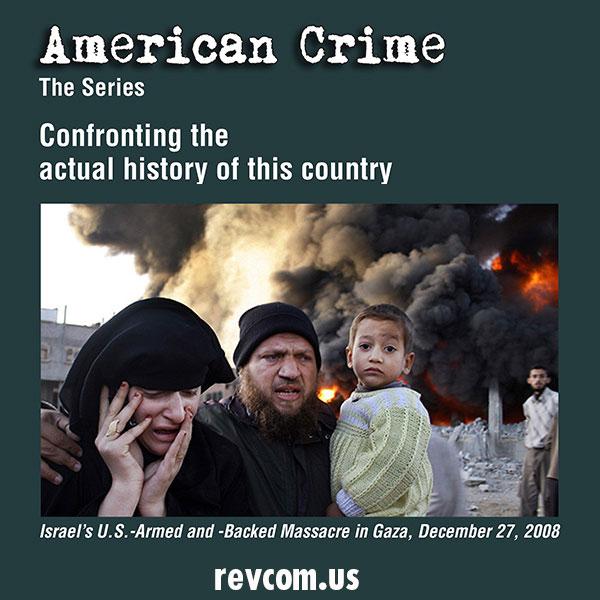
American Crime Ad for whole series with image of U.S. airstrike in Gaza.


_______________

FOOTNOTES:

1. Lynching in America: Confronting the Legacy of Racial Terror, Third Editiona report from the Equal Justice InitiativeWhat Are Lynchings? NAACP.org. [back]

2. American Crime Case #12: The 1921 Tulsa Massacre and the Destruction of Black Wall Street, revcom.us, January 20, 2020. [back]

3. American Crime Case #9: The 1919 Massacre of Black Sharecroppers in Elaine, Arkansas, revcom.us, October 19, 2020. [back]

4. The Rosewood Massacre, Wikipedia. [back]

5. Susan Barringer Wells, A Game Called Salisbury: The Spinning of a Southern Tragedy and the Myths Of Race (2d ed. 2010), cited in Lynching in America: Confronting the Legacy of Racial Terror. [back]

6. The number of racist terror lynchings does not include hangings and mob violence that followed some criminal trial process. We also distinguish terror lynchings from racial violence and hate crimes that were prosecuted as criminal acts. Between 1849 and 1928, there were also hundreds of lynchings and instances of racist violence targeting Mexican Americans and Mexicans in the border states of the South and Southwest. In the West, between 1850 and 1900, Chinese immigrants were also subjected to lynch-mob pogroms. See American Crime Case #16: “La Matanza”: A Decade of Lynching & Terrorizing Mexican People in South Texas, 1910–1920, revcom.us, July 1, 2019; American Crime #67 - 1848-1900: Brutal Exploitation and Ruthless Oppression of Chinese Immigrants, revcom.us, February 13, 2017. [back]

7. The Rebirth of a Nation by Jackson Lears, cited in the talk by Bob Avakian, The Problem, the Solution, and the Challenges Before Us, revcom.us, August 31, 2017. [back]

8. See, “The Rise of the Lynch Mob” in The Oppression of Black People, The Crimes of This System and the Revolution We Need, revcom.us, October 16, 2021. [back]

We are at a turning point in history. The capitalist-imperialist system is a horror for billions of people here and around the world and threatening the very fabric of life on earth. Now the election of fascist Trump poses even more extreme dangers for humanity—and underscores the total illegitimacy of this system, and the urgent need for a radically different system.

The website Revcom.us follows the revolutionary leadership of Bob Avakian (BA), the author of the new communism. Bob Avakian has scientifically analyzed that we are in a rare time when an actual revolution has become more possible in the U.S. He’s charted a strategy for making that revolution, and laid out a sweeping vision and concrete blueprint for “what comes next” in the Constitution for the New Socialist Republic in North America.

Revcom.us projects BA’s voice, leadership, and vision throughout society. It posts his timely leadership for the revcoms (revolutionary communists) and the whole movement for revolution, including his social media posts, and curates his whole body of work. 

Our website applies the scientific approach BA has developed to analyze major events in society and the world—why they are happening, how they relate to each other, how all this relates to the system we live under, where people's interests lie, how revolution is in fact the solution to all this, and what the goals of that revolution are.

Revcom.us acts as a guiding and connecting hub for the revcom movement nationwide: showing what’s being done, digging into what’s right and what’s wrong, and rapidly learning—and recruiting new people into what has to be a rapidly growing force. As part of this, revcom.us feature and promotes the weekly The RNL—Revolution, Nothing Less!—Show on YouTube.com. 

Put it this way: there will be no revolution unless this website not only “keeps going” but rises to a whole different level!

DONATE NOW to revcom.us and get with BA and the revcoms!

Your donations contribute to:

If you are horrified at the Trump/MAGA fascism spawned by this system of capitalism-imperialism coming to power in the world’s top nuclear-armed superpower… outraged at the tremendous harm this fascism is perpetrating on people in this country and the whole world… hate the Dark Ages morality and Christian fascism that they are trying to forcibly impose…see the very existence of humanity being threatened by the increasing danger of nuclear war and destruction of the environment: Be part of supporting this revcom.us website that—now more than ever—plays a crucial role in exposing the system ruling over us and in leading people out of this madness to a radically different and far better future. 

See FIVE REASONS you should donate, spread the word about revcom.us, and urge your friends and others to donate and subscribe to this website.