June, 2025
While all eyes were on the war, the regime’s repressive apparatus quickly began to consolidate its power by engineering a full-scale police state. The U.S./Israeli military aggression against Iran has in effect created an environment for the Islamic Republic of Iran [IRI] to take the atmosphere of repression to a suffocating new height through comprehensive security measures and is trying to stifle any voice of protest in its infancy. This state of war is not a defensive response, but rather an active strategy of the regime that has no legitimacy to survive in the midst of the crisis by controlling a society and attempting to prevent the resurgence of protests.
It is in this context that, just hours after the ceasefire was announced [on June 24], there was news of an exponential increase in people being arrested. According to one news report, more than a hundred people were arrested in one day in Kermanshah [province] alone. Vehicle searches under the pretext of “finding drones and spy equipment” are a pretext for intimidation and mass arrests. The number of arrests since the start of the war has reached more than 1,000, and executions continue unabated even in the midst of the war. In just the first 11 days of the war, three people were executed on charges of spying for Israel. Judiciary spokesman Asghar Jahangiri made a blunt statement during Friday prayers in Tehran on June 20: “Our people demand punishment for the disruptors!” This is a green light for more widespread executions. He also said in a televised interview on Tuesday, June 24, that a meeting with the head of the judiciary had decided to make “necessary provisions” to establish special branches in prosecutors’ offices and courts across the country so that these courts could file legal cases against “enemy” infiltrators. Judiciary head Mohseni Ejei stressed that the cases would be handled “quickly and decisively” and take into account “wartime conditions.” Shortly afterwards, on Wednesday, June 25, three Kolbars [cross-border porters] were executed in [the city of] Urmia on charges of espionage.
The judiciary spokesman announced that a bill had been submitted to the parliament that would amend the law on “espionage” to broaden the scope of the law to encompass any movement. Afterwards, on July 2, [IRI regime-affiliated] Tasnim News Agency wrote: “The Islamic Consultative Assembly approved a two-step plan to increase the punishment of spies and collaborators” with the Zionist regime and hostile states, in order to “fill the existing legal vacuum.” This is a new tool to treat every protester—from ordinary people to journalists and photographers, and so on—as “spies.”
These laws are a means of legalizing the killing of political and social opponents. In such circumstances, even a protest post in cyberspace can become a pretext for the physical elimination of individuals. Draconian censorship, constant disruption of the internet, and blocking of news and communication flows are also part of this project that will cut off the connections among protesters, isolate individuals, and break ties in the struggle.
It is easy to see that this regime, out of fear of social explosion, is in the process of systematically eliminating its opponents. The IRI has intensified its attack on the people in the name of eliminating "infiltrators,” despite the fact that for decades, Israeli spies have been eavesdropping on IRI command centers, and Mossad agents [Israel’s secret police] have penetrated the most sensitive organs of the regime's military and security apparatus.
The repression is not just on the streets. The raids on the homes of the families of those killed in the 2022 [Woman, Life, Freedom] uprising, the warnings to journalists not to publish actual news, the deletion of reports are all indications of a government that knows that it will collapse if it does not lie. Progressive journalists today say that, from the IRI’s perspective, the danger posed by factual reporting is no less than the danger from bombs.
These actions make clear that the IRI is building a wartime police state.
This pattern is not unprecedented for the IRI. The high-water mark of IRI crimes came during the 1980s, coinciding with their war with Iraq, when it executed thousands of political activists and prisoners of conscience. Any dissenting voice was silenced with the threat of being stigmatized as having “colluded with the enemy” during the war. Today, the same scenario is repeated with an updated vocabulary (“infiltrator,” “spy”). Repression is not only a reaction to an external threat, but also the system’s built-in survival mechanism. Throughout its existence, its main weapon has been its willingness to suppress and fabricate lies. If its repression is met with only silence, the machine of repression can escalate to genocide.
But in the face of this monster of oppression, a life-giving phenomenon is growing—spontaneous popular solidarity of a people who shelter one another, provide medicine and treatment, support the downtrodden, form teams of different ages to give aid to people, etc. These are not just humanitarian actions. These are the cornerstones of new and inspiring relationships for the future society. This spontaneous solidarity can become broader and more organized and reach higher levels, both in terms of political awareness and how to confront the regime’s repressive apparatus. Therefore, organizing different segments of the people and linking their scattered struggles has become more vitally important today than ever before and has the potential to seriously change the balance of power in favor of the people and provide solid foundations for future battles against the regime of the IRI or any regime like it.
At such a juncture, political and social activists, especially students, have a historic responsibility—the task of organizing the scattered forces of the people, transforming empathy into a network, transforming fear into collective courage. They can be the intermediary link between the scattered strata: links between students and workers, between women and media activists, between the families of prisoners and the masses of the people as a whole; they can form cells to protect the lives of prisoners, to neutralize the machine of intimidation, and to raise awareness about all aspects of the criminality of the IRI and imperialist oppression, and the prospect of a future without them.
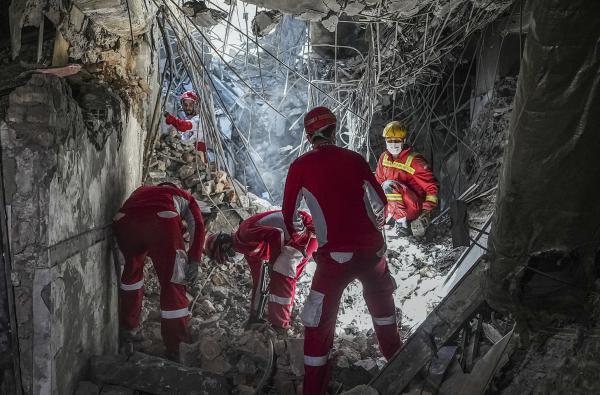
Rescuers search through the rubble of a damaged section of Iran’s Evin prison on June 24, 2025, the day after an Israeli airstrike. Photo: AP/Mostafa Roudaki
One of the urgent tasks today is to fight and organize for the immediate release of prisoners, especially political prisoners. The attack on Evin Prison by the fascist Israeli government on June 23, 2025,1 was not just a foreign attack. It was a wake-up call for the lives of political prisoners and a factor in intensifying the repression by the IRI. The regime had been warned many times before not to turn prisoners into hostages of war and to release them immediately. However, the IRI ignored these warnings and kept the prisoners in the heart of sensitive areas, while Israel, with full knowledge, bombed Evin Prison. The exact number of people killed in this attack is still unknown.2
By smashing Evin Prison, Israel did what the IRI had been planning for years: evacuate Evin and disperse the prisoners. This one act shows that there is no substantive difference between these two fascist regimes. After this attack and the smashing of Evin, the Israeli Foreign Minister shamelessly tweeted: “Long live freedom”! This also proved that Israel’s “freedom” is no different from the “freedom” of the IRI.
The IRI’s response to this attack was to transfer the men imprisoned in Ward 4 to the Greater Tehran Prison and the women prisoners to Qarchak Prison. It has been reported that Evin Prison has been evacuated. These transfers are not just a relocation—they are a purposeful attempt to break the solidarity within the prison against the IRI, to disperse families, and could even pave the way for secret repression or the physical elimination of some prisoners. In response, the families of the prisoners have courageously rallied in front of Evin Prison. This spark of solidarity must be met with a nationwide uprising of the people. Political prisoners are the people’s children—and their release is the duty of us all. The slogan “Political prisoners must be freed” should resound in the streets, universities, neighborhoods, and in front of the prisons. Now, rescuing political prisoners is not only a liberatory responsibility, it can also strike a mortal blow to the backbone of the IRI’s repression. If the people step up, these days could become a turning point in building revolutionary solidarity for the overthrow of the IRI.