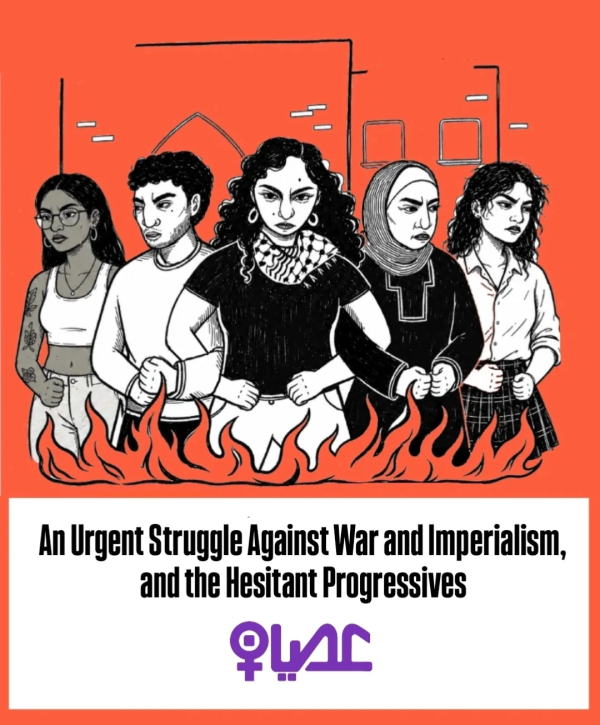
Graphic: OSYAN
All people need to rise up against the imperialist aggression of the U.S. and Israel against Iran—an aggression that, in its second round, has left thousands dead and several million displaced and unemployed, while threatening to push us back into the Stone Age. Those who seek the liberation of the people of Iran from the despotism, oppression, exploitation, and repression of the Islamic Republic [IRI] bear an even greater responsibility in this regard. For everything we hate about the IRI is a miniature reflection of the social, political, and ultimately economic relations of the global capitalist-imperialist order.
But the bitter reality is that some people do not oppose war and foreign intervention at all, while another section—although opposed to them—remains hesitant to express firm opposition and disrupt this political landscape. As a result, the most active opposition to this imperialist aggression has been ceded to the IRI, both inside and outside Iran, in varying proportions.
The problem with leaving this struggle to the IRI is not merely that it grants legitimacy to a repressive and anti-popular government. The reality is that, contrary to its claims, the IRI is fundamentally incapable of conducting this struggle on a genuinely anti-imperialist basis. The IRI is itself a regime dependent upon imperialism and therefore inevitably conducts this war and struggle within the framework of rivalries among global powers. In doing so, it turns our land into the terrain of that game and our people into its playing cards.
This is a situation that must be overturned and replaced by an active and broad-based resistance from below, animated by a genuinely anti-imperialist spirit. Anyone who cares even slightly about the future of ninety million people in Iran, and millions more throughout the region and the world—anyone who feels even the slightest sense of responsibility toward that future—must become part of organizing and amplifying this anti-war and anti-imperialist resistance.
With the rise of Trumpist fascism, U.S. imperialism has become a far more dangerous monster than before—even though the history of the U.S., from its founding onward, has been filled with conquest, genocide, slavery, and warmongering. Following the Second World War, when it established itself as the world's leading imperialist power, its record became saturated with coups, military interventions, political manipulation, and economic domination throughout the globe, particularly across the Global South….
This danger did not disappear with either the Twelve-Day War or the subsequent forty-day renewed assault. Rather, it has assumed increasingly unpredictable dimensions. You are reading these lines at a moment when, although we are formally in a period of ceasefire and negotiations continue, low-intensity warfare persists and a third round of even more severe military attacks on Iran looms on the horizon. The urgent question is: How should we oppose this aggression, and how should we organize against it?...
The Contradiction Between the U.S. and the Islamic Republic
The U.S.’ problem with the IRI has nothing to do with the reactionary and repressive nature of this regime toward its own people…. Therefore, U.S. actions against Iran can only be understood as part of the long history of colonial, neocolonial, and imperialist oppression imposed on the people of Iran, a history stretching back centuries. It is striking that despite the clarity of this imperialist history, the determining structures of global power, and the particular role that Trumpist fascism is playing in preserving U.S. hegemony, some sections of the IRI’s “left” opposition repeat the claims of Trump and other fascists, asserting that it is Iran that has been “waging war against America for forty-seven years.”
The IRI’s boasts about exporting the Islamic Revolution, its cries of “Death to America” and “Death to Israel,” its cultivation of proxy forces, and similar policies are all aimed at slightly improving its position within the existing system itself. This is a goal to which it has now moved somewhat closer through its leverage over the Strait of Hormuz. But it would be mistaken to conclude that the IRI has somehow transformed Iran into an imperialist country or launched a war against American imperialism. Although it has challenged certain U.S. interests to some extent, the principal challenger to the U.S. is Chinese imperialism. No matter how much the IRI may dream of building a Shi’a empire, Iran cannot become a superpower without a complete upheaval of existing global relations….
Contradictions within the Anti-War Front and What Is to Be Done
From the streets of Tehran, where state-organized nightly parades are taking place, to Belgium in the heart of Europe, bloodied flags of the IRI have been raised in opposition to aggression against Iran. In Iran, due to the absence of internet, only the regime has been able to broadcast its approved messages to the world: “Women without hijabs and opponents of the government have also come to the field to defend the homeland under the flag of the IRI.” This is while we know that many opponents of war and imperialism are either in the prisons of the IRI, recently arrested, or, because they refuse to stand under this flag, have been forced into isolation and inactivity, with no way to make their voices heard in the world.
But the situation in Europe and North America is different. Although many anti-war demonstrations with the flag of the IRI are organized and supported by regime agents and their affiliates, many honest and progressive people in these countries have also raised this flag to express their opposition to U.S. imperialist actions. They want to support Iran, not necessarily the government. And sometimes they ask: what alternative symbols can be used for this purpose? But the issue goes beyond introducing alternative symbols and flags. The issue is that the reactionary nature of the IRI’s resistance against imperialism is not properly understood, and some believe that the IRI, despite all its problems, is still an anti-imperialist force and must be supported (at least at this stage, while it is under bombardment).
Here we face a contradiction: U.S. imperialism is an aggressor and must be unequivocally condemned and forced to withdraw its hands from Iran. On the other hand, the IRI is not a liberating force against imperialism. The correct political translation of this contradiction is that everyone must stand firmly and decisively against U.S. and Israeli military aggression and in support of Iran, regardless of which government is in power. These ranks must be broad, expansive, and inclusive, and the condition for joining them cannot be “support for the overthrow of the IRI.” However, at the same time, defending the reactionary IRI and reinforcing the illusion of its anti-imperialist nature damages the direction and content of this resistance and ultimately keeps it within the logic of the same system. Therefore, we need to struggle jointly against war and imperialism and change global public perceptions about the nature of the IRI’s defense.
Empty radical posturing and childish ultra-leftism do not help our immediate and urgent struggle; rather, they reflect historical irresponsibility. The overthrow of the IRI is impossible without the creation of a popular, anti-imperialist, anti-American force. As we have seen, neither American bombs nor pro-American forces such as the [monarchist Reza] Pahlavi movement can bring down the IRI. If today we hand over the banner of struggle against imperialist aggression to the IRI, we will not be able to speak of any liberatory possibility in the future.
As an independent force from governments, we do not have missiles or drones, and we are not engaged in military competition with Iran’s ruling class to defeat imperialism. But in the political arena, the difference between our form of struggle and confrontation with imperialism and that of the IRI must be made clear to people. This difference is not limited only to the fact that the IRI is in power and has oppressed us; it also lies in our understanding of imperialism, our method of exposing this aggression, and our horizon for struggle against it. Our analysis of U.S. imperialism is connected to our analysis of the IRI, and these two are not separate enemies. By seeing their structural interconnectedness, we can recognize that today’s immediate struggle against U.S. attacks—based on our own principles and framework—will help weaken the IRI and build a liberatory force among the people.
Therefore, we address activists and progressive leaders: do not hesitate or stand passively on the margins out of fear that your struggle will be co-opted by the government. The way we confront U.S. attacks today—the content and horizon of our struggle—both distinguishes us from the government and places us in a better position for the overthrow of the IRI. The imperialists started this war, and the IRI is reorganizing itself and extracting concessions from it, but we must stop it. The people should not be left to spontaneously resist these crimes. Spontaneous emotions of the people will certainly be appropriated by the government, but you should play your vanguard role and organize the people in a genuinely anti-imperialist struggle—one that opposes not only foreign aggression but also the broader structures of domination within which the IRI itself is embedded.